Your support helps us to tell the story
From reproductive rights to climate change to Big Tech, The Independent is on the ground when the story is developing. Whether it's investigating the financials of Elon Musk's pro-Trump PAC or producing our latest documentary, 'The A Word', which shines a light on the American women fighting for reproductive rights, we know how important it is to parse out the facts from the messaging.
At such a critical moment in US history, we need reporters on the ground. Your donation allows us to keep sending journalists to speak to both sides of the story.
The Independent is trusted by Americans across the entire political spectrum. And unlike many other quality news outlets, we choose not to lock Americans out of our reporting and analysis with paywalls. We believe quality journalism should be available to everyone, paid for by those who can afford it.
Your support makes all the difference.
Read more
Human lifespan may ultimately be capped at about 200 years even if advanced anti-ageing treatments come to fruition in the future, according to a new study.
Russian scientists attempted to understand if there was a hard limit on how long humans could live if every major cause of ageing was eliminated except for DNA changes in cells called somatic mutations.
DNA mutations tend to accumulate over a lifetime as cells divide or as they suffer damage from metabolism or environmental exposures and this important factor of ageing is hard to eliminate.
In the latest study, scientists describe a mathematical model for simulating how different organs deteriorate as somatic mutations accumulate over time.
Researchers simulated an ideal scenario in which other key contributing factors of ageing, such as chronic inflammation, mitochondrial dysfunction and the build-up of aged cells, could be reversed.
“We developed an incremental modelling framework that progressively incorporates factors contributing to ageing into a model of population survival dynamics, which we used to estimate lifespan limits if all ageing hallmarks were eliminated except somatic mutations,” they said in the study published in the journal NPJ Ageing.
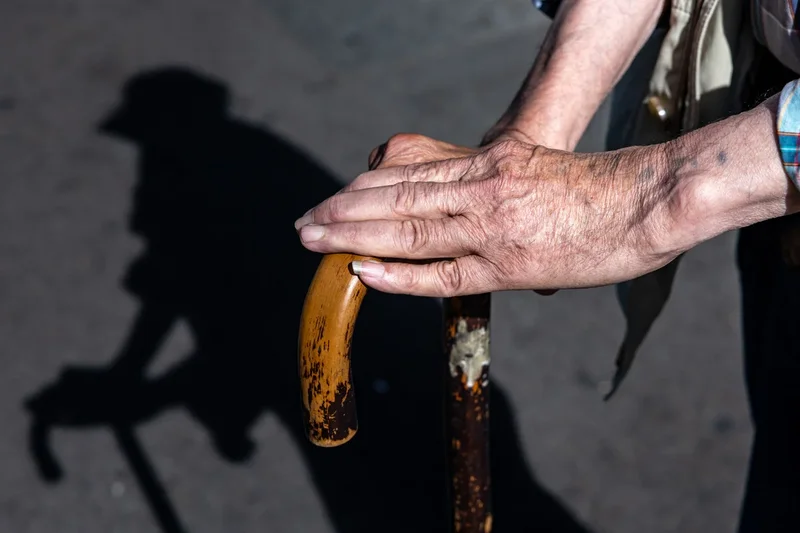
Hands of an elderly man (AFP via Getty)
The study shows that different organs tend to respond very differently to DNA mutation damage.
The brain and the heart are particularly vulnerable as some of their critical cells are irreplaceable and rarely divide or get replaced after birth.
The liver, in contrast, constantly replaces senescent, worn-out cells.
When researchers combined the simulations of various organs into a single model, they found that humans experiencing only mutation-driven ageing could attain a median lifespan of 146-194 years.
“Our results suggest that even if all hallmarks of ageing were eliminated except for somatic mutations, median human lifespan would reach 146 to 194 years, roughly twice the current 79 years,” they wrote in the study.
“This approximate two-fold gap in median survival indicates that other hallmarks of ageing likely contribute at least as much to limiting human lifespan as somatic mutations do.”
Researchers, however, caution that their findings depend strongly on assumptions about how organs interact and fail. They warn that the findings must be interpreted as theoretical as the study is not an experimental demonstration.
Anti-aging and facial sun protection cream for sensitive skin (AFP via Getty)
The findings mainly try to establish that DNA mutations will remain the biggest obstacle if future medicine is able to eliminate every reversible aspect of ageing.
The study further shows how much individual ageing mechanisms tend to contribute to overall lifespan.
“Our work provides a critical first step towards dissecting ageing into quantifiable mechanistic components,” scientists wrote.
“Ultimately, incorporating other major ageing factors could pave the way to a comprehensive, mechanistic theory of ageing.”