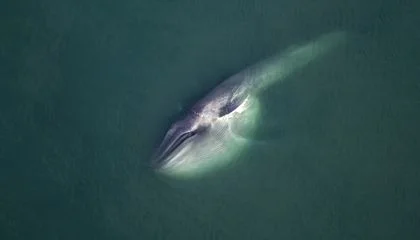
Nearly 1,000 feet below the sea off the coast of Norway’s Svalbard archipelago, on a glass cable the width of a human hair, scientists detect a massive object moving through the water. It’s so big that the water it displaces when it moves produces low-frequency waves that radiate outward from its body. These waves ripple away toward the seafloor, where they stretch the tiny glass cable, buried beneath the seabed, almost imperceptibly.
Onshore, laser pulses are fired down the cable, and as the light travels, microscopic imperfections scatter the light in the glass. Often, when researchers get feedback like this, it’s a submarine moving over the cable, or even a large ship chugging along the surface above. But today, they’ve found a blue whale.
Typically, to find whales, scientists use a hydrophone, essentially an underwater microphone that can pick up a whale’s calls. They’re often fixed to the seabed or suspended from research vessels. But in 2020, a team of Norwegian researchers discovered that, from the web of subsea cables that lace their way across global oceans, they could detect whale calls, too; they published a study on this finding in 2022. Recently, some of the same scientists published a new study on how to detect whales using fiber-optic telecommunication cables even when they’re not producing any sound at all, in situations when they’d otherwise be out of reach for researchers.
Two discoveries had to be made before this one was possible: the 2022 study that showed scientists could passively detect whale calls using cables, and other experiments that demonstrated how passing ships could be picked up by the cables. The water displaced by their hulls as they move emits low-frequency waves that scientists can measure. These frequencies radiate from the moving object outward, decaying as they go.
“Similar to when you drop a rock on the sea surface, you get these beautiful waves,” says Martin Landrø, a geophysicist at the Norwegian University of Science and Technology and lead author on the new study.
When submarines or other large ships pass over these cables, they stretch the fiber-optic glass cable the same way the blue whale did, but because of Automatic Identification System ship-tracking data, scientists were able to confirm that they were indeed vessels, and could even pinpoint which ones they were.
With the whale, it was a different story. It was vocalizing on the surface, something the Norwegian research team was able to detect from their interrogator station onshore. Then, when the whale dove, they could see the same sort of disturbance they’d previously observed when submarines or ships on the surface motored over the cables. The whale’s call allowed them to trace the disturbance to the animal—they could “see” the whale near the cable, even though it was completely silent.
“So, we are quite sure that the whale is vocalizing and then diving, and then we can see this very low-frequency signal that certainly has nothing to do with the vocalization, but can be attributed to the swimming, or movement of the whale,” says Landrø.
The approach itself is called distributed acoustic sensing, or DAS. The team detected the hydrodynamic pressure and velocity fields in the low-frequency DAS data created by the whale’s motion. The study is “an important first step in evaluating the feasibility of this approach,” says Shima Abadi, a mechanical engineer at the University of Washington’s School of Oceanography in Seattle, who was not involved in the study.
Blue whales are the largest animals on Earth, so it’s perhaps unsurprising that they could displace enough water to disturb the cable. But studying the pressure waves from water movement can be tricky because the frequencies are much lower than actual whale calls. Landrø and his team already knew how to do this with ships, though, and the diving blue whale provided a path from surface to seabed that pieced the puzzle together.
The team used a physics equation from 1917 that was originally created to study how tiny bubbles collapse in water. Though bubbles and blue whales have quite the size difference, the same basic physics applies, and the scientists were able to use the well-known Rayleigh equation to synthesize the whale’s low-frequency disturbance.
The breakthrough presents a significant opportunity for monitoring whales at the seafloor—where they’ve previously been invisible to scientists. “We could look at seasonal or daily changes in behavior, and also track them and detect whales that are not vocalizing at all,” says Landrø. This type of monitoring could unlock the secrets of what whales really do when they dive deep. Currently, scientists use suction tags placed onto the animals at the surface to look at their subsea behavior, but these tags can fall off and often don’t last long. For “animals like gray whales that feed on the bottom, this might be a technique to study them,” says William Wilcock, a marine geophysicist at the University of Washington’s College of the Environment, who was not involved in the new study.
Fun fact: The Smithsonian's blue whale skull
- The National Museum of Natural History has a two-ton, 19-foot-long blue whale skull in its collections. Dubbed "Big Blue," the specimen hung from the museum's ceiling for a couple of decades beginning in the late 1970s. The skull is currently stored at the Garber Preservation, Restoration and Storage Facility in Suitland, Maryland.
Subsea cables are mostly used for telecommunications and to transmit information, be it banking details, large data or even foreign intelligence. They connect islands and continents and are very costly to deploy. The fiber optics themselves are extremely thin, so hundreds of them will make up a single cable, protected by a plastic or metal casing, no more than an inch or two in diameter, and buried or clamped to the seabed.
An estimated 600 subsea cables are active today, with over 930,000 miles of cables weaving their way across the global seafloor. The specific fiber used for the Norwegian study, measuring 160 miles in length, was deployed in 2015 and is used to connect two cities.
Often, these cables are owned by telecommunications companies—and, increasingly, by data companies like Google and Amazon. Many of these cables have what are called dark fibers, wherein one of the glass fibers lays dormant, in case more bandwidth is needed in the future. In that case, sometimes companies will allow scientists to make use of that fiber for monitoring and research. “But, most of the communication cables, people don’t have access to them,” says Wilcock, “and if they charged what it actually costs to send data on it, then it’d be impossible [for researchers to afford].”
The cables themselves, beyond spying on silent whales, can be geopolitically sensitive. They can pick up “dark” vessels passing over them and can even intercept sensitive information sent along them. “To discriminate between, for instance, a ship, a submarine or a whale, whales are often more irregular in their shape,” says Landrø. But he has to be careful with the data his team publishes—the substation where they were based is less than 200 miles from the nearest Russian outpost and maybe 700 miles from the North Pole, an area of high sensitivity for governments and replete with untouched natural resources.
Instead of searching for covert military operations, these scientists are studying cetaceans in their natural habitat, one that researchers have consistently struggled to access. Knowing the population density of whale pods is becoming increasingly crucial for shipping, military operations and industrial players attempting to build in the ocean. This new monitoring technique could help track whale numbers, and, “for people trying to understand the recovery of whales and whaling, that’s a key bit of information,” says Wilcock.
The biggest limitation of the discovery is distance. “We demonstrate that we can observe hydrodynamic pressure and velocity signals from a cruise ship at 413 meters [1,400 feet] water depth, and up to 550 meters [1,800 feet] from the fiber cable. In comparison, the smaller blue whales can be observed when diving within 40 meters [130 feet] of the fiber-optical cable,” the study reads. And again, access to the cables is tricky, and many data companies don’t allow any outside researchers to use their infrastructure.
The science is in its infancy, but it provides an exciting glimpse into the deep-sea lives of whales and opens the door to future exploration in the subsea realm.
“There are still several questions that need to be addressed, such as the maximum water depth and animal-to-cable distance over which detection is possible,” says Abadi, but, even with potential limitations, “[the cables] could offer an underwater observing capability analogous to what satellite imagery provides above the ocean surface.”