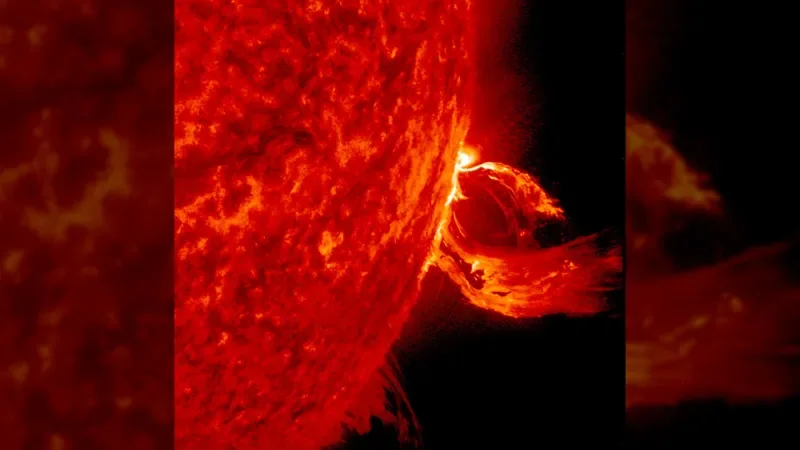
The sun routinely blasts charged particles into space, but similar outbursts from other stars have been mysteriously hard to spot. A new experiment suggests that the strong magnetic fields of some stars could be keeping the blasts of charged particles, or plasma, in check.
A magnetic field halted streams of plasma in the experiment, causing them to break up and stop, scientists report in a paper accepted to Physical Review Letters. That suggests that magnetic fields surrounding stars could suppress the plasma outbursts, which are known as coronal mass ejections.
“Magnetic fields really impact how coronal mass ejections are either ejected or travel,” says astronomer Joe Callingham of the University of Amsterdam, who was not involved in the work. “It’s quite supportive evidence that maybe some of them are suppressed.” That suppression could be important for understanding the potential for life on planets in other star systems, because frequent, powerful coronal mass ejections, or CMEs, can make a planet inhospitable to life.
CMEs are outbursts of plasma from the corona, or outer atmosphere, of the sun. They often accompany bursts of radiation called solar flares. Astronomers hunting for CMEs from other stars have focused on those that emit copious flares.
Surprisingly, the CMEs have been mostly absent, with evidence of them detected on only a handful of stars other than the sun. But those flare-happy stars also tend to have much stronger magnetic fields than the sun. That could be foiling the search for CMEs, astrophysicist Julián Alvarado Gómez suspects. “We think that some of the very active stars live in a regime that the sun doesn’t show us.”
Alvarado Gómez, of the Leibniz Institute for Astrophysics Potsdam in Germany, linked up with a team of plasma physicists who had been studying the effects of magnetic fields on streams of plasma.
In their experiments, the researchers hit a target with a laser, launching a stream of plasma into a magnetic field of varying strength. When the magnetic field was weak, the plasma continued unperturbed. But crank up the field and something dramatic happens to the plasma streams, says plasma physicist Sophia Chen, who worked on the study at the Extreme Light Infrastructure – Nuclear Physics facility in Măgurele, Romania. “They all branch out like a tree, and they stop … and then sometimes [they] would curl over, and [they] would turn back.”
Computer simulations of the experiment suggested the culprit was a phenomenon called a kink instability, which can cause streams of plasma to make a sharp turn. Even though the streams of plasma in the experiment were just millimeters long, they exhibit similar physics to large stars, according to a mathematical scaling relationship.
The experiment isn’t a perfect replica of a CME, though. Real-life CMEs form from loops of magnetism in stars’ coronas, which snap and send plasma flying. As a result, CMEs carry their own tangled magnetic fields, a situation difficult to replicate in a laboratory.
More observations of stars are also needed. The apparent dearth of CMEs may be partly because astronomers haven’t looked long enough, says Callingham, who was part of a team that reported evidence of a coronal mass ejection from another star in 2025. But stars’ magnetic fields also seem to be playing a role.
Either way, CMEs are key for determining the possibility of life in other star systems. That’s because CMEs can blast a planet so hard they strip it of its atmospheres and make it into a barren rock. “You need to understand how the star acts. Is the star a good host?” Callingham says.
“The habitability problem is this many-piece puzzle, and this is an important piece we need to understand.”