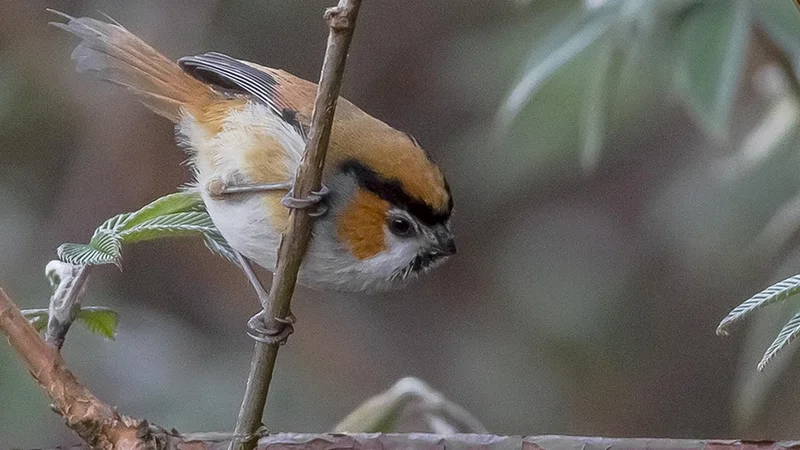
A black-throated parrotbill, an inhabitant of the eastern Himalayas
\| Photo Credit: Dibyendu Ash
As spring approaches in the hyper-biodiverse Himalayas, birds that are accustomed to cooler climes migrate to the north. This is driven not just by temperature or precipitation alone, but also the availability of prey: arthropods (insects and spiders). But climate change is altering the rhythm of this dynamic.
Scientists at the Centre for Ecological Sciences, Indian Institute of Science (IISc), Bengaluru, set out to study the phenomenon in Arunachal Pradesh’s Eaglenest Wildlife Sanctuary and understand the changing patterns in insect availability and avian migration through seasons.
Arthropods at higher elevations might emerge earlier in the year in response to the advanced onset of summer as a result of climate change, Umesh Srinivasan, associate professor, Centre for Ecological Sciences, IISc, told The Hindu. “However, many species of birds might not use temperature as a cue to migrate upwards, but might use cues such as day-length, which does not change with warming.” Therefore, he added, “migratory birds might move to reach higher elevations on a ‘normal schedule’, only to find that the peak in arthropod abundance has already abated, leaving them with suboptimal resource availability.”
Climate change brings about spring early, and the abundance of arthropods also peaks earlier, Tarun Menon, lead author told Nature India. “This can have detrimental effects for migratory birds, especially the insect-eating and ground-feeding birds,” he added.
They found that arthropods, which most of the world’s birds rely on are “highly sensitive to temperature”, but also, in the mountains, where most terrestrial birds live, the variation in their abundance is likely to influence bird movement. The study was reported in the paper Biology Letters, A Royal Society journal.
For the study, scientists sampled arthropods and birds, in summer and winter, across a 2,300 mt forested elevation gradient. They found that in summer, both aerial and terrestrial arthropod numbers increased with elevation in summer but dropped in the higher reaches in winter.
Arthropods are highly sensitive to climate, and in mountain ranges such as the Himalayas, winter frost “may force most arthropods into a state of dormancy called diapause,” the paper says. “This is likely to cause their relative abundance to decline at high elevations in winter”
The scientists sampled 12,744 arthropods in summer and 4,079 in winter, using sticky traps. Their abundance increased with elevation in summer but reduced during the winter. As many as 1,971 birds belonging to 160 species were captured with fine nets in summer and 1,721, belonging to 133 species in winter.
This is the first time that seasonal and elevational changes in arthropod richness has been related to the movement of montane birds.
From the Science pages
Question Corner
How did we identify fossil fuels to be remains of fossils, particularly those of dinosaurs?
Flora and fauna
Published - July 22, 2026 04:43 pm IST