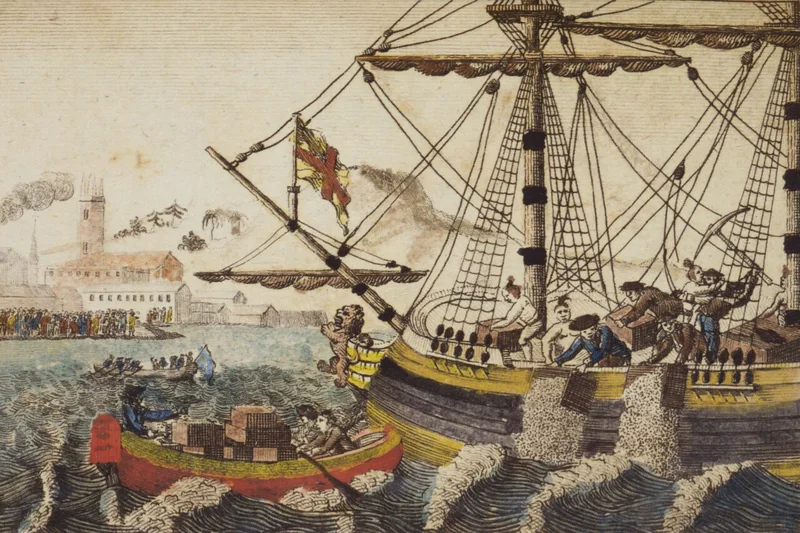
Since 1987, the Old South Meeting House in Boston has displayed a Chinese tea chest label. For decades, historians and others assumed the label was recovered during the Boston Tea Party in 1773. Turns out, it wasnât.
New research suggests the label originated sometime between the 1860s and 1870sâa century after the famous event in American history. Tristan Brown, a historian at the Massachusetts Institute of Technology, conducted an archival and linguistic analysis of the artifact, publishing his findings in American Historical Review. According to Brown, previous studies had mischaracterized the Chinese text. In addition to correcting the age of the artifact, Brown found that its historical significance lay elsewhere, specifically the record of trade between China and America at the time.
“The discovery doesn’t diminish the label; it replaces one story with a richer one,” Brown told Gizmodo in an email. “That broader story, of how revolutionary memory gets made through objects whose own histories stretch across the globe, is what I hope the paper contributes to ongoing conversations about history, material culture, and American identity.”
A birthday surprise
Brown, whose expertise is in Chinese history, began studying the label as part of an initiative by American Historical Review to commemorate the 250th anniversary of the United States. His goals were to establish the labelâs provenance and provide a reading of the Chinese text on the label. To MIT News, Brown explained that previous analyses by the British Museum and Harvard University hadnât actually confirmed the label as a Tea Party relic; they just hadnât âruled outâ the possibility.
âI believed it was real,â Brown told MIT News. âNone of the parties who had previously assessed the labelâs provenance concluded definitively that it wasnât from the Boston Tea Party. And frankly, it was hard to imagine how an American family with no ties to China could have possessed a label written in formal Chinese listing the exact teas that were traded in the region.â
A shift in perspective
For the study, Brown contacted descendants of Thomas Wells, who donated the label to Old South Meeting House in 1987. While analyzing the actual text, he also realized that the label was written in Cantonese, not Mandarin. The latter, Chinaâs official language, was what previous teams had used in their attempts to decipher the label.
Once Brown approached the label in Cantonese, things started to become much clearer. Importantly, his reading found âSmith, Archer & Co.,â a New York-based firm that traded with East Asia during the latter half of the 19th century. At the end of the label, there’s a signature that reads: “Respectfully inscribed by Yuan Tianbo, proprietor of the tea shop for Smith, Archer & Co.,” according to the paper. Further archival research turned up a Cantonese merchant active in Yokohama, Japan, in the 1860s with the same name.
âThat was the moment the entire story changed,â Brown said to MIT News. âOnce we could date the label, we finally knew where to look.â
A story of commemoration
In close collaboration with the Wells family, Brown traced the labelâs history back to a certain John Milton Wells, whose surviving records indicated he imported East Asian teas. This was likely when the label entered the Wells familyâs collection, he explained. The story of the label being a relic from the American Revolution first appeared in a local newspaper from the early 1900s. Brown posited that the centennial celebrations of U.S. history in the 1870s prompted American families to emphasize their connections to the root of the nation.
“Honestly, what I find most compelling is that the real story turns out to be more interesting than the legend it replaces,” Brown told Gizmodo. John Milton Wells was a “genuine American original, a descendant of a Boston blacksmith who headed west during the Gold Rush, didn’t strike it rich, came back to Michigan, and built a life selling imported Asian teas out of what he called his ‘California Tea Store.'”
“That’s a story of American ingenuity, westward expansion, and transpacific commerce, and it actually happened,” he added.
Unexpected, but still significant
Brown stressed that the discovery represents a changed, not tarnished, historical significance to the artifact. Even if it wasnât a part of the Boston Tea Party, the historical record associated with its journey from an East Asian commercial network to a Boston museum shows the rich, globally connected history of the United States.
The findings also reflect the growing opportunities in historical research thanks to large digitized databases containing thousands of recordsânot just books, but things like receipts and commercial directoriesâthat scientists can now access for renewed insights. It also highlights the importance of considering Chinese languages other than Cantonese to study the widespread influence of Chinese culture in history.
“Together, these developments made it possible to identify a company name hidden in plain sight in the labelâs text for over a century,” Brown told Gizmodo. “I suspect there are many more discoveries waiting to be made as these tools and frameworks continue to develop.”