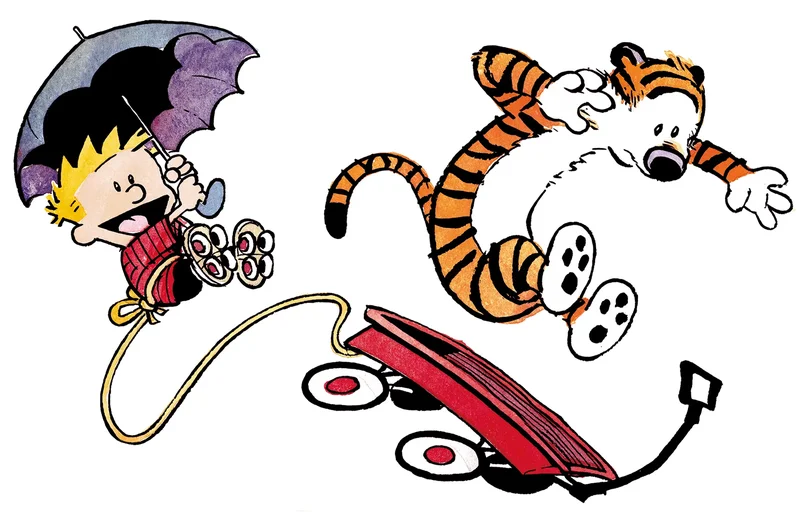
According to his essays in the 10th anniversary collection of Calvin and Hobbes, Bill Watterson deliberately chose to not give Calvin's parents actual names. While readers occasionally get a glimpse into their inner lives, through Dad's cycling habit or Mom's love of reading, both characters' primary relevance to the strip is in how they relate to Calvin. For all his precociousness, Calvin's still at an age where he might not realize that his parents have real names. More importantly, it adds nothing to the strip for them to have them, so they don't.
In addition, Watterson was always careful to keep Calvin's parents from being prosaic dispensers of time-honored wisdom. In fact, every time Calvin's dad tells him an entertaining lie about the world rather than the actual truth (like saying with a straight face that there's a guy with a printing press inside every ATM), you get a keener insight into just how these two people produced a kid like Calvin. Some parents get the child they deserve.
That doesn't mean Calvin's parents are consistently wrong. They've got their own irrationalities and pet peeves, but they've both got a point more often than not, especially in the face of Calvin's angry inability to comprehend the world's absurdities.
With that in mind, there are two specific strips I'd call out here as the best moments of Calvin's dad. One simply feels more apt than ever in 2026, while the other one is both sad and true.
Dec. 7, 1993: Rage against the machine
Every once in a while during Calvin and Hobbes's run, Calvin's dad turns into a bit of a mouthpiece for Watterson to air some complaint he has about what was then modern living. Sometimes, it's the most boomer of boomer complaints, like how there are too many brands and types of peanut butter on store shelves, but there's some truth in the madness.
If anything, the strip for Dec. 7, 1993 feels more apt for the 21st century than it does in the 20th. When everything you do or say online, or sometimes even offline, is fodder for a ravenous data-gathering system, it can feel pleasantly renegade whenever you unplug. Leave your phone at home, read physical books, listen to old records: whatever you can do to avoid leaving a data shadow is more worth doing than ever. Bill Watterson saw it coming.
May 10, 1989: Adulthood is an ad-lib
This relatively early strip comes at the end of a short story arc, where Calvin's family comes home to discover their house has been burglarized. Their TV and jewelry are missing, but after a brief moment of panic, it turns out Hobbes isn't. Depending on who you choose to believe, either the burglars didn't take him or he scared them off.
While Calvin isn't that bothered by the event, his parents are, and they take center stage for a brief, rare moment to discuss the aftermath. Part of it involves this conversation, about one of the terrible truths of adulthood that everyone has to deal with sooner or later: some of us may have more of a plan than others, but we're all making it up as we go.
Most of Calvin and Hobbes is naturally about Calvin, and his ongoing frustration at the world around him. It's not that unusual for the strip to move into territory that Calvin himself isn't suited to cover, but when it does, it's always careful. There's some real truth in the burglary arc, about vulnerability and adulthood, and it's an underrated installment in the strip's run.