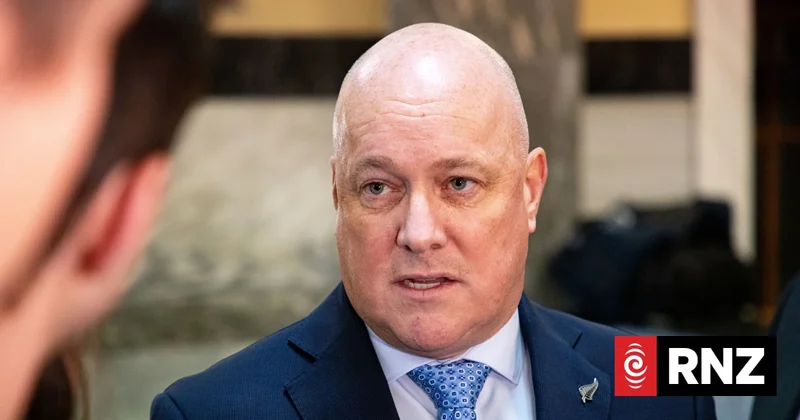
The political drama of Christopher Luxon's leadership challenge has been ignored by National party supporters in Nelson at a public meeting on Thursday night.
Around 600 people turned up to the meeting at Annesbrook Events Centre, where the prime minister fielded questions about employment, housing affordability, crime and sustainability among other issues.
Luxon entered the room to loud cheering and applause, his first public meeting since surviving a confidence vote following an urgent caucus meeting on Wednesday.
He was joined by Nelson candidate Blair Cameron and West Coast Tasman candidate Katie Milne and told the crowd he enjoyed "getting out of the bubble of Wellington" and hearing "the good, the bad and the ugly" from people.
During the hour-long meeting there were no references to the recent confidence vote or questions from the crowd about Luxon's leadership, but instead a focus on the party's plan to "fix the basics" and "build the future".
Early on in the meeting when a National Party sign bearing that slogan on the lectern came unstuck, Luxon grabbed before it fell and said, "actually, I was going to fix some basics and build the future right now".
He fielded questions on what National would do to help young New Zealanders, how the new India free trade agreement would help small and struggling businesses, why the environmental issues facing the country weren't being taken more seriously, how homelessness was being addressed and how National planned to tackle youth crime and violence in the community.
High school student Noah Johnson told Luxon young people were facing major uncertainty around housing, education, and employment and asked how National would address that if re-elected.
Luxon said the reason he got into politics was to rebuild the proposition for young people in New Zealand.
"In the last 12 months we had a 14 per cent growth in Kiwis leaving Australia and coming home to New Zealand, which is really exciting and really encouraging."
He said National was focused on building a more economically productive economy, addressing housing supply issues by reducing bureacracy and had a policy to make KiwiSaver compulsory to help people build retirement savings.
"We've started that work, we've got more to do, but I'd be pretty excited as a young person that this could be a great place to build a family and to live your life here."
The final question of the night came from a deaf, former sex worker who said the loss of thousands of public sector jobs meant her business in Wellington collapsed overnight.
Through an interpreter, she told Luxon there were many self-employed people in the sex industry and it provided reliable work, but National's economic policies had made it difficult to work in the industry and many sex workers had gone on the benefit or were working two jobs to survive.
Luxon said the issue was a "demand problem" and that National was focused on economic growth and creating new opportunities for people.
"We're also focused on getting more efficiency in our public service and we are going to restructure it and reform it. We want it to be less bureaucratic and we want it to be delivering better for New Zealanders and offering better service."
After the meeting, Luxon spent almost as much time as he had onstage speaking to people who queued up to see him. He said a lot had offered words of encouragement.
"We came out of a room very united, very determined that we are going to work to make this election about a very clear choice."
National had a responsible economic plan, focused on long term growth, Luxon said.
"It's about making life more affordable for people and, most importantly, setting up the country to realise the great potential that's in it. That's a pretty exciting proposition."