If only I had long golden hair to let all the way down. Waking in a room in the Observatory Hotel’s Gothic Revival tower in New Zealand’s Christchurch – located beneath the city’s 160-year-old astronomical observatory – I recall the story of Rapunzel.
I have visions of my whanau – or loved ones – climbing the fortified tower on a ladder of long beautiful hair to take in the stars with me using the old equatorial telescope above my room.
But my husband is home in Sydney. And I’m sad (not really) and lonely (not) and enjoying a king-size bed so luxurious, free of snoring and full of down, that it is difficult to leave.
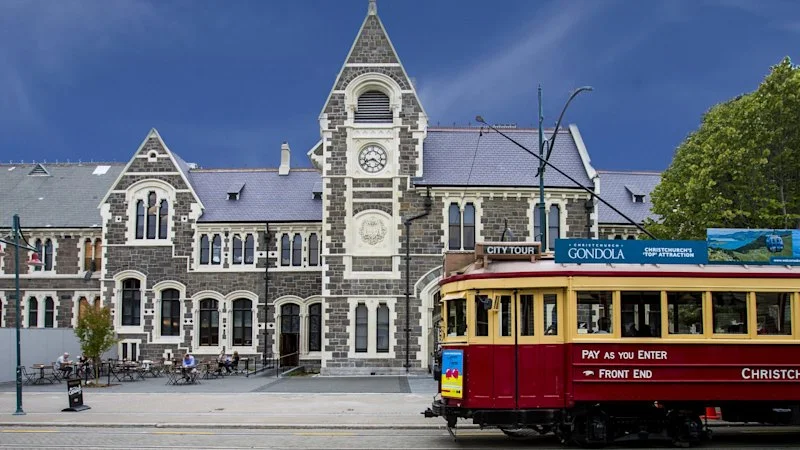
I’m in Christchurch for three days to attend Open Christchurch’s annual event celebrating the city’s architectural heritage and treasures. They include the Te Matatiki Toi Ora Arts Centre – the largest group of grade-one heritage buildings in New Zealand – which includes the hotel where I’m staying and laying my increasingly grey-blonde hair.
Like so much of this South Island city of 419,000, its 21 Gothic Revival buildings, made of cut stone dating to late 1880s, were badly damaged by the February 2011 earthquake. The total cost of the rebuild is estimated at $200 million, including $83 million spent so far.
Get exclusive travel deals delivered straight to your inbox. Sign up now.
But Christchurch, New Zealand’s unluckiest city, is having a moment, and it’s a good time to visit, as I’m told frequently,
After years of death and destruction wreaked by earthquakes, bushfires, the pandemic and a terrorist attack, 16 anchor projects – essential to its recovery – are now complete, including Te Kaha/One New Zealand Stadium and the public library Tūranga.
Many of the 75,000 locals who left 15 years ago are returning. Tourism is up, many coming to see a new city emerge from the rubble that remains a vivid reminder of how life can change in the blink of an eye.
A decade ago, another New Zealand city, Wellington, was crowned the coolest little capital in the world. Now Christchurch Mayor Phil Mauger says Christchurch has taken the crown. “It is the capital of cool,” Mauger says. (Mauger is no spring chicken. Neither am I, so I wonder about his definition of cool).
Whatever the case, it’s worth starting any visit to Christchurch with a visit to Quake City at the Canterbury Museum for a quick lesson in the science of liquefaction, with photographs and videos of what the city looked like before the deadly earthquake struck on February 22, 2011, killing 185 people and destroying 80 per cent of the city’s CBD. Quake City also houses the much-loved old cathedral’s spire and cross that came down – one of 1200 buildings and 10,000 homes razed and buried under 900,000 tonnes of liquefaction, silt, ash and debris.
Quake City includes videos of survivors like Sue Spiegel, who became known as the woman trapped in the window of the wrecked cathedral. After the quake, she said it was like the city had Alzheimer’s. Nobody could find familiar landmarks or meeting spots.
A quake of 7.1 magnitude in September 2010 left the city largely unharmed, but it unleashed 7000 aftershocks. It was the smaller 2011 quake, nearer to the CBD and closer to the surface, that destroyed the city, founded in 1848, and caused $40 billion in economic losses.
But now there’s change in the air. And whatever your definition of cool, in these times of generational inequity nothing is cooler than a city boasting new apartments and townhouses, a buzzy library, and restored heritage buildings. To top it off affordable rents and homes are attracting young people.
There is also street art, murals, the funky facades of parking lots; excellent coffee; the food – not one bad meal in five days – the lack of traffic, the new city markets, and the flat layout of the inner city which makes walking, scootering and cycling easy.
The art was designed to put smiles on locals’ faces after the quake and create new meeting places, says leading architect Hayley Fisher, studio principal with architects Warren and Mahoney, whose founders brought their own spin on modernism to New Zealand’s South Island.
Art here is as prolific as the country’s sheep, including those made from plastic outside the library that also double as bollards.
Kiwis don’t take themselves too seriously. Take the topic at one of Open Christchurch’s events held at the mid-century modern Harewood crematorium, designed by Warren and Mahoney in 1963. Panellists were asked to complete this sentence: “I’d die happy once I saw (insert your favourite piece of architecture).”
Architects on the panel chose Frank Lloyd Wright’s Prairie Houses and Le Corbusier’s Notre-Dame-du-Haut in Ronchamp. But Open Christchurch director and architectural historian Jessica Halliday nominated a modernist icon, namely architect Peter Beaven’s gem, the Lyttelton Road Tunnel Administration Building and its toll plaza, which was damaged in the earthquake and then demolished.
Christchurch 2026 is very different from the colonial city, which was said to have been more English than those back “home”.
The local Māori iwi were statutory partners in the rebuild, bringing the governing philosophy of “a great love/goodwill to all people”. Halliday says post-quake Christchurch increasingly reflects cultural stories, values and the culture of Ngāi Tahu, its principal Māori people. Young Kiwis wearing warm possum merino beanies now mix words in Māori and English.
For all the tragedy, locals say the quake gave the city a chance to build a better city.
Nothing represents this more than the new One New Zealand Stadium (Te Kaha) – which means “enduring strength” by WAM and Populous, and the new library Tūranga by Architectus and Schmidt Hammer Lassen Architects with Ngāi Tuahuriri and Matapopore.
At an open day celebrating the stadium, 30,000 visitors turn up. Five- and six-year-olds play football (that is, rugby) and locals argue over whether the grass is fake. (It’s not).
To get a sense of the city, walk along the revitalised Avon River (Otakaro) that winds through Christchurch’s centre. The earthquake caused the river to buckle, and raw sewage flowed into it. Now home to the region’s New Zealand longfin eels, it includes a moving memorial to earthquake victims.
Local Māori writer Juanita Hepi says Māori influence in the rebuild is reflected in native planting, names, and “attempts to reconnect the city back to waterways and whakapapa” (genealogy).
Over lunch at the centrally located New Regent Street, full of boutique stores, fashionable bars and restaurants, Hayley Fisher says she was among the last people to see the city’s precious 1864 Christ Church Cathedral with its steeple intact.
An hour before the quake – after getting a marriage certificate for her wedding which was to be held days later – Fisher was standing in the cathedral square with her husband to be. Driving home, her phone lit up with texts saying the cathedral had gone. The building where she got her certificate was demolished. The church where she had planned to get married was ruined, too.
For so many residents like her, the day of the earthquake was one of sliding-door moments: “I could’ve, I would’ve, and if only.”
In the centre of the city today, it is difficult to believe that New Regent Street’s row of 44 nearly 100-year-old Spanish Mission-style shops with jewellery stores and cafes was almost demolished.
Designed to be the most beautiful street in New Zealand, it was covered in glass after the earthquake. But it still stands thanks to its solid foundation, built to withstand a sizeable quake.
Not far from there, is the A-framed Transitional Cathedral, known as the Cardboard Cathedral. The building designed by Shigeru Ban with Warren and Mahoney in 2013 was among the body of work to win Ban the Pritzker Architecture Prize in 2014.
Chris Oldham, the cathedral’s administrator, said many people had hated the idea of the temporary cathedral, but that’s changed. “It has become an iconic building in its own right,” Oldham said. Whether it survives is unclear.
The partly restored and stabilised Gothic Revival-style Christ Church Cathedral is now open for hard-hat tours, and impromptu concerts.
Designed by Sir George Gilbert Scott in 1859, its stone spire was damaged but survived earthquakes in 1881, 1888 and 1901. The 2011 quake, though, was too much. It was updated by architect, Benjamin Mountfort in 1881 and 1894, and Warren and Mahoney are now working on the project.
Its ongoing rebuild continues to be the most complex, costly, contentious and important project in the city. Many like Hepi want to leave the cathedral partially ruined; “Not as neglect, but as memory. Ruins tell the truth about vulnerability, about disaster, about history,” she said.
Fisher, though, is most proud of the nearly completed the Otago Medical Research Centre – a medical science centre built to withstand a once-in-200-years earthquake. It represents the future, she says.
THE DETAILS
VISITThe next Open Christchurch annual festival of architectural excellence will be held between April 30 and May 2, 2027. To see how the earthquakes of 2010 and 2011 damaged Christchurch visit Quake City. See openchch.nz; quakecity.co.nz/visit
STAYTo immerse yourself in Christchurch’s history and architecture, try the boutique Observatory Hotel, a heritage building in walking distance of the city, the Botanic Gardens, and good food. See observatoryhotel.co.nz
FLYAir New Zealand operates direct flights between Christchurch and Sydney and Melbourne. See airnewzealand.com.au
The writer travelled as a guest of ChristchurchNZ.