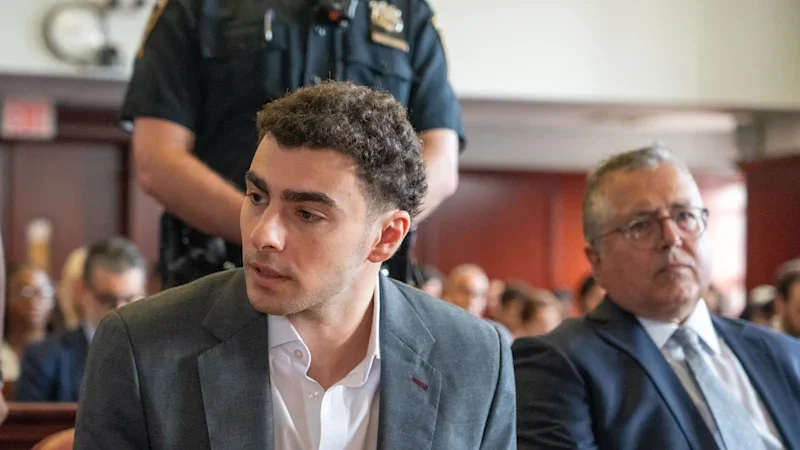
Washington: Luigi Mangione, the American man accused of killing healthcare chief executive Brian Thompson, is expected to plead guilty to federal stalking charges, creating legal uncertainty about his upcoming state-level murder trial.
His anticipated plea opens the door to his lawyers attempting to get his state trial dismissed on double jeopardy grounds, legal experts say, with New York law particularly grey on the matter.
How did we get here?
Mangione, who is now 28, was arrested on December 9, 2024, in connection with the fatal shooting of Thompson on a midtown Manhattan street several days earlier.
The brazen crime shocked the world, but also generated sympathy for Mangione from parts of the community amid broader controversy over access to American healthcare. For some people, he became something of a pin-up or political prisoner.
In court, he has faced two separate tracks of charges – murder charges levelled by New York state and stalking charges (resulting in death) levelled by the federal government. Other federal charges have been dropped. He pleaded not guilty to the state charges.
What has happened now?
A special hearing has been scheduled on Friday (US time) at the request of both the prosecution and defence, where Mangione is widely tipped to plead guilty to the federal charges.
Many US media outlets reported he would do so, citing sources familiar with the matter, while a former federal prosecutor in New York, Berit Berger, agreed it was “very likely” based on the sequence of events.
“You would typically have one of those [hearings] if he was going to plead guilty,” she told this masthead. “That doesn’t necessarily mean it will happen tomorrow.” Mangione could also change his mind at any time.
Why it matters
Such a plea could have a significant impact on his state-level murder trial, for which jury selection is due to begin within weeks.
Berger said she expected Mangione’s legal team would try to have the state murder charges dismissed on the basis of double jeopardy – the principle that someone can’t be tried for the same crime twice. “It’s actually a pretty interesting legal question,” she said.
In the US, the state and federal prosecutors can both bring charges in relation to a crime, if applicable. Berger says that for the most part, they co-operate and don’t double up, unless the federal government believes it has a significant interest in the matter, or that a federal sentence would be substantially longer.
In most cases, she said, pleading guilty to the federal stalking charges would not invoke double jeopardy on the state murder charges, as the court would consider the harms to be significantly different.
Why it’s complicated
But “New York’s a little different than other states”, Berger said, owing to some quirks in the law. “My guess is this will not preclude the New York case from going forward, but it’s a little bit more complicated.”
One of the reasons for that complexity is the case of Paul Manafort, Donald Trump’s former campaign chairman, who in 2019 was charged with mortgage fraud by the Manhattan district attorney.
Manafort had already been convicted federally, and a judge ultimately dismissed the state case due to double jeopardy. The lawyer who argued the case for Manafort was Todd Blanche, who just last week was confirmed as Trump’s attorney-general, in charge of the Department of Justice.
What happens next?
Either way, Berger – who now lectures at Columbia Law School – said there was no prospect Mangione would escape a long jail sentence. The federal charges are two counts of stalking resulting in death, which carry a maximum sentence of life in prison.
A judge sentencing him on federal charges would know the context of the state matter, even if it is abandoned. “There’s not going to be a deal where he gets out of jail earlier,” Berger said. “I don’t think this is a chance for him to evade accountability.”
Mangione’s lawyers did not immediately respond to a request for comment. At an unrelated news conference in Washington, Jamie McDonald, the US attorney for the Southern District of New York, declined to elaborate on what would happen.
“There’s a [court] conference scheduled for 11am on Friday. That’s all we can say at this time,” he said.