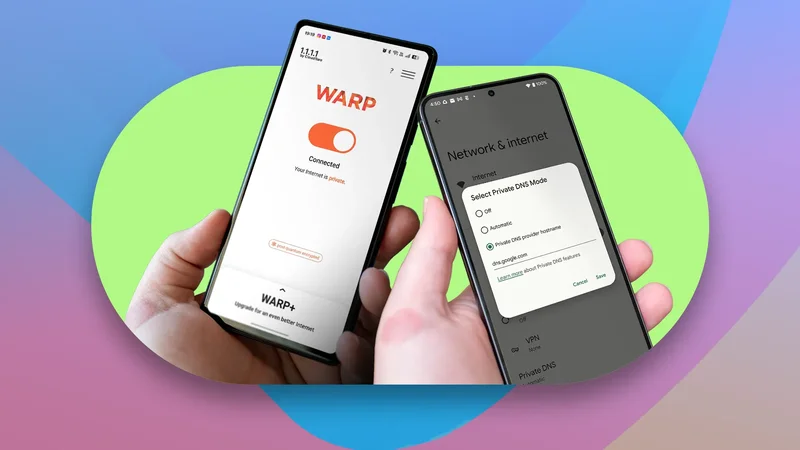
Most people don't change the DNS settings on their phone for no reason. If you're looking up this option, you're usually looking for a specific utility or reason.
In my case, I didn't want every network deciding how my phone resolves websites and services. Plus, I wanted to get around certain geographical blocks.
There are a few options available to an enthusiast when it comes to swapping DNS, but Cloudflare and Google's public DNS come on top.
So, I decided to test them out head-to-head. I expected the biggest decision maker between them to be speed, but that difference is imperceptible.
Instead, what I found more interesting was that Cloudflare lets me do more than Google DNS after the fact.
Cloudflare, Google DNS, and internet privacy on
Android
Trivia challenge
Think you know your DNS resolvers and privacy settings on Android? Put your knowledge to the test.
What is the IP address of Cloudflare's primary public DNS resolver?
What is the IP address of Google's primary public DNS resolver?
Which Android version first introduced native support for Private DNS, allowing users to set a custom DNS-over-TLS provider system-wide?
What does DNS-over-HTTPS (DoH) primarily protect against compared to traditional DNS?
On a modern Android device, where would you navigate to set a system-wide Private DNS provider like 1.1.1.1?
Cloudflare offers a privacy-focused DNS variant at 1.1.1.2 that blocks access to what type of content?
What is the hostname used to configure Cloudflare's DNS-over-TLS resolver in Android's Private DNS setting?
Which protocol does Android's built-in Private DNS feature use to encrypt DNS traffic?
Your Score
Thanks for playing!
Private DNS gives me a consistent resolver across all networks
DNS encryption adds protection without the overhead of running a VPN
When it comes to swapping out the DNS, Android's Private DNS feature is the starting point for everyone.
You can enter a provider hostname and have the phone use DNS over TLS instead of using the resolver provided by your network provider.
This could be your wireless carrier or even your home broadband when you're connected over Wi-Fi. And getting started is very simple.
Both Google and Cloudflare provide a URL that you enter into your private DNS setting. In the case of Google, this is dns.google.com, while Cloudflare uses 1.1.1.1.
After you've applied the private DNS setting, it works across your Wi-Fi and cellular connections.
That last part is important because you probably switch between data providers multiple times a day.
When you leave home, you switch over to your wireless carrier, and maybe when you get to a coffee shop or office, you'll switch over to their Wi-Fi network.
Setting a private DNS means that all DNS resolution happens through the same single resolver.
So what does that mean?
Using private DNS standardizes one part of your network connectivity. For example, if a website works on one connection and not on another, you can eliminate DNS as one of the issues. This problem arises more often than you'd imagine.
Both Cloudflare and Google's DNS resolvers tend to be very fast, so you can expect slightly faster browsing all around.
Elsewhere, there's encryption. It's not a VPN, and a private DNS can only protect DNS traffic, but both Google and Cloudflare support DNS over DLS and over HTTPS.
A portion of your traffic remains fully encrypted, and that portion is the one that sends out queries to the internet. You don't really need a VPN for everyday browsing, but that's only the start.
Cloudflare gives you more flexibility than Google DNS
Google DNS is the set it and forget it option
Testing both DNS resolvers, I quickly realized that speed is just the start.
While both DNS resolvers are equally fast for all practical purposes, Google's public DNS is a great set-it-and-forget-it option, but not the one to pick if you want a bit more flexibility.
That's where Cloudflare steps up. While Cloudflare's default 1.1.1.1 resolver gives you standard DNS resolution without additional content filtering, you have options.
For example, Cloudflare offers a specific resolver designed for family use. One of these DNS resolvers can block domains associated with malware and phishing, making it a great choice for households that might not be up to speed with the best internet safety practices.
Elsewhere, it offers a DNS resolver that can block adult content across your network. This is an excellent choice for households with young children, and it automatically blocks any unapproved content on all devices, including smartphones, tablets, and laptops.
All it takes is changing one setting at the phone or router level, and it handles everything else.
Using Cloudflare as your DNS resolver also gives you access to WARP. If you use Cloudflare's app, it lets you switch between DNS-only mode and Warp mode.
In DNS-only mode, it works like Private DNS, where it encrypts your DNS queries. That's it. WARP goes further by tunneling your devices' entire traffic through Cloudflare's network.
This gives you all the security and encryption benefits of using a VPN. Keeping in mind that this is not a traditional VPN, you cannot change your geolocation on the fly using WARP.
The idea here is that if you want to secure your entire traffic over a network that you don't entirely trust, let's say public Wi-Fi, that's where WARP comes in.
When comparing Google DNS and Cloudflare's Private DNS, this flexibility stands out. The numbers are more than fast enough that you won't notice a difference.
However, Cloudflare gives you the option to filter content and encrypt the entirety of your traffic. That's something that Google DNS doesn't offer, but on the flip side, Google DNS gives you a little more simplicity.
Cloudflare wins out for being more than a simple DNS resolver
The choice between them depends on your goal.
If you want the simplest way to get around your network provider's DNS restrictions, Google DNS is probably the way to go.
If you're like me, and you like the ability to tweak your experience and definitely don't mind a free VPN-like service as an add-on, I would recommend going the Cloudflare route. It gives you all the speed with a side of security. Can't complain about that.