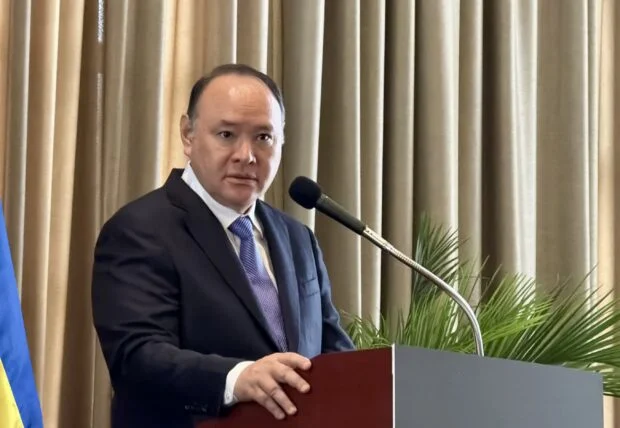
Teodoro calls China action vs 100 Filipinos ‘extortion and blackmail’
MANILA, Philippines — Defense Secretary Gilberto “Gibo” Teodoro Jr. on Thursday accused China of “extortion and blackmail” over its action against more than 100 Filipinos in China, rejecting any comparison between Filipinos nabbed in China and Chinese nationals arrested by law enforcers in the Philippines.
The Department of Foreign Affairs (DFA) said that it was verifying the reported arrests of Filipinos by Chinese authorities.
Article continues after this advertisement
The defense chief said that “the action against 100 Filipinos is plain and simple extortion and blackmail.”
“We strongly condemn both the attempt by China to interfere in our law enforcement processes and the blatant blackmail against Filipinos,” Teodoro said.
The defense chief was reacting to remarks by Chinese Foreign Ministry spokesperson Guo Jiakun last Monday that Chinese immigration authorities had taken action against more than 100 Philippine nationals for allegedly illegally working or living in China.
Guo was responding to a question by the Chinese Communist Party-controlled Global Times on whether the Chinese government’s action was in response to the Philippines’ “frequent detention of Chinese nationals.”
‘Standard, civil manner’
Without directly referring to the detention of Chinese nationals by the Philippine government, Guo said the operations were part of China’s efforts to strengthen supervision of foreigners illegally entering, living or working in the country and were carried out in accordance with Chinese law.
Article continues after this advertisement
“Actions have been taken in accordance with the law against over 100 Philippine nationals for illegally working or living in China,” Guo said.
He also said Chinese immigration personnel acted in a “standard and civil manner” during the operations and ensured the protection of the rights and interests of the foreign nationals concerned.
Article continues after this advertisement
Without citing the recent high-profile arrest of a group of Chinese in Mindanao recently, Teodoro said actions taken by security forces were carried out with valid search warrants issued by the proper courts and those arrested were the main suspects behind alleged illegal activities.
“The individuals arrested by the authorities were the principals of these illegal enterprises,” Teodoro said.
Verifying with embassy
The DFA said it was coordinating with the Philippine Embassy in Beijing and Philippine consulates in China to verify the arrests, including the exact number and status of the Filipinos detained.
“The Philippines respects China’s sovereign right to enforce its immigration laws, as it does the right of every state to enforce its own laws on foreign nationals within its jurisdiction,” the DFA said.
The DFA also urged Chinese authorities to ensure the welfare of the detained Filipinos and promptly inform Philippine diplomatic posts of their arrests and detention, citing the Vienna Convention on Consular Relations and the 2013 Philippines-China Consular Agreement. It said Philippine posts would provide consular assistance as needed.
Teodoro said that while Chinese authorities emphasized the legitimate work visas and passports of the arrested Chinese nationals, they refused to address the illegal activities the Chinese authorities allegedly committed in the Philippines.
“This is an admission by them that indeed the acts of these individuals were illegal under Philippine law,” he said.
PH operations
Teodoro’s remarks follow a series of Philippine law enforcement operations that netted Chinese nationals.
In May, authorities arrested 69 Chinese and one Filipino at a steel manufacturing facility in Tagoloan, Misamis Oriental. The Chinese were accused of working illegally, with authorities also looking into possible violations of immigration, labor and environmental laws.
The National Bureau of Investigation said the plant was owned by a Chinese businessman facing charges of violations of immigration laws, falsification of public documents and perjury. The plant was allegedly producing substandard steel.
The raid also raised concerns over radioactive contamination at the 22.6-hectare facility. Experts from the Philippine Nuclear Research Institute detected radioactive materials, uranium-238, thorium-228 and thorium-232, in imported scrap metals used by the plant. The Department of Environment and Natural Resources ordered the plant’s shutdown.
Philippine authorities have also arrested suspected Chinese spies. In January 2025, the NBI announced the arrest of five Chinese nationals over alleged illegal intelligence-gathering activities.
In March 2025, authorities also arrested Chinese nationals and a Filipino on Grande Island in Subic Bay also for alleged intelligence-gathering involving Philippine and foreign naval assets.
In addition, the government has enforced a ban on Philippine offshore gaming operators, or Pogos, most of them managed by Chinese nationals who allegedly victimize their fellow countrymen who are not allowed to gamble in their homeland. Some Chinese nationals have also been arrested or are wanted for alleged kidnapping, murder and torture also of fellow Chinese.
Thousands of Chinese Pogo workers have left the Philippines following the ban in late 2024.
No comparison
Teodoro rejected any comparison between the cases involving Chinese nationals in the Philippines and Filipinos facing action in China.
“Filipinos in China have neither the intent nor the capacity to commit violations of Chinese law much less in the scale perpetuated by Chinese nationals here,” he said.
He accused Chinese authorities of covering up for the Chinese nationals targeted by Philippine law enforcement.
“The fact that the Chinese government is actively covering up for these individuals is the best evidence of their complicity in the nefarious acts of these people,” Teodoro said.
Teodoro said that Chinese nationals who do not violate Philippine law would be treated fairly like other foreigners in the country.
“I reiterate that if these Chinese nationals were not involved in defrauding the Filipino people, which is now amplified by the cover-up done by Chinese authorities, then they will be treated in the same way as other law-abiding foreigners residing in the Philippines,” he said.
Over the years since 2011, several Filipinos recruited as drug mules by foreign syndicates have been arrested, convicted and executed in China.
In 2016, ACTS-OFW Rep. Aniceto Bertiz III urged then President Rodrigo Duterte to push for the legalization of over 200,000 undocumented migrant workers in China, including household workers, tutors, private teachers, among others who were not given work visas by the Chinese government. There has been no official or independent confirmation of the figure he cited.
Suspected spies
In April 2025, three Filipinos were arrested in Beijing for suspected espionage. According to a China Daily report quoting Chinese security authorities, one of the Filipinos was identified as a “long-term resident” in China who was apprehended after he was repeatedly seen “loitering near military facilities” to “collect sensitive information.”
The state-run Xinhua News Agency said the three were found to have handed over “sensitive material” about China to a “Philippine contact,” citing an anonymous official from China’s Ministry of State Security.
The three had confessed to the charges against them while the case remained under investigation. —WITH A REPORT FROM INQUIRER RESEARCH