From carcasses up to 60 kilograms hanging on steel racks to gourmet meat platters infused with herbs and spices and decorated with edible flowers.
Spectators and supporters were in for a visual feast as 24 of New Zealand’s top butchers and
From carcasses up to 60 kilograms hanging on steel racks to gourmet meat platters infused with herbs and spices and decorated with edible flowers.
Spectators and supporters were in for a visual feast as 24 of New Zealand’s top butchers and apprentices faced off in the 2026 National Butchery Awards on Thursday night, run by Retail Meat New Zealand.
Competing butchers had two hours to do boning, trimming, cutting and marinating before presenting their final labour of love in mock storefronts, ready to sell in a silent auction.
They had to impress eight judges, including a chef, with their technique, craftsmanship, immaculate presentation of their final products, and show that meat was cut in a way that meant it could be cooked well.
North Auckland butcher Bryce Gyde appeared to be in a flow state as he seasoned a premium lamb shoulder.
“I’ve got garlic and rosemary in it, and I’m about to top it with a chicken stock diamond, so what that does is, when you cook it, it actually melts and infuses all that nice chicken stock into these lamb shoulders when you slow-cook them,” he said.
Gyde, along with his teammates Luka Young and Calum Sutherland, were crowned the winning team of the Master Butcher Challenge, the category for the most experienced butchers.
Rhys Tamanui from Waipawa Butchery in Hawke’s Bay won the under-35 young butchers category, and Te Awamutu’s Cody Burbery scooped the apprentice of the year award.
One of the judges, Brian Everton, said they were looking for the skill of removing the bones so as not to damage the cut and cause tough meat.
He said waste minimisation was also one of the criteria considered.
“It’s all about utilisation; it’s getting the best value out of the carcass, out of the cut that you got, so it’s the way that you make sure that you don’t have waste.
“Because every little mistake or little bit of meat only ends up in trimming, which ends up in mince, which is lower value.”
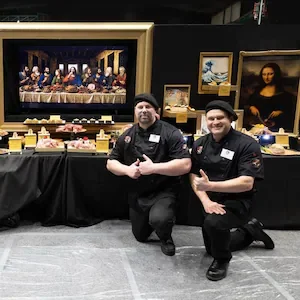
The competition was not short of innovative spins, including meat presented as art pieces, alongside adaptations of famous paintings such as Starry Night, Mona Lisa and The Last Supper.
A twist on the usual pork and apple sauce tradition, a platter of maple syrup-infused apples, stuffed with pork and topped with pork lard, caught the eye of head judge Peter Martin.
“When that cooks, the rendered pork fat is going to melt down through that pork as it’s cooking, and you’ll get the sweetness of the apple that’s contained it; you’ll end up with something yummy and delicious,” Martin said as he observed the work of Whangarei butcher Chloe Steel.
Twenty-four-year-old Mya Wilson Hiraka recently completed her final exams for her three-year apprenticeship and is now a qualified butcher.
This is her second time at the National Butchery Awards, after winning the best pork product category last year.
Hiraka made 21 products from the raw meat she was given, including a pork shoulder, lamb leg, two chickens and beef rump, to scoop the emerging talent award at Thursday’s competition.
“My biggest thing, becoming a butcher and wanting to do all those things and showcase my talent, is to inspire the younger generation to do the same, and whatever you put your mind to, you can go far in it,” she said.
“I never thought butchery could take you around the world, but it can, and that’s where I wanna head.”
Part of her goal is to compete in the World Butchers’ Challenge in Australia in two years.
She said butchery also allowed her to give back to her home community in Ōpononi.
“Giving back to my community, whānau, the ones who’ve supported me, being a butcher, go up to the marae for tangihanga, funerals, and I’m able to get into the back room and help cut up the carcass, and that’s very rewarding.”
Martin said the butchery trade continued to draw in young talent.
“Butchers are really relaxed; we don’t have the temperament of a chef, we don’t have the 2am starts of a baker. People who like working with their hands and like a physical aspect to the job they do are really attracted to this industry.”
Martin, who works for an agency that provides industry training and apprenticeships, said job prospects had been strong for the butchery trade.
“One of the most frequent calls we get is, ‘Do you know of a qualified butcher who would look to come and work for me?’. Something’s really interesting: carpenters [during] economic downturn, their jobs disappear; people eat, and that doesn’t really face a downturn.”