How do you build a planet before there are any galaxies to put it in? It sounds like a trick question, but a new study from the University of Portsmouth suggests the universe managed exactly that.
Astronomers have long assumed planet formation was a late arrival, a process that only picked up pace once the universe had settled down and produced generations of stars like our Sun. This new research pushes that timeline back dramatically, to just 100 million years after the Big Bang. Given the universe is roughly 13.8 billion years old, that is the equivalent of building the first house on a street before the town around it even exists.
An artist's impression of a first generation star ending as a pair instability supernova, an explosion violent enough to leave nothing behind, scattering more than a hundred solar masses of carbon, oxygen and iron into space (Credit : NOIRLab/NSF/AURA/J. da Silva)
The story starts with the very first stars, known as Population III stars. These were monstrous by modern standards, and some ended their short lives in a particular kind of explosion called a pair instability supernova. It is one of the most violent events physics allows, capable of hurling more than 100 times the Sun's mass in heavy elements like carbon, oxygen and iron out into space. Think of it as the Universe's first delivery of raw materials, dropped off long before anyone had drawn up the blueprints.
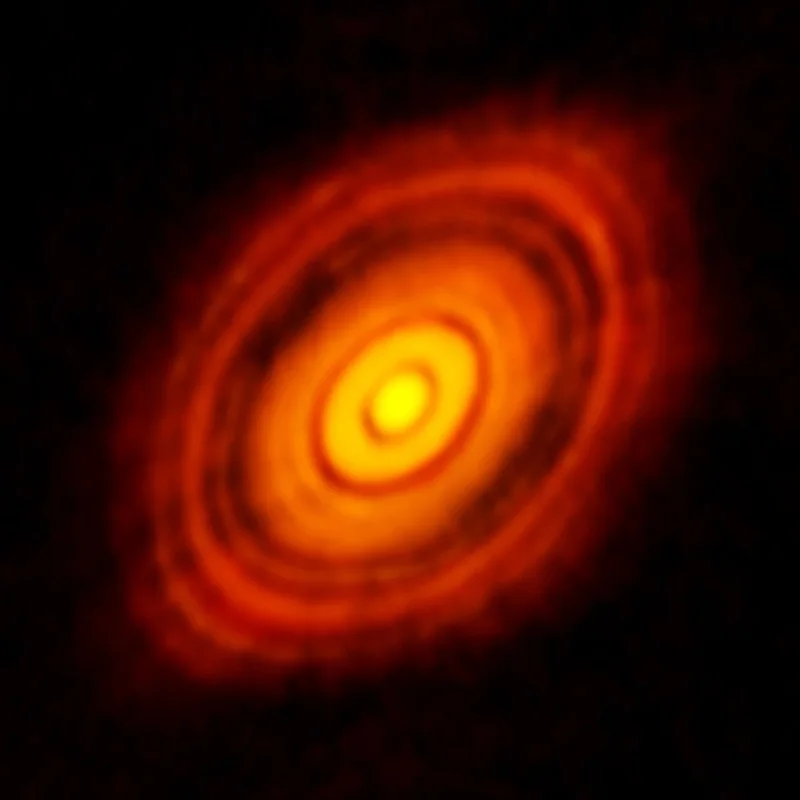
Dr Daniel Whalen and his team, including PhD student Chris Jessop, ran computer simulations tracing what happened to that scattered debris. They found it could enrich nearby clouds of gas so heavily that those clouds collapsed under their own gravity, spinning up into discs around newly forming stars, much like the disc that once surrounded our infant Sun.
In one simulation, a disc formed around a star about 70 per cent the Sun's mass, and inside it the team found several Earth masses' worth of solid material sitting roughly where Earth itself would sit, one Sun-Earth distance out. The bigger surprise was water. The disc held a healthy supply of it, not far short of the amount available when our own Solar System came together, and water delivered this way is thought to be how Earth got much of its own.
As Whalen puts it, if the ingredients for planets were in place this early, it raises an obvious next question. Could habitable worlds have formed far sooner in the universe's history than anyone dared imagine, long before there was a Milky Way to call home?
Four protoplanetary discs around young stars in the Orion Nebula, each between two and eight times the width of our Solar System. Discs like these are unremarkable in the universe today. The new work argues they were forming before there were galaxies to hold them (Credit : NASA, Mark McCaughrean (MPIA), C. O'Dell (Rice University))
That question cannot be answered yet, but it reframes how astronomers think about the earliest chapters of cosmic history. The building blocks were there almost from the start. What remains is finding out just how far that story runs, and whether somewhere among those first scattered discs, a planet, and perhaps even life, got a head start on the rest of us.
Source : The Ingredients for Planets Formed Far Earlier Than Thought