China’s AI talent race is starting younger - with parents seeking headstarts for their children
AI talent is commanding a huge premium in China - and parents are betting that exposing their children to technology early could give them a headstart.
HANGZHOU: It is summer break, but 13-year-old Yu Chenhao is spending five days of it learning about artificial intelligence (AI).
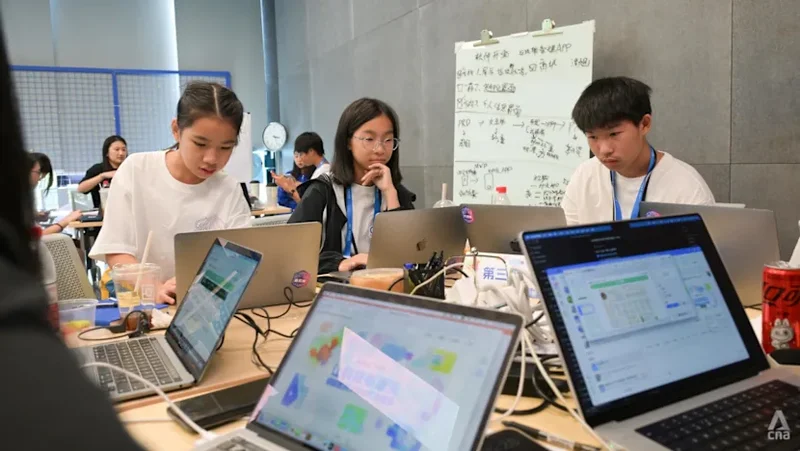
He has travelled from Shanghai to Hangzhou to join 20 others at a camp held at the headquarters of Chinese fintech giant Ant Group.
There, young attendees, aged between 12 and 18, spend hours at their laptops, working through PowerPoint slides and writing lengthy AI prompts and codes.
When organisers call for a break to announce a tour of the building, many attendees are reluctant to stop. Some carry their laptops along, still tinkering with their projects as they walk.
“We came to the camp to learn how to use AI - so later on, we probably won’t be that anxious,” he told CNA of his working future.
“Because (when) we know how to use it, and how to create value with it, we won't be eliminated.”
Yu’s team project is a smart pillbox that reminds seniors to take their medicine, and the right dosage, on time.
“We started by thinking about how we could help the elderly,” Yu said.
“After filtering ideas and doing some questionnaires, we found that the elderly actually have quite a lot of problems around taking medicine - so we thought: can we help them take it more simply and effectively?”
Others arrived with more curiosity than concern.
“At first I thought AI would be pretty dry - typing code all day,” said 12-year-old Li Peiran.
Five days later, she had built a prototype game about intangible cultural heritage and wanted to turn it into software.
“Coming here wasn’t what I’d imagined,” she added.
“You learn while playing, and you can make things you actually want to make. It's pretty fun.”
China is racing to prepare its citizens for an AI-driven future.
Its AI education market is projected to reach 160 billion yuan (US$22 billion) by 2027, according to analytics firm Changjiang Securities - and is set to approach 180 billion yuan by 2030.
China’s study-tour market is also expected to top 240 billion yuan this year, according to data cited by state newspaper People’s Daily, with AI-themed camps said to be growing faster than traditional categories.
While no official count exists, AI camps aimed at youths have multiplied this year across the country - with prices ranging from a few hundred yuan to more than 20,000 yuan.
Their rise also comes amid a national push by Beijing to introduce AI courses and teaching methods into primary and secondary school curriculums.
An action plan issued by five ministries in April called for “AI-plus education” across all stages of schooling by 2030.
Ant Group’s five-day programme in Hangzhou, the Young Founders AI Camp organised by its tech arm Ant Digital Technologies (Ant DT), was free - but by invitation only. It was also the first such camp organised by Ant DT.
Chinese internet giant Tencent also started its own AI holiday camps for students aged between 13 and 18 in June - offering training in areas such as AI product management, robotics and quantum computing.
Ant DT’s Young Founders AI Camp was more than just corporate social responsibility, according to chief planner Ma Wenting - it was also a test of what children could build with the company’s tools, and to see if young attendees could turn their ideas into viable products.
“Previously we'd recruit engineers. (But) now we think that being good at using AI is actually the better direction,” Ma said, adding that such programmes can better expose students to technology evolving faster than schools can keep pace with.
“Education doesn’t always evolve quickly enough to keep pace with new developments,” she added.
“Companies operating in the industry stay much more current with new developments (and) in a way, they're filling a gap in education today.”
PAYING A PREMIUM FOR ELITE AI TALENT
But the push also reflects a shortage of elite AI talent as competition among Chinese tech firms intensifies.
A viral screenshot that circulated on the Sina Weibo microblogging site in July offered a glimpse into the battle for AI talent.
A computer science student from Tsinghua University’s Yao Class - a prestigious elite programme founded by Turing Award laureate Andrew Yao - posted an offer letter purportedly for a DeepSeek internship - offering a pre-tax salary of 5,500 yuan a day.
Over 22 working days, that would exceed 120,000 yuan a month - nearly 19 times the 6,435 yuan average monthly salary of an average bachelor’s degree graduate, according to education consultancy MyCOS.
DeepSeek did not address the news - but the company’s own job listings have put standard pay for large-model interns at 500 to 1,000 yuan a day, which includes a housing allowance.
Ivy Fan, an 18-year-old interning at a Shenzhen tech unicorn, earns around 6,000 yuan a month.
“Personally - although I'm only 18, which counts as very young … I've met plenty of people younger and stronger than me - who can land that 5,500-a-day internship.”
“So yes, I'm envious,” she said.
Even in the same industry and companies, the “gap between non-technical and technical roles is genuinely enormous”, she added.
BUT HOW EARLY IS EARLY ENOUGH?
At Ant DT’s AI summer camp, 13-year-old Qin Sihan was working on a mutual-aid app for people with disabilities.
“They don't want to be (just) helped. They also want to use their own strength to help others,” she said.
She recalled being “pretty nervous” at first.
“I never imagined I could make a product myself,” she said, adding that she thought “AI coding would be really difficult”.
“But now I've found that it's not that hard - and it's actually really interesting.”
“Our team’s teacher helped enormously,” she added. “He was my way in, teaching me how to use AI - and use it well.”
For parents watching these developments unfold, the uncertainty is feeding questions of their own: how early should their children start preparing?
Beijing mother Ma Tanyu began looking for a different path for her 12-year-old son when he started to fall behind at school.
“Beijing is just brutally competitive,” she said, adding that she had been looking at “other roads”.
She eventually began looking at the tech track and came across an ad by a local education provider for a three-day AI camp in Hangzhou for 2,980 yuan.
Costs would also cover staying at a five-star hotel, transport around the city and a visit to Alibaba’s headquarters.
But she understood that the camp would be more than just an introduction to AI - it would equip children with valuable skills - like knowing how to file patents for products, which could ultimately in turn help with school admissions.
She also hoped her son would build confidence.
On the third day, he entered a World Robot Contest event and came home with two certificates - and was overjoyed.
“Ever since, he's kept telling me: 'Mum, I'm amazing. Mum, I'm great',” she said.
“For us, this was a huge confidence boost.”
He came back without much interest in studying more AI, she said - but she still keeps encouraging him anyway.
“We'll have to learn it (AI) sooner or later - better sooner than later. Whatever he ends up wanting to do when he grows up, I think this is a very good experience.”
Ant DT chief planner Ma sees that commercial market up close - and is blunt about it.
“Such institutions do exist - genuinely selling anxiety, and using that anxiety to drive commercialisation,” she said.
That is precisely what should not drive a child, she added.
“When they genuinely use AI to produce the product form they wanted, they get encouraged, and that drives them to use it better. I think that matters far more than being driven by anxiety.”
But she is also equally careful not to overstate what the technology at her own camp did.
When the young attendees were working out what to build, they were not using AI at all, she said.
For example, Yu’s idea of a smart pillbox for seniors, came from a boy who was thinking about his own grandmother, who often forgets whether or not she has taken her medication.
“These aren't AI-era problems - they're problems that have always existed,” she said.
Qu Jialin, 46, a senior aviation engineer from Hangzhou who also promotes AI education products online as a side gig, has watched the demand grow up close. Her 13-year-old son, Qu Yisen, was among the attendees.
“AI camps are all expensive,” she told CNA, adding that most “wage-earning families won’t consider camps like this”.
Those who do sign up, are typically well-off families whose children attend international schools and are already paying hundreds of thousands of yuan a year, Qu said.
But she does not expect a few days at an AI camp to produce young masters.
In her view, what families pay for is access and exposure.
“(Attendees) can make good friends with like-minded children and talk with real AI engineers - an online course doesn’t have that. It’s an experience.”
Her son spent most of the week at the camp fixing bugs, but did not mind spending his holiday on it.
“This is really fun too - getting AI to code, and then the program you've made, you can play with it yourself,” he said.
“Seeing your own results … it gives you a sense of achievement.”
A six-day summer camp is “completely insufficient for understanding AI”, said Chi Boyang, who founded Xinya AI, a Beijing-based academy that focuses on AI learning for children aged 8 to 14.
It charges between 199 to 299 yuan for half-day camps and 12,900 yuan for a six-day camp hosted at a leading international school.
When it comes to learning AI, “age genuinely doesn’t matter that much”, Chi said.
The parents coming through his doors also have varying levels of knowledge and familiarity with AI, he added.
Some know little about the technology and want their children exposed to it.
Others, including some who work at tech companies like Huawei, understand it well themselves but still struggle to teach it to their children.
“Their technical skills may be strong, yet they feel they have no way to transfer that AI knowledge to a child,” Chi said.
Some parents attend courses to see how AI is taught, and then guide their children at home.
But despite the growing interest, few are thinking as far ahead as preparing their children for careers in the field, Chi said.
“Do parents think as far as ‘I'm turning my child into an AI talent’? I don't think it's gone that far yet.”
WHO MAKES IT THROUGH?
A record 12.7 million graduating students will enter China’s job market this year, up 480,000 from last year, according to the Ministry of Education.
Sectors that once absorbed large numbers of graduates - like finance, IT, real estate and education, have been shrinking since 2020 and now hire far fewer people, said Wang Dan, China director at consultancy Eurasia Group.
They also demand skills that many graduates do not have, she added.
Those entering the workforce with no experience are “disproportionately hurt”, noted Su Yue, chief China economist at the Economist Intelligence Unit (EIU).
Their work tends to be repetitive in nature, she said - the kind AI can most easily replace.
For China’s young graduates who are trying to position themselves, the question now is which skills remain the most valuable?
Fan, the intern in Shenzhen, has gained experience in social media operations, product testing and tracking new AI model releases. She has also organised AI hackathons.
She has her sights set on studying economics and management - despite the field being widely named as one of AI’s first casualties.
Her strategy is to focus on the things that technology cannot easily replace - like judgement and the ability to deal with people.
“There are two important things at the moment,” she said. “One side deals with people - organisational ability, expression, judgement and aesthetic sense. The other is dealing with technology and algorithms … and the talent at the intersection becomes truly top-tier.”
Guo Shan, a partner at research firm Hutong Research, said human judgement has become more valuable and important during these times.
“You need to ask good questions - and to know whether AI is tricking you,” she said,
BETTING EARLIER ON AI TALENT
Parents are also responding to signals from a labour market where demand for AI skills is growing fast - even if the fiercest competition is concentrated among a small number of specialists, analysts said.
“For certain types of roles, it is a talent war,” said the EIU’s Su.
“It's just a small number of jobs that are competing for the right talent.”
China's biggest technology companies are rapidly expanding their intake of AI workers.
For the class of 2026, Baidu said more than 90 per cent of its 4,000 offers would be AI-related, while Alibaba said AI roles would make up more than 60 per cent of over 7,000 offers.
Graduate AI postings on recruitment platform Maimai rose by almost half in the first five months of this year, and now account for more than a third of all campus vacancies there.
The premium for some skills is already clear.
A survey conducted by 51job, one of China’s largest human resource portals, put the median monthly salary for large-model algorithm engineers at 24,760 yuan, compared with 13,621 yuan for AI testing roles.
But companies are not simply hiring and paying more. They are also looking earlier.
ByteDance founder Zhang Yiming co-founded a non-profit centre that takes 30 students aged 16 to 18 each year for full-time research.
Analysts said that partly reflects how difficult it is to predict which skills - and which people - will prove most valuable as AI develops.
“People don't know how AI will play out, so the search is broader,” said Guo from Hutong Research.
“You don't know who you are looking for.”
For companies, that uncertainty creates an incentive to cast the net wider and earlier.
“We are still in the trial-and-fail cycle, and it's more a fear of missing out,” Guo added.
“You want to hire the talents, but you do not know what they can do yet.”
That does not mean everyone with AI skills is commanding extraordinary salaries.
Wang from the Eurasia Group, said a rare researcher with exceptional mathematics and algorithm skills occupies a very different market from a graduate who applies existing models.
“It's really just a handful of talents we're talking about, and that's probably why there is this very expensive investment in signalling,” she said.
EIU’s Su similarly described the outsized pay packages as “isolated cases”.
But when companies cannot yet know where the next generation of talent will emerge, there is little incentive to wait until it is fully formed.
“It's better to access those talents as young as possible,” Guo said.
“It's worse if the talents go to the US, stay there, and never come back to China.”
But none of it guarantees results.
“Regardless of how much investment there is, you could end up with nothing,” Wang said.
China has tried accelerating its brightest before, she noted, citing the University of Science and Technology of China's Youth Class, set up in 1978. “Real innovation needs room.”
“The bet now is too early on one narrow skill,” she said.
“In a few years, if there's a breakthrough in another type of technology, whatever they're investing in now doesn't yield anything.”
Su, an economist and the mother of a four-year-old whose kindergarten now invites families to draw pictures using AI, is unconvinced the race needs to start now.
“They are still too young to be concerned about their future,” she said.
“It's just too early.”