Commentary: A reality check is needed on Arctic shipping
It will take a long time before new routes become more than a niche commercial activity, says Richard Milne for the Financial Times.
OSLO: There is plenty of hype around business potential in the Arctic and how new shipping routes will change global trade patterns.
About a third of the world’s undiscovered gas and an eighth of its oil lie in the far north. And abundant hydropower and geothermal energy in places from Norway and Sweden to Iceland and Greenland mean it is the perfect place to position data centres and other electricity-hungry industries.
But the pace of change in the polar region is often slow, dare one say glacial, despite it being the fastest-warming region in the world. For instance, take a look at United States President Donald Trump’s recurring obsession, Greenland, where no oil and few minerals are being exploited despite decades of exploration.
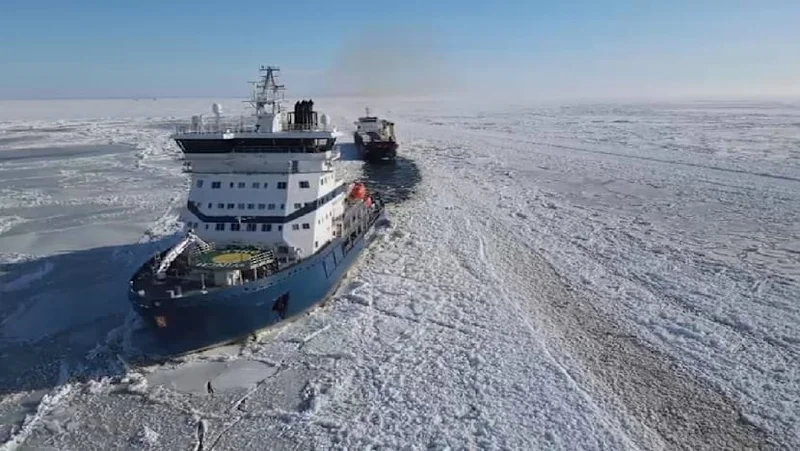
The latest potential Arctic business breakthrough was reported this week: Sea Legend, a Chinese container shipping company, will launch the first regular service through the Arctic. It is sailing a vessel between Ningbo in China and Felixstowe on the UK’s east coast, using the so-called Northern Sea Route over the top of Russia. This comes after a record number of full transits last year of the Northern Sea Route, which can halve journey times from Asia to Europe.
NICHE COMMERCIAL ACTIVITY
Still the cold, hard fact remains that Arctic shipping is nothing more than a niche commercial activity. There is a long way, and time, to go until it becomes a viable business proposition of scale. Nonetheless, moves like Sea Legend’s are hugely interesting geopolitically.
“The commercial aspect is not there yet. For the majority of (trade) volumes, this is really far away,” Vincent Clerc, the chief executive of Danish shipping giant Maersk, told me late last year, suggesting a timeframe of decades.
The Northern Sea Route has not lived up to Russia’s expectations, not least as sanctions following the full-scale invasion of Ukraine have curbed foreign ships. That has left it mostly used for transporting Russia’s own petroleum and mineral resources from its frozen north.
But there is clear potential for China, especially as it looks for alternatives to popular trade routes that could have chokepoints controlled by the US or its allies. That is an acute concern for Beijing, something that has led it to look at building a potential Ice Silk Road.
The Northern Sea Route is not exactly problem-free here either, though. Given the entire route is under Russian control, it merely substitutes one chokepoint for another. Worse, the entrance to it is via the Bering Strait, on one side of which sits the US.
Journey speed is another consideration - Sea Legend’s weekly service touts that it will cut the 40-day normal journey between the two ports in half. But there are issues here, too. The service is only planned for three months in the summer, hardly offering the reliability that most businesses require. There are also fears it could end up being more expensive with fuel savings offset by higher costs for icebreakers and more.
Clerc himself says there are three problems to be solved before the route gains traction. The first is geopolitical, with sanctions on Russia making it currently off-limits for most shipping groups. Then, there are environmental considerations around any potential accident in the Arctic.
“The third one is commercial: because it’s relatively unpredictable when the route opens and closes, there is no commercial demand to switch. Customers don’t want you to flip-flop because their entire lead times get thrown in the air, and it’s very difficult to plan with this,” adds Clerc.
The Maersk boss says the route might compete against rail freight from Asia to Europe but not ocean-borne containers, the main motor of globalisation.
So no big commercial container shipping line is likely to offer anything any time soon to rival the hundreds of container ships sailing through the Suez Canal and the Strait of Malacca.
But with the Arctic warming so quickly - the Norwegian archipelago of Svalbard is, for instance, seeing temperature rises five to seven times the global average - and the big powers jostling for position in the polar region, the new shipping route is also a reminder that slow change still can bring momentous shifts with time.