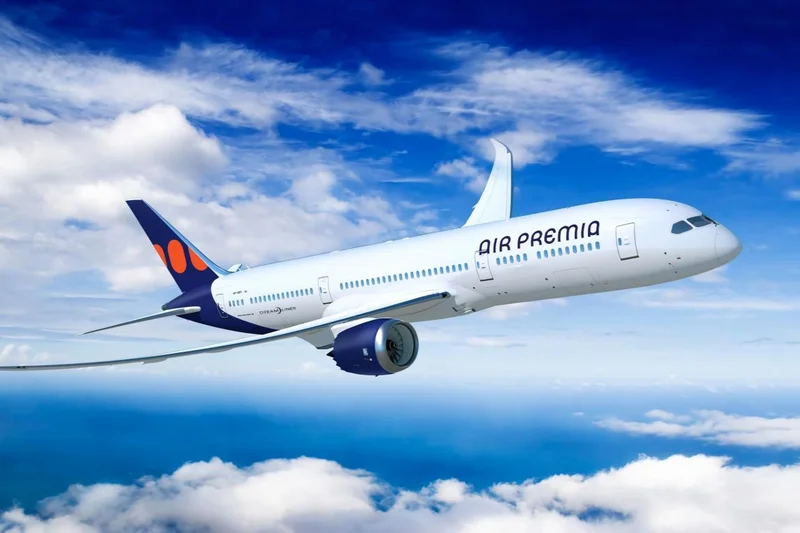
The viability of Trinity Airways and Air Premia’s long-haul businesses remains in doubt, as both budget carriers struggle to build stable profit structures to keep their expanded operations afloat, industry officials said Thursday.
The two airlines had been widely seen as major beneficiaries of remedies imposed by competition authorities to address concerns stemming from Korean Air’s acquisition of Asiana Airlines. The measures required Korean Air and Asiana to make room for rival carriers on routes where regulators are concerned the merger could reduce competition.
Under these measures, Trinity Airways, formerly T’way Air, took over four European routes, flying from Incheon to Paris, Rome, Barcelona and Frankfurt. Air Premia was also selected to operate an Incheon-Honolulu route under measures aimed at preserving competition following the merger.
The expansion has given the low-cost carriers (LCCs) access to major international markets, but it has also exposed them to a heavier cost structure than traditional budget airlines.
Long-haul operations require wide-body aircraft, higher fuel consumption, larger crews and greater spending on maintenance and overseas operations.
For airlines with relatively small fleets and limited financial resources, long-haul operations are widely seen as highly challenging, according to industry officials.
Long-haul aircraft remain tied up for many hours on each flight, limiting daily utilization, while maintenance problems or other disruptions can have a greater impact because smaller carriers have fewer spare aircraft to deploy.
The financial strain is already visible. Both airlines are trying to improve deteriorating profitability amid a weak Korean won and elevated fuel costs. Trinity Airways reported an operating loss of 265.5 billion won ($194 million) last year, while Air Premia posted an operating loss of 32.1 billion won during the same period.
“Long-haul routes can generate significant sales, but sales growth does not necessarily translate into profits,” an aviation industry official said. “The cost structure is much heavier, and smaller airlines are highly vulnerable to fluctuations in fuel prices, exchange rates and passenger demand.”
Trinity Airways’ European expansion illustrates the challenge. While the four routes have strengthened its presence in major European markets, operating a broad long-haul network requires significant fleet capacity and financial resources. Any aircraft shortage or maintenance problem can quickly affect multiple routes.
Air Premia faces a similar challenge in the U.S. market. Its hybrid business model, positioned between traditional full-service carriers and LCCs, offers passengers more services than a conventional budget airline while maintaining relatively competitive fares.
However, the strategy also leaves the carrier caught between the high costs of long-haul operations and limited pricing power.
The government's goal is to create viable competitors to the enlarged Korean Air, but the policy could prove counterproductive if smaller carriers are forced to maintain unprofitable routes.
“Route transfers alone cannot create meaningful competition,” another industry official said. “The new operators need sufficient financial and operational strength to maintain those routes for years and compete consistently.”
This creates a difficult test for Trinity Airways and Air Premia. The official said the two budget carriers must expand their networks enough to compete with a much larger Korean Air, while at the same time keeping costs under control and building sustainable profit structures.
If they fail, the merger's competition remedies could have an unintended consequence — accelerating the financial deterioration of smaller carriers instead of creating stronger competitors in Korea's long-haul market, the official said.