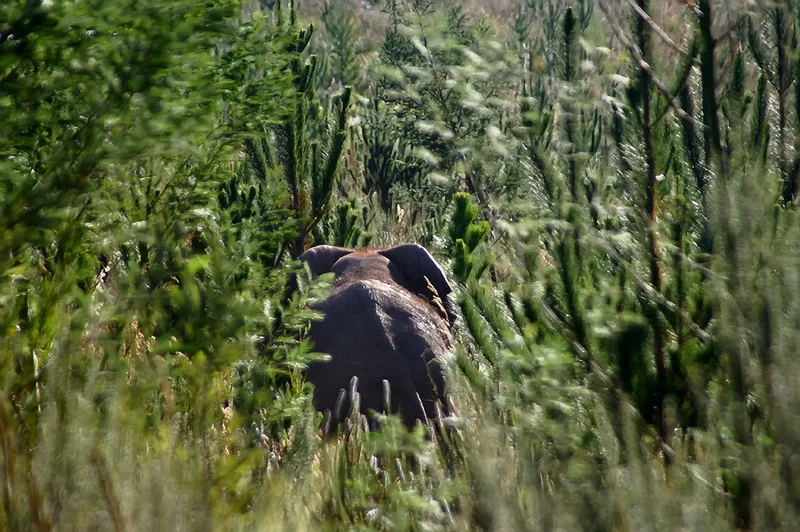
Deep in the Knysna forest, where the light struggles to reach the ground through centuries-old canopy and the air stays cool and damp even in the height of summer, a lone elephant moves through trails that no longer lead anywhere.
Rangers call her “Strangefoot”, for the unusual, wide shape of her footprint pressed into the forest floor.
She is thought to be the last lonely matriarch here, the final survivor of a population that took refuge in the forest and once numbered in the hundreds, which for centuries moved freely between the Cape's coastal forests and the wilder country to the north-east.
A recently proposed plan to bring her companions from elsewhere fell through late last year, and at around 50 years old, she is unlikely now to ever again hear another elephant call back to her across these trees.
She is not a symbol of hope.
She is a warning of what isolation looks like when it has gone on for too long to undo, and of everything South Africa still stands to lose if the country's remaining wild places are left to shrink into islands of their own.
What is corridor conservation and why does it matter for climate change
The core work of the Eden to Addo Corridor Initiative (E2A) is to link three of the region’s major protected areas - the Garden Route National Park, the Baviaanskloof World Heritage Site - and the Addo Elephant National Park, through a network of privately owned land drawn into biodiversity stewardship.
Strung together, these corridors span roughly 400km, cross seven mountain ranges and pass through five of South Africa’s seven biomes. If completed, the vision would join close to a million hectares of unbroken conservation landscape, one of the most ambitious connectivity projects on the continent.
This logic is not unique to South Africa. It reflects a global shift away from “fortress conservation”, of isolated, fenced-off reserves, toward connected landscapes that let species and ecological processes move freely.
The best known example is the Yellowstone to Yukon Conservation Initiative (US-Canada), whose founders describe corridors as basic climate infrastructure: they let species adapt and shift as the climate changes, rather than becoming trapped in place, the way Strangefoot ultimately has been.
A 2025 study in the journal, Biodiversity and Conservation, co-authored by researchers from Wageningen University, Germany’s Senckenberg Society, and E2A’s Rhian Berning and Brian Reeves, modelled how nine mammal species might move across this exact landscape, identifying 40 potential corridors.
As the study’s authors put it, connecting landscapes like this one is essential not only for protecting biodiversity, but for “enduring the impacts of climate change”.
As rainfall patterns shift and drought reshape what land can support, species free to follow the conditions they need stand a chance of persisting; species boxed into a single reserve do not.
It is against that same backdrop of isolation, and the corridor blueprint built to prevent it, that a very different kind of sighting, a few kilometres away, matters so much more than it might first seem. “It’s not often that one sees an endangered species on your land,” reads a recent social media post from E2A, marking aardvark sightings across its corridors.
The aardvark was uplisted from least concern to near threatened in South Africa’s 2025 Regional Mammal Red List. Seeing aardvarks thrive on land that ordinary landowners have voluntarily opened to conservation is proof, still small but real, that 20 years of quiet restoration work is beginning to turn a corner.
20 years in the making
This year, the Eden to Addo Corridor Initiative marks its 20th anniversary as a registered non-profit, built not on government funding or corporate backing, but on the conviction of one woman that a different kind of conservation was possible.
Founded in 2006 by Joan Berning, a farmer, conservationist and cheesemaker on the foothills of the Outeniqua Mountains near Plettenberg Bay, the organisation grew out of a realisation as simple as it was profound.
“It started with my love for elephants,” Berning says, “and I realised that there are in fact elephants in the forest here, in the Garden of Eden.”
Those elephants, now down to the solitary Strangefoot, became, for her, a symbol of something far larger than any single species: the thousands of plants, animals and ecological processes that depend on landscapes being connected rather than fenced apart.
A Southern African pioneer
In this region, E2A was among the first organisations to put that thinking into practice. Since 2006, it has helped bring an estimated 55 000ha of privately-owned land into interconnected biodiversity stewardship across five corridors, each addressing a different ecological gap between the mega-reserves it links.
It is not alone in this ambition; further north, the Kavango-Zambezi Transfrontier Conservation Area (KAZA) links protected areas across five countries, Angola, Botswana, Namibia, Zambia and Zimbabwe, into what is often described as the largest terrestrial conservation area on Earth.
Compared to KAZA’s scale, E2A’s 400km can look modest. But its significance lies less in size than in proof of concept: showing that corridor conservation can work in a landscape dominated by private and commercial farmland, built one voluntary agreement at a time, in the most biodiverse area for its size on the planet.
That track record has not gone unnoticed internationally. In a letter dated 1 July 2026, WWF South Africa endorsed E2A’s nomination for the 2027 Earthshot Prize in the “Protect and Restore Nature” category, writing that E2A’s work is “built on precisely” an understanding of connectivity that “encompasses the processes that sustain clean water, pollination, soil stability and climate regulation”.
Behind those figures are individual landowners who chose, often at real personal cost, to manage their land differently. On the Pietersrivier Nature Reserve, Katot Meyer has spent years pulling invasive alien vegetation out of the riverbeds, so that water long throttled by thirsty foreign wattle and pine can find its way back to the surface.
“It’s not for me, it’s for the future,” he says. “We must give back a better environment than what we got. That’s the way to do it. And … it’s nice to do it, actually. To hear the stream of water, after you’ve cleared the little rivers. That stream of water, to hear it and see it. Really, it’s phenomenal.”
He puts it more simply elsewhere: “If you look after your land, your land will look after you,” a line that captures what climate scientists call ecosystem-based adaptation.
E2A’s current chief executive, Rhian Berning, who took over leadership from her mother Joan, frames the urgency starkly. “There's this small window of opportunity we have left,” she has said, “to actually make life on Earth possible.”
Joan Berning’s answer to how we can meet a challenge that size has remained consistent for 20 years: “We have a solution. We have corridors.”
The obstacles in the way
None of this has come easily, or cheaply. E2A is a small non-profit dependent on donor funding and sponsored staff time and working with commercial farmers to enter into long-term stewardship agreements has required two decades of relationship-building, one property at a time.
That tension is playing out acutely right now, on E2A’s own doorstep. The Robberg Coastal Corridor sits directly beside the Robberg Peninsula, where a citizen campaign called Save Robberg has spent 2026 opposing two development applications, a 166-erf residential and commercial subdivision and a 121-unit retirement estate, on land it describes as critically endangered fynbos habitat with no municipal water or sewer infrastructure.
The first phase of public comment periods on both applications have closed and objections are now before the authorities. It is a reminder that corridors, once built, are not necessarily wholly protected: a landscape reconnected by conservation agreements can still be affected by a single approved development.
What success would mean
If E2A’s vision is realised in full, a connected million-hectare landscape would help stabilise water catchments, buffer farmland against worsening droughts and floods and give the region’s plants and animals room to shift their ranges as conditions change, rather than being trapped, as Strangefoot is, with nowhere left to go.
It won’t undo what has already been lost. Strangefoot will live out her long life alone and no corridor built now will change that.
But somewhere out along the Keurbooms, where Meyer has spent two decades coaxing rivers back to the surface, there is a version of the future in which the next matriarch never finds herself in that position at all, where an elephant, or a leopard, or a humble aardvark, can simply walk from one mountain range to the next and find another of its kind waiting on the other side.
That is what 20 years of quiet, unrewarded labour has been building toward. It is not yet finished. But for the first time in a long time, it feels within reach.
Marking the milestone
E2A’s 20th anniversary celebrations, walks and talks run from 24 to 26 September in Plettenberg Bay and across corridors in the Garden Route. Those wanting to support the initiative’s next chapter can do so through its “Guardians of Eden” monthly giving programme, or by joining one of its planned guided slackpack hikes through the corridors themselves.
For a closer look at the people doing the work, Keystones Expeditions’ documentary series Corridors of Life, produced by Samuel Chevallier, follows landowners and community members like Meyer across the corridors E2A has spent 20 years building.
*Concar has worked one day a week as a paid communications consultant to the Eden to Addo Corridor Initiative.