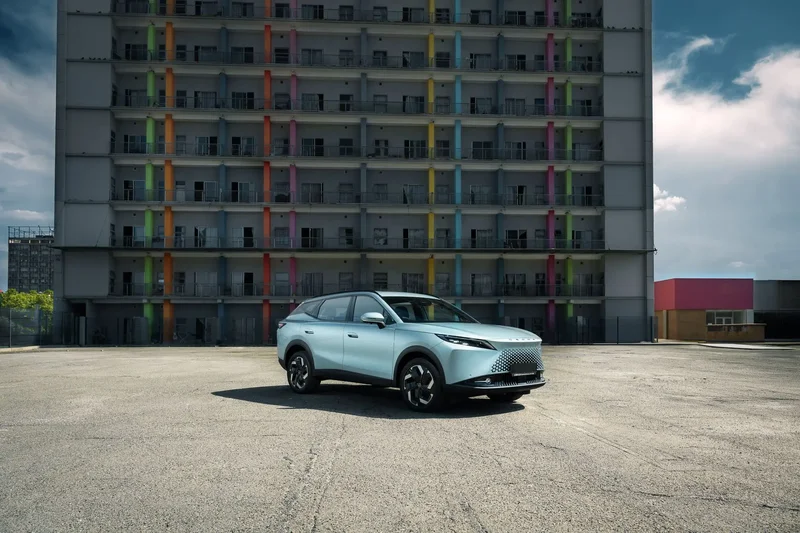
Spending the past five days with the Omoda C7 SHS has left me even more convinced that electrified vehicles make the most sense in urban environments.
The C7 SHS is the third vehicle I have driven with Chery Group's Super Hybrid System, so this time I was more than happy to experiment with the different driving and power deployment modes.
The C7 plug-in hybrid pairs a 1.5-litre turbocharged petrol engine with a single electric motor and a Dedicated Hybrid Transmission, sending 255 kW and 525 Nm of torque to the front wheels.
The vehicle was delivered in Forced power saving mode, which prioritises battery retention by keeping the battery charged to around 80%. I quickly realised this because I could hear the 1.5-litre turbocharged engine running at almost every traffic stop. It is not an unpleasant sound but it is noticeable. At times it reminded me of a generator, which, in fairness, is effectively what it is doing by running at higher revs to keep the battery topped up.
The first setting I tried was Smart power saving mode, which “selects the best time to charge the vehicle to achieve a balance between economy and power", it allowed the vehicle to spend far more time in EV mode. For me, this is where the C7 SHS makes the most sense. It is remarkably quiet. Road noise from the 20-inch tyres is well suppressed, while wind noise remains low even at motorway speeds.
That quieter cabin also allowed me to appreciate the Sony sound system. Unlike the system in the C9, the setup here feels much better integrated. The sound is punchy and clear, with a cohesive presentation rather than individual speakers drawing attention to themselves.
Even the subwoofer blended into the overall soundstage, only making its presence known at higher volumes. I never felt the need to turn the volume up much, largely because the cabin is already so well insulated.
Most of my driving consisted of my daily commute, which is around 9 km each way, allowing me to remain in EV mode for the majority of the time.
Three days into the test, I drove the vehicle home, a journey of roughly 90 km. I had not had the opportunity to recharge the 18.4 kWh LFP battery, so the system automatically switched to hybrid mode once the battery dropped below 20%. As I reached Tshwane city centre, about 60 km into the trip, the vehicle returned to EV mode before switching back to hybrid operation once I rejoined the motorway.
Out on the open road, I found the petrol engine less intrusive. With music playing, the engine note largely faded into the background. It also reinforced how I would use the C7 SHS if it were mine: drive in EV mode around town, then let the hybrid system take over for longer motorway journeys while topping up whenever possible at one of the growing number of charging stations around Johannesburg.
Driving the car this way also delivered impressive efficiency. During my time with the vehicle, fuel consumption dropped as low as 4.4 l/100 km.
This is where the C7 SHS really stands out. It delivers 255 kW and 525 Nm of torque, yet returns fuel consumption figures more commonly associated with a much smaller, less powerful vehicle. It offers strong performance without demanding a significant compromise in efficiency.
Likes
The ability to travel around 80 km in EV mode is a genuine benefit for daily driving, while the combined range of around 1 000 km provides welcome flexibility on longer journeys.
The Sony sound system is excellent and the interior fit and finish never had me questioning the R689 900 starting price.
Performance is effortless, with overtaking requiring very little planning thanks to the immediate torque delivery.
The styling has also grown on me over the past few days. Whether that is because I have become accustomed to it or because I kept noticing people looking at the car, I am not entirely sure. Either way, it has presence. The animated welcome lighting sequence, particularly at night, adds a nice touch every time you approach the vehicle.
Not so sure about
Like many modern vehicles, too many functions are buried within the touchscreen. This is now the third Chery Group product I have driven and I still find the infotainment system more complicated than it needs to be.
Physical buttons for functions such as the mirrors and climate control would make everyday use much easier.
The heated and ventilated front seats are welcome, although it is puzzling that only the front passenger receives a massage function.
I also enjoyed the panoramic roof but my test vehicle developed a noticeable rattle whenever the roof was open while driving at moderate speeds around town.
Verdict
The C7 SHS left a positive impression. The Super Hybrid System continues to show that plug-in hybrids can bridge the gap between conventional petrol vehicles and fully electric cars without introducing range anxiety.
For drivers who spend most of their time in the city but still cover longer distances regularly, the C7 SHS offers a convincing balance of performance, efficiency and everyday usability. While there are still areas that could be improved, particularly the user interface, the overall package is well suited to the way many South Africans actually drive.