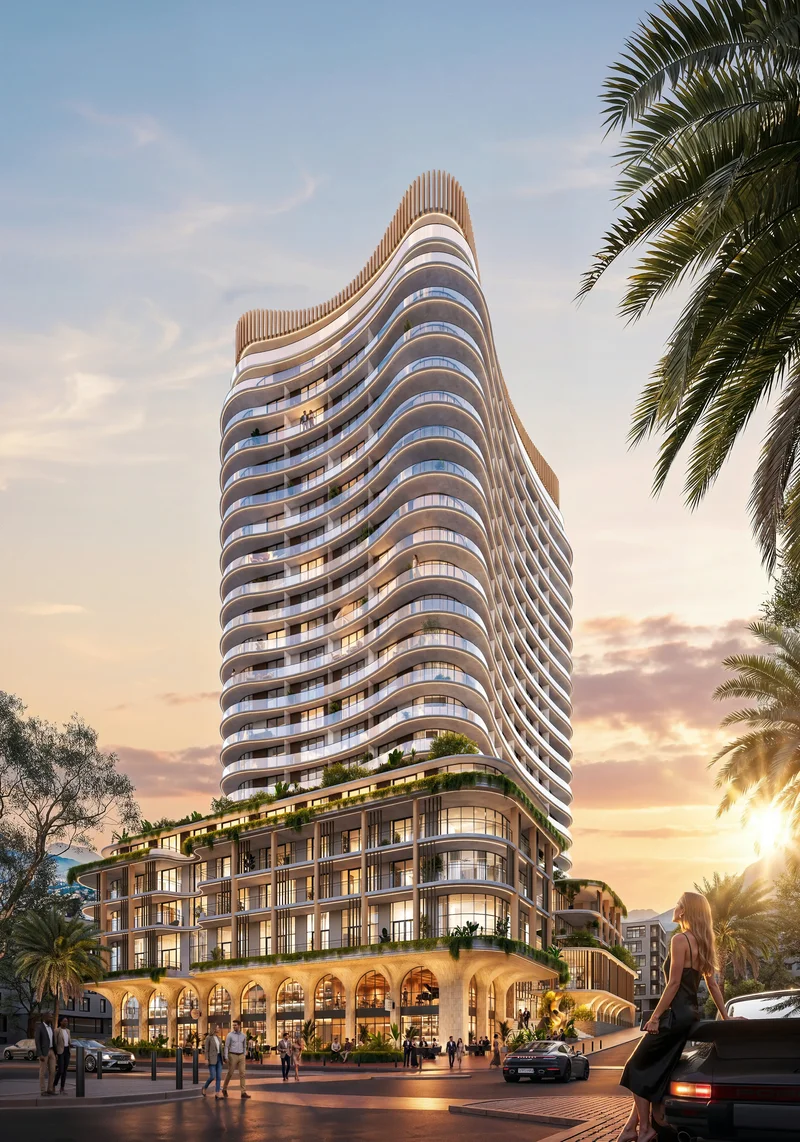
A queue of numbers ticking upward on a screen and a queue of buyers doing the same thing behind them. Tricolt Group, the developer, and Launchbase, the off-plan marketing company behind the digital campaign and sales platform, invited me to watch sales go live on The Madison, Tricolt's new 23-storey development at 142 Bree Street, Cape Town.
By the time the counters stopped at midnight, it had become, the biggest single-day residential property launch in South African history.
I was sitting in the room at the Launchbase headquarters in Cape Town's Southern Suburbs watching strangers commit hundreds of millions of rand to flats that do not yet exist. More than R1.255 billion in off-plan sales during the launch, out of a development value of R1.7bn. Before the launch, 96 flats had been secured through Tricolt and KGP Luxury Realty's networks of investors. Once the public sale opened, a further 176 units were reserved in under an hour, taking the day's total to 272 flats- 72% of the development's 378 units and 74% of its total sales value. Ten of the 14 penthouses found buyers too, leaving just four on the table.
"The response exceeded our expectations and is a testament to the confidence buyers continue to place in the Tricolt brand. To achieve these results on launch day is an unbelievable achievement and we're incredibly proud of the entire team and our partners who made it possible," says Tricolt Group CEO Tim Kloeck.
"From the outset, we knew we had an opportunity to create something special, not another residential building. We wanted The Madison to feel distinctly Cape Town and to make a positive contribution to Bree Street and the surrounding neighbourhood."
The scale of the response has pulled Tricolt's construction plans forward. Construction is targeted to begin in early 2027, with completion expected roughly 28 months after that, putting handover somewhere around mid-2029.
Buyers snap up 272 flats at The Madison in less than 24 hours, making it the biggest single-day residential property launch in South African history
Going up: Construction of The Madison is targeted to begin in early 2027, with handover expected in mid-2029. Photo: Supplied
Who was doing the buying? You might be surprised to hear that 80% of Madison purchasers were South African. That goes against something we've heard for years in the Cape Town prime property market: its boom is largely a foreign-capital phenomenon, driven by semigration and offshore money chasing a soft rand.
Paul Berman of Berman Brothers, a prominent Sea Point developer, who has tracked sales data on the Atlantic Seaboard from Green Point through to Llandudno for decades, consolidating figures reported through property statistics by estate agencies, says: "Since 2021, sectional title and freehold sales on the Atlantic Seaboard have consistently generated between R5.6bn and R5.7bn a year and that held up even through Covid What's extraordinary is that in 2025, the market jumped 46% to R8.2bn."
Of the consolidated figure, Berman says roughly 29% to 30% has come from foreign buyers.
About 80% of the purchases, historically, have been cash rather than mortgage finance. "There's been a lot of cash sitting on the sidelines waiting for the right investment," he said.
"I'm a converted immovable-property proponent. During Covid, the markets imploded you couldn't touch or feel your shares. Property doesn't work that way. It has an inherent, fundamental value that ... keeps creating value."
Is it a bubble?
"I don't believe it's a bubble if you look at the number of tourists and flights: 10.5 million passengers came into South Africa last year and that's increasing year on year. Cape Town has been discovered. It's got the people, the culture, the proximity to the sea and the mountain it's got everything you could wish for in one place."
He points to price-per-square-metre growth as evidence: "Before we were struggling to achieve R50 000/m², then R80 000, then we hit R100 000 now it's north of R200 000 in some areas, like Clifton."
It's an unapologetically bullish read from someone whose business depends on the market remaining strong. A 46% single-year jump is unusual. Concentrated cash-buyer demand in a narrow strip of coastline can just as easily be read as a market getting tighter at the top as one that's sound throughout.
The Madison doesn't sit on the Seaboard it's next door in the city centre, on Bree Street. The Cape Town Central City Improvement District's State of Cape Town Central City Report 2025 says property investment in the inner city hit a conservatively estimated R12.758bn in 2025/26 across 29 projects, a 41% jump on the R9bn recorded the year before. The city centre's residential stock has swelled to 7 675 units, most of them on the Foreshore.
Sixteen of the 29 projects, worth R6.221bn, are purely residential. The median price of a sectional title unit rose to R1.95 million in 2025, up 53.5% since the pandemic low of R1.27m in 2020, even as the number of units sold in the inner city fell from a post-Covid peak of 935 in 2021 to 675 last year.
Rentals have moved, with the average two-bedroom asking rent in the inner city climbing from R28 630 in August 2025 to R33 439 by February 2026, in under six months.
The combination, fewer transactions but higher prices and rising rents, can be read two ways. Either the CBD's stock is getting scarcer and more premium or the pool of buyers and tenants able to participate is narrowing. Both are probably true.
In the same CCID report, before it became the record-breaking Madison, Tricolt's tower appears in the report's development pipeline under its earlier name, The Fynbos, listed among "proposed" projects with its investment value marked "TBC". A few months later, the market put a definite number of R1.255bn on it in a day.
What the Atlantic Seaboard and the CBD have in common is structure. Both operate almost like their own islands or separate silos in the property market. They have distinct micro-economies with their own supply constraints, their own buyer profiles and their own pipelines of new stock but the same underlying demand outrunning what can physically be delivered.
In 2025, the average central city flat buyer was 41, younger and more urban, probably working nearby or renting out the unit, while the Atlantic Seaboard's cash-heavy buyer base looks like something closer to accumulated wealth parking itself in bricks and mortar. Different buyers, different price points, the same scarcity dynamic.
None of this settles whether Cape Town's prime property market is a bubble or a new floor. Berman's argument is a strong one and The Madison's numbers back up the amount of mostly local buyers, cash-rich demand and a construction timeline being pulled forward rather than pushed back because presales came in faster than anyone expected. But every figure is a reservation rather than a completed transfer and a luxury-market record on Bree Street tells us little about housing affordability for most South Africans. What I can say with certainty is that what I saw on launch day was a pool of people betting, in real time and in large numbers, that Cape Town's "bubble" hasn't burst and isn't finished. We'll know soon enough whether that was smart money or just good marketing, once the 272 reservations turn into signatures on a transfer document.