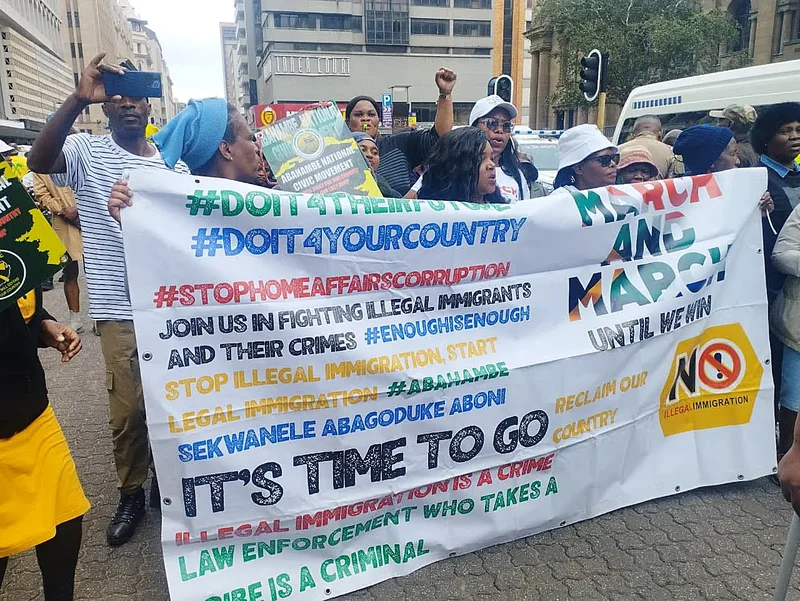
During a debate on xenophobia in South Africa on the “Dr Shola speaks” podcast hosted by Shola Mos-Shogbamimu, the British academic, activist and political commentator, Farai Muvuti, the CEO of the London-based Southern African Times, said: “There is no way that 60% of crime can be committed by 4.5% of the population.
It is a mathematical anomaly. It is impossible. To those who are pushing that number, if you have not done maths go back to school and then make your case.”
Muvuti was responding to a bogus statistic that is often cited by xenophobes to support their ideology of hatred.
South Africa has an excellent statistical agency, despite severe underfunding. Census 2022 found that there were 2.4 million international migrants in South Africa, equivalent to 3.9% of the population. To be clear, these are not estimates for documented international migrants.
Stats SA does not ask international migrants about their legal status in South Africa. Undocumented does not mean that they are not counted. Stats SA knocks on the door of your Congolese neighbour. Its estimates are for documented and undocumented international migrants.
In November 2023, there were 3.1 million international migrants, equivalent to 5.1% of the population, according to a Stats SA report on migration statistics from the 2022/2023 income and expenditure survey (IES).
The United Nations Department of Economic and Social Affairs found that there were 2.6 million international migrants in South Africa in 2024, equivalent to 4.2% of the population.
Using 2025 population estimates, we can conclude that the number of international migrants is between 2.5 million (3.9% of the population) and 3.2 million (5.1% of the population). If we exclude those who are South African citizens – 529 542 in census 2022 and 352 822 in the IES – the number of international migrants is between 1.9 million (3% of the population) and 2.8 million (4.5% of the population).
Only a xenophobe would scapegoat 3% to 4.5% of the population for all South Africa’s problems, including crime. This is not a crisis because the mid-point of these estimates is almost the same as the world average of 3.6%.
According to a paper by the Institute for Security Studies (ISS): “There is no statistical relationship between international migration in South Africa and crime. There is also no evidence that most immigrants commit crimes or are responsible for most crimes in the country.”
The ISS says while the South African Police Service does collect data on the demographics of suspects, this information is not shared publicly and appears to be a closely guarded secret. “In the absence of SAPS data, the next best option is to look at the available data on the nationality of people who are in South African prisons.
“Between 2017 and 15 November 2021, an annual average of 3 599 undocumented foreigners were incarcerated out of a total of 158 329 inmates. This represents an average of 2.3% of the total inmate population, a far smaller percentage than is popularly believed.”
In recent years, there has been a sharp increase in international migrants who are arrested for breaking immigration laws. The flip side has been a surge in deportations to 57 784 in 2025/2026 from 14 859 in 2020/2021.
In a presentation to parliament in February 2025, the department of correctional services said there was a total of 102 444 sentenced offenders on 23 January 2025. This included 12 676 sentenced foreign nationals.
An analysis of prevalent crimes committed by foreign nationals showed that 65.3% (8 281) were for the relatively minor offence of breaking immigration laws.
Correctional services spokesman Singabakho Nxumalo says these offenders typically serve 30 to 90 day sentences, after which they are handed over to home affairs for deportation.
According to the law, this is an offence that is a little more serious than shoplifting. A like-for-like analysis of real criminals shows that there were 4 395 sentenced foreign nationals. This was equivalent to 4.3% of all sentenced offenders. If one excludes those who were breaking immigration laws, this was equivalent to 4.7% of sentenced offenders.
Both estimates are in line with their share of the population. Therefore, their propensity to commit crimes is the same as that of South Africans, who account for 95.3% of sentenced offenders according to the second measure.
There were 89 768 South Africans in prisons. Nxumalo refused to provide a breakdown of the crimes committed by these prisoners. A breakdown of the 4 395 sentenced foreign nationals shows the number that is sentenced for each prevalent crime: immigration law with additional crimes (1 851), murder (705), rape (425), robbery (425), housebreaking and theft (422), theft (281) and robbery aggravating (177).
The hatred of Nigerians by many South Africans is irrational. Census 2022 found that there were 24 718 Nigerians in South Africa, equivalent to 0.04% of the population.
In 2011, the Census showed that there were 26 341 Nigerians in South Africa, equivalent to 0.05% of the population. Based on their share of the population there should be less than 50 sentenced Nigerian offenders in South African prisons serving time for serious crimes.
Nxumalo refused to provide statistics about incarcerated Nigerians and their prevalent crimes. If the xenophobes were really concerned about drugs, they would have marched against South African kingpins such as the Big Five cartel, whose main business is drugs, as Dumisani Khumalo, the head of crime intelligence, told the Madlanga commission.
They would have marched against the taxi bosses who are kingpins in KwaZulu-Natal and distribute drugs from taxi ranks, according to a provincial crime expert that I interviewed.
They would have marched against the Mexican Silanoa cartel, which had drug manufacturing facilities in Limpopo and the North West that were worth R3 billion.
The xenophobes do not really care about crime or drugs: they latch onto any false narrative that advances their ideology of hatred.
South Africa is a violent nation of murderers and has always been one of the crime capitals of the world. In 1995, the homicide rate – the number of murders per 100 000 people – was 60. It declined to 37.5 by 2025 as the number of international migrants increased.
During 2025, there were 23 640 murders, equivalent to 65 a day. If one excludes micro island states, South Africa has the world’s third-highest homicide rate after Jamaica and Ecuador according to the World Bank and it is the last country that can scapegoat international migrants for crime.
Crime is crime.
Progressives should not focus on the nationality, race or ethnic group of criminals. Political opportunists will weaponise the statistics to advance xenophobic, racist and tribalist ideologies.
The proportion of any national, racial or ethnic group within the population of sentenced offenders will be broadly in line with their share of the population.
Duma Gqubule is an advisor on economic development and transformation.