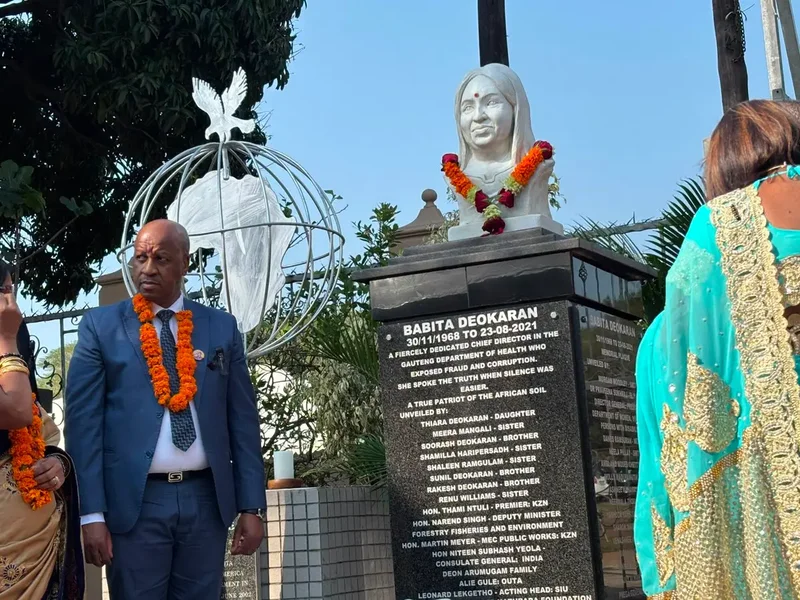
There is something profoundly broken in a country where we build monuments to people who did the right thing while failing to build institutions capable of protecting the next person who does it.
On Sunday, I stood before the monument to Babita Deokaran in Mount Edgecombe and spoke about the uncomfortable truth her death represents. South Africa has become remarkably good at celebrating whistleblowers after they have been killed. We name them heroes, tell their stories, lay wreaths, unveil monuments and promise never to forget.
But the real test of a democracy is not how it remembers the dead. It is how it protects the living.
Deokaran was murdered because she chose integrity over silence. Lieutenant Colonel Frans Mathipa was murdered while doing what we expect a police officer to do — investigate serious crime wherever the evidence leads. They represent different manifestations of the same national tragedy: in South Africa, those who do the right thing can become more vulnerable than those doing wrong.
The latest revelations from the BBC concerning Mathipa's murder should therefore chill every South African who still believes that the state exists to protect them.
The BBC's investigation, based on hundreds of pages of police and court documents, alleges a compelling evidentiary trail implicating members of the Special Forces in Mathipa's murder.
Among the evidence reported are links between vehicles allegedly used to trail Mathipa and a Special Forces front company, as well as tracking and other evidence placing suspects at critical locations. Seven Special Forces members and a military police officer face murder charges. They deny the allegations.
Even more disturbing is what happened afterwards.
According to the BBC, police received an alleged warning that investigators could be killed regardless of how many were assigned to the case. Twelve members of the military were eventually arrested in connection with various charges, including Mathipa's murder and the alleged abduction and murder of two Ethiopian nationals. Some of those accused have remained within the military and one was promoted.
These are allegations that must ultimately be tested in court. But they raise questions that cannot simply be wished away.
And Public Interest SA did not discover these concerns yesterday.
When the Hawks arrested two SANDF members in June 2025 in connection with Mathipa's murder, we applauded the investigators precisely because they appeared willing to follow the evidence into the state itself. Ten further SANDF members subsequently handed themselves over, bringing the total number of accused military personnel to 12. We said then that the case demonstrated the importance of investigators being able to pursue evidence regardless of the institutional stature of suspects.
Then came the extraordinary decision to promote Brigadier General Solly Lechoenyo, an accused person in the matter, to command the Special Forces.
In January, Public Interest SA condemned that decision. We made an important distinction: this was not about presuming guilt. It was about judgement, ethics and preserving institutional integrity while the courts determine the allegations.
In February, together with civil-society organisations, we escalated the matter to President Cyril Ramaphosa, urging urgent precautionary measures.
We warned about the implications for ongoing investigations, witness safety and public confidence in the rule of law.
The question now is brutally simple: What more must happen before those entrusted with the security of the Republic act?
The President cannot outsource constitutional leadership.
The South African Police Service cannot outsource the prevention and investigation of crime.
The National Prosecuting Authority cannot outsource the prosecution of those against whom sufficient evidence exists.
And the state cannot outsource its obligation to protect those who expose wrongdoing or those who investigate it.
Yet this is increasingly what South Africans appear to be witnessing.
Our criminal-justice system is supposed to perform a simple but indispensable chain of functions: prevent crime, investigate crime when prevention fails, prosecute those against whom sufficient evidence exists and secure justice through the courts.
When that chain breaks, impunity flourishes.
When police investigators are threatened or killed, investigations are compromised.
When whistleblowers are intimidated or assassinated, corruption becomes safer.
When accused officials can remain embedded in sensitive institutions, public confidence evaporates.
And when political leadership fails to respond decisively, the message becomes devastatingly clear: the state may be prepared to mourn the victims but it is not necessarily prepared to protect them while they are alive.
That is not merely a policing problem. It is a constitutional crisis.
And it is why the forthcoming Public Interest SA Whistleblowers Awards and Summit matters.
On 26 and 27 October, at Melrose Arch in Johannesburg, we will once again gather to honour people who have had the courage to expose wrongdoing, often at considerable personal and professional risk.
The awards are intended to celebrate courage, integrity and the public value of speaking truth to power.
But there is an uncomfortable irony in celebrating whistleblowers while the conditions that make whistleblowing dangerous remain largely unchanged.
What exactly are we celebrating if the whistleblower must choose between remaining silent and risking their life?
What does an award mean to a family whose loved one was murdered for exposing corruption?
What does a certificate of recognition mean when the state apparatus that should protect a courageous citizen is itself compromised, paralysed or indifferent?
The answer cannot be another ceremony.
The awards must become a reminder — even an indictment — of what the state owes those who place the public interest above their own safety.
We should not need monuments to remind us of the price of integrity.
We should not need awards to persuade the state that whistleblowers matter.
And we certainly should not have to wait until someone is dead before acknowledging that they were right.
Our December 2025 International Anti-Corruption Day statement warned of the assassination of whistleblowers, criminal infiltration of state institutions and persistent failures of accountability.
We called for stronger whistleblower protection, independent prosecutions and an unflinching determination to pursue the powerful and well-connected.
Eight months later, the warning feels less like an advocacy position and more like an indictment of our collective failure.
South Africa cannot continue telling citizens to speak up while quietly accepting that speaking up may make them a target.
We cannot tell police officers to investigate organised crime while failing to ensure that investigators themselves are protected.
We cannot demand ethical public servants while leaving them exposed to the very criminal interests they are expected to confront.
And we cannot celebrate Babita Deokaran's courage on Sunday, honour whistleblowers on another day and then return to business as usual on Monday.
The monument unveiled in her honour carries a profound message. The Whistleblowers Awards carry another. Together they ask the same question: What kind of country are we building for the person who chooses to do the right thing?
Because stone cannot protect a whistleblower. Bronze cannot secure an investigator. Awards cannot prosecute assassins.
Only functioning institutions can do that.
The ultimate tribute to Babita Deokaran, Frans Mathipa and every other fallen defender of integrity is therefore not another statue, another speech or another award.
It is a South Africa in which doing the right thing is no longer a potentially fatal act of courage.
President Ramaphosa, the SAPS and the NPA must reclaim the responsibilities from which they appear, at times, to have all but abdicated.
Prevent crime. Investigate it. Prosecute it. Protect those who expose it. Protect those who investigate it.
And hold accountable those who abuse the power of the state to obstruct justice.
Because a democracy that cannot protect the person who tells the truth — or the investigator who follows that truth — is not merely failing its citizens.
It is teaching them a dangerous lesson: Silence is safer than integrity.
And that is a lesson no constitutional democracy can afford to teach.
Tebogo Khaas is chairperson of Public Interest SA and founder and convenor of the Whistleblowers Awards & Summit .