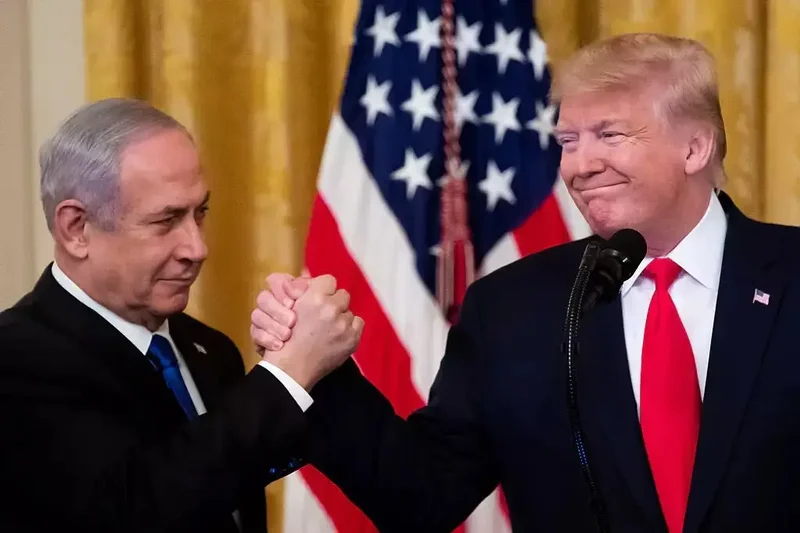
A few days ago, Donald Trump told the world his Board of Peace had struck a historic agreement to disarm Hamas and wind down the war in Gaza.
On Sunday, in front of his cabinet, Benjamin Netanyahu took it apart in one sentence: “Israel rejects the 15-point document.” No pullback, he added, until Hamas surrenders every weapon and no Palestinian state for as long as he holds the job.
That is not a hiccup in the roll-out. It is the president’s signature foreign-policy achievement being contradicted, on camera, by the one man it depended on.
Here is the detail the White House would rather you skip. Hamas said yes. The 15-point roadmap the Board of Peace published on July 31 laid out a phased trade: Hamas hands its weapons to a new Palestinian administration while Israel steps back from the yellow line drawn in last October’s ceasefire.
Hamas agreed to the framework in Cairo. The government that torched it in public was the one Washington arms.
The usual script, in which Israel reaches for peace and Palestinian rejectionists refuse it, runs backward this time and everyone covering the story can see it.
Why would a prime minister spike a deal his patron just called historic? Follow the calendar. Israel votes on October 27, Netanyahu is behind or level in the polls and he governs at the mercy of far-right ministers who treat any withdrawal as surrender. Concede in Gaza and the coalition walks. The coalition walking ends the career.
Alon Pinkas, a former Israeli consul general, put it plainly: the rejection makes sense only in the light of that election. Netanyahu can absorb Trump’s displeasure. He cannot absorb losing his base 90 days before a vote.
He barely disguised it. In the same appearance where he killed the plan, Netanyahu called Trump his greatest friend in the White House. Friendship, apparently, does not extend to doing what the friend asks.
This is where Trump’s whole theory of foreign policy runs into a wall. The pitch has always been that deals get done because he is the one doing them. Leverage, personal chemistry, a signing ceremony, a headline. The formula works on a trade partner who wants a tariff lifted. It fails on a foreign leader for whom saying yes is politically fatal.
No amount of Oval Office warmth changes the arithmetic and Netanyahu, who has outlasted a run of American presidents, knows exactly how much defiance he can get away with.
The rejection landed harder because the mediator had bent his way. Before Sunday, the Board of Peace backed his demand that Israeli forces stay put beyond the yellow line until Hamas is disarmed. Netanyahu got the sequencing he wanted and torpedoed the plan anyway. When a party rejects terms tilted in its favour, the sticking point is not the terms. It is that any deal is inconvenient before an election.
Give the pressure its due. It has done something. Under Washington’s push, Israel quietly scaled back its operations and eased off the near-daily targeted killings and the ceasefire is standing.
American leverage can freeze a war. What Sunday proved is what it cannot do. It cannot buy the political endgame, a real withdrawal and a horizon for statehood, from a man who has staked his survival on refusing exactly that. Trump can extract a pause. He cannot manufacture the decision that ends the war because that decision belongs to a domestic Israeli calculation he does not control and never did.
Underneath all of it sits a contradiction Washington keeps pretending it can finesse. You cannot be the primary arms supplier and the neutral referee at once. Every weapon that underwrites the campaign also underwrites the leader waging it, which is why the peace plan and the war-fighting draw on the same American account. When the referee stocks one team’s armoury, his whistle stops meaning much.
The pattern is not confined to Gaza. The same week he buried the roadmap, Netanyahu was boasting about fresh operations in Lebanon, another front where Washington’s writ turns out to be thinner than its arms shipments imply.
The stakes are not abstract. More than 73 000 Palestinians have been killed since October 2023, by the enclave’s health ministry’s count, including more than 1 200 since the October ceasefire supposedly took hold. Israel holds roughly 70% of the territory.
Every week the endgame slips, the count climbs and the ground under any future Palestinian state shrinks. A framework that treats the numbers as background noise while chasing a photogenic announcement was never built to hold.
There is a version of American policy with more to show for itself. It admits that leverage aimed at freezing violence is not the same as leverage aimed at ending it and that the second kind means conditioning the weapons, not just the applause. It backs the ceasefire’s terms against whichever side breaks them, this week Netanyahu’s government, rather than treating a client’s campaign schedule as a fact of nature. It judges success by whether Palestinians and Israelis are closer to security and self-determination, not by whether a body named for peace managed to issue a document.
None of that means abandoning Israel. It means refusing to let one prime minister’s electoral maths set the ceiling on American diplomacy.
Trump wanted the win. He got a lesson instead. You cannot personality your way past another leader’s survival instinct and you cannot broker a peace while you are financing the war.
The Board of Peace can keep publishing plans. Until Washington is willing to spend its leverage on the outcome rather than the announcement, those plans will keep dying in the drawer and people will keep dying outside it.
Dr Imran Khalid is a columnist and geostrategic analyst.