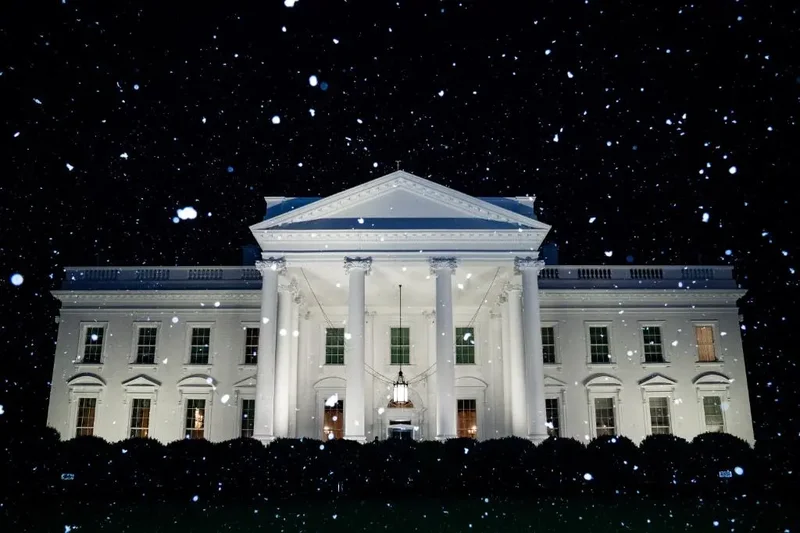
Last week, two judges told President Donald Trump he could not renovate the United States.
A federal appeals court ordered work stopped on Trump’s White House ballroom, ruling that the president did not have the authority to build a 8 400m2 addition without Congress having its say.
The ruling was 2–1. The court gave the administration two weeks before its order takes effect, allowing time for the inevitable appeal to the Supreme Court.
This is not a small extension for an extra bedroom. The ballroom is roughly twice the size of the White House. The plans envisage a grand neoclassical building that seats hundreds of people. The East Wing has been demolished to make way for it.
Trump says America needs the ballroom because our method of entertaining large numbers of distinguished White House visitors involves putting them in a tent, which makes the world’s most powerful nation look like it is hosting a wedding.
The project was originally announced at around $200 million (R3.2 billion). The price has since doubled to roughly $400m. The administration says private donors will pay for it. We all know how true that is.
Trump has also begun presenting the project as a matter of national security, complete with bomb shelters and drone defences. Presumably this means that if America ever comes under attack, several hundred citizens will be able to survive beneath a tasteful dance floor.
The appeals court was unmoved.
“Whether or not a massive ballroom should be constructed is for Congress to decide,” the majority said, “and is not a matter for executive self-help.”
Executive self-help. There could hardly be a better description of the second Trump presidency.
The ballroom issue is not just a ballroom issue. It is part of something much larger and stranger: Donald Trump’s attempt to physically remake Washington — and by reflection, the US — in the image he carries around in his head.
He started small. Within weeks of returning to the White House last year, Trump began redecorating the Oval Office. Gold eagles. Gilded mirrors. Auric ornamentation on the fireplace. White gold flourishes. Little golden cherubs imported from Mar-a-Lago above the doorways. At least it was thematically consistent.
By March 2025, reports were describing an Oval Office meandering into the aesthetic territory of Versailles by way of a Las Vegas casino. Trump was not finished. The gilding continued, spreading across walls, doors and architectural details throughout the building like a bacteria.
There is nothing inherently sinister about a man liking gold. Liberace liked gold and never invaded Greenland.
But aesthetics tell us something. American presidential architecture has traditionally tried to communicate restraint.
Trump reverses the relationship. The institution is the backdrop. The occupant is the attraction. Washington begins to look less like a capital he governs than a property he has acquired.
He replaced the grass at the centre of the Rose Garden with paving, creating a patio more suited to entertaining as he sees it. Enormous flagpoles appeared. Trump ordered classical architecture to become the preferred style for all federal buildings, declaring that public architecture should project grandeur, dignity and civic pride.
And then he decided Washington needed a triumphal arch.
The proposed 80m high Independence Arch would stand near Memorial Bridge between Arlington National Cemetery and the Lincoln Memorial, welcoming people entering Washington from Virginia.
For comparison, the Lincoln Memorial is about 80m tall. Paris’s Arc de Triomphe is 50m. The White House ballroom is only 70m. The “arc de Trump” stands 30m taller than the Statue of Liberty.
The proposed structure would carry the words “One Nation Under God”, be topped by a winged Lady Liberty and guarded by four golden lions, basically extending the White House across the capital.
Federal arts officials approved the design in May, although veterans and others have challenged the project.
The National Park Service said a couple of weeks ago that the arch would block the view between the Lincoln Memorial and Arlington National Cemetery and have an impact on 35 other Washington landmarks.
Construction plans contemplate work taking place up to 20 hours a day, year-round, for three years, with cranes rising as high as 100m, higher than Big Ben’s tip.
And here we arrive at the wonderfully Trumpian problem with building yourself a triumphal arch.
You normally require a triumph.
Rome built them to celebrate victorious emperors and generals. Paris’s Arc de Triomphe honours those who fought for France during the Revolutionary and Napoleonic wars.
Trump’s arch commemorates America’s 250th birthday. I guess it celebrates victory in the Revolutionary War?
The ballroom enlarges the president’s house. The arch enlarges the president’s silhouette across the capital.
There is something more significant going on here than Trump simply imposing his taste on Washington.
Architecture is one of the ways power explains itself.
Kings build palaces. Dictators have generally been fond of enormous plazas, columns and statues, preferably of themselves. The point is not merely to create something beautiful. It is to tell the person standing beneath it who is large and who is small.
Ceauşescu gave Bucharest the Palace of the Parliament, a 365 000m2 colossus now regarded as the heaviest building on Earth. Dictators have long understood something democrats sometimes forget: if you want citizens to understand how powerful you are, you can always tell them. But concrete makes the point more effectively.
The American republic was supposed to work differently. Its great buildings monumentalise the institutions: Congress gets the Capitol. The presidency gets the White House. The individual president gets the keys for a few years and if history is sufficiently impressed, perhaps a monument later.
Washington got an obelisk. Lincoln got his temple. Jefferson got his rotunda. But they had the courtesy to become history first.
Trump appears unwilling to wait. Normally, American presidents have the courtesy to die before turning themselves into tourist attractions. Not Donald Trump.
America invented the presidency partly because it did not want a king. Trump seems determined to give the office the décor it has been missing ever since.
Politics is temporary. Architecture is not. An executive order can be cancelled. A policy can be reversed. An 80m arch remains standing in the landscape, telling people decades later what and who mattered.
That may be the deeper ambition behind all this. Trump is not simply trying to make Washington look like him. He is attempting something more difficult: to make a temporary presidency permanent.
The Kennedy Center offered perhaps the most literal example. Its Trump-controlled board voted to add Trump’s name to the institution, turning the John F Kennedy Center for the Performing Arts into the “Trump Kennedy Center”, until a federal judge ruled in May that only Congress could legally rename it and ordered Trump’s name removed.
Trump acts. Someone eventually arrives holding a copy of the Constitution.
The ballroom ruling therefore matters for reasons far beyond architecture. The judges were essentially reminding the president of a profoundly un-Trumpian principle: this is not yours. It’s the public’s!
Democracy rests upon a simple proposition: power is borrowed. Trump’s instincts run in the opposite direction. He comes from a world of Trump Tower, Trump Plaza, Trump Vodka, Trump Steaks. Now the brand has encountered a country.
If Trump University, then why not Trump America?
It’s important to be clear: presidents have altered the White House many times. Truman practically rebuilt it. But he didn’t refashion it specifically in his own image.
Trump is fascinated by the visible representation of power: marble, enormous flags, gold, arches and gigantic ballrooms.
Everything must communicate magnificence. I suppose we’re lucky he hasn’t tried to put the word “TRUMP” over the entry portico.
The ballroom will eventually be built. Trump has promised to take the case to the Supreme Court and nobody should assume Friday’s decision is the last dance.
But for now the construction has encountered that most irritating feature of democracy: someone else gets a say. Trump’s efforts have been foiled to overcome the one flaw with power: it eventually ends.
Presidents are temporary. But buildings last for centuries.
American democracy was designed around the first fact. Trump appears increasingly interested in the second.
In the Land of the Free, the president is supposed to live in America. America is not supposed to live in him.
Michael Brian Lee is the Mail & Guardian’s US correspondent in New York.