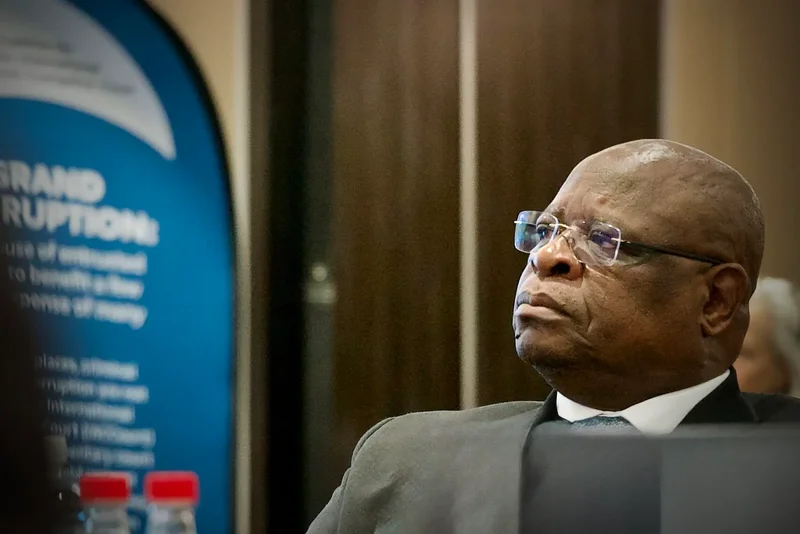
It’s been four years since the Zondo Commission delivered its five-part State Capture report to President Cyril Ramaphosa, implicating close to 1500 people in the looting and capture of South Africa’s state-owned enterprises.
Yet, as former chief justice Raymond Zondo points out, the country still doesn’t have the one institution he says would make the difference between endless commissions and actual accountability: an independent Public Procurement Anti-Corruption Agency (PPACA).
The purpose of such an agency would be to continuously analyse tenders and intervene when it sees suspicious patterns. As envisaged by the Zondo commission, its role would be to detect, investigate, disrupt and pursue procurement corruption. In other words, it would be equipped to detect and disrupt corruption before billions disappear.
A PPACA is not included in the Public Procurement Act 2024, which went in a somewhat different direction, creating a Public Procurement Office within National Treasury, whose functions include promoting compliance, developing measures to maintain procurement integrity, advising procuring institutions, developing standards, monitoring procurement, maintaining supplier information and supporting the procurement system.
Addressing last month’s Integrity as a Competitive Advantage conference, hosted in Sandton by the European Union’s Enhancing Accountability Programme’s Technical Assistance Facility together with the Swiss Chamber of Commerce (Southern Africa chapter) and Good Governance Africa (GGA), Zondo lamented government’s apparent unwillingness to implement his recommendation.
There are also delays: more than two years after the Public Procurement Act was signed into law in July 2024, it has not come into force. Treasury published draft regulations for public comment this year and the consultation period was extended into July. Yet on the government’s official legislation page, the status of the Act remains starkly unchanged: “Commencement: To be proclaimed.”
The Act is also the subject of a constitutional challenge concerning the adequacy of public participation in its enactment, while Parliament is separately considering the Public Procurement Second Amendment Bill, 2026, which would amend several provisions of the Act.
Zondo’s frustration with these delays and the omission of the PPACA was palpable at the conference: “We need leaders who are able to make decisions reasonably quickly. If a corrupt person continues in his position, the message it sends is ‘we don’t care about allegations of corruption, or findings of a commission.’”
A procurement law without a standalone anti-corruption agency behind it sends much the same message, he suggested, being that prevention and detection remain an afterthought, bolted on to a system rather than built into it.
A PPACA type body is not a new demand. Back in 2011, the Constitutional Court ordered Parliament to establish an independent anti-corruption body meeting international “STIRS” standards – specialised, trained, independent, resourced and secure in its tenure.
Instead, South Africa has stitched together the Hawks, the Special Investigating Unit, the Asset Forfeiture Unit and the National Prosecuting Authority (NPA), none of which has the structural independence the court demanded.
The data is sobering even where there has been progress. As of last year, the NPA’s Integrated Task Force was working through 218 criminal investigation recommendations arising from the Zondo Commission, with only about a fifth finalised or enrolled for trial and just over half still under active investigation.
Four state capture-related cases have produced guilty verdicts and the government has recovered close to R11 billion in stolen public funds, a fraction of what was looted and none of it touching the “big matters” Zondo says should have gone to court by now.
Some of that stems from institutional turmoil at the top. Shamila Batohi’s seven years as National Director of Public Prosecutions ended in 2025 amid a string of setbacks – including the collapse of charges against former minister Zizi Kodwa and the NPA’s continued failure to extradite Gupta brothers Atul and Rajesh from the United Arab Emirates, more than three years after their arrest in Dubai.
Her successor, Andy Mothibi, took over while facing both a legal challenge to his own appointment and the same backlog of unresolved state capture matters, though he has pledged to accelerate prosecutions and asset forfeiture.
Whether that ambition translates into courtroom results for cases like the R5.6-billion Prasa/Siyangena scandal (in which contracts were awarded to Siyangena, bypassing normal competitive procurement) – where prosecutors reportedly have a detailed roadmap but no charging decision – will be an early test of his tenure.
Meanwhile, South Africa now has a live demonstration of what urgency looks like. The Madlanga commission, probing corruption and political interference in the criminal justice system, has moved from testimony to arrests in a matter of months, including senior police officers implicated in a R360-million tender scandal. It’s proof that when there’s political will, the machinery of accountability can move quickly.
If the government has been slow to act, the private sector voices at the Integrity conference offered a useful nudge on why it should move faster. Dr Max Burger-Scheidlin of the International Chamber of Commerce (Austria) argued that corruption is corrosive to the corrupt themselves.
Clean money can be invested and enjoyed openly, he said, while criminal proceeds require a lifetime of staying under the radar of local and international authorities.
Karam Singh, who leads GGA’s anti-corruption advocacy, pointed to the absence of adequate monitoring tools, like Corruption Watch’s Procurement Watch system, as a structural gap that lets red flags go unnoticed. And Wayne Duvenage of OUTA made the case that ethics can’t just be a policy statement: King V now requires directors to demonstrate – not merely claim – corruption-free conduct, backed by measurable tools and, he suggested, a public database of suppliers who fail to meet ethical standards.
Zondo added his own suggestion to business: set up whistleblower funds controlled by business itself, not government, precisely because the government’s own track record on follow-through remains the problem.
Four years after the final volume of the State Capture report landed on the president’s desk, the pattern is familiar: commissions produce damning evidence, government commits to reform and the institution capable of enforcing that reform in real time – an independent body built specifically to catch procurement corruption before it metastasises – never quite gets built.
The Madlanga commission shows accountability can move fast when there’s appetite for it. The unfinished Public Procurement Act shows what happens when there isn’t. The question that Zondo’s successors in government need to answer is not whether they agree with him but why, 14 years after the Constitutional Court first ordered it, that agency still doesn’t exist.
Helen Grange is a writer and sub-editor at Good Governance Africa.