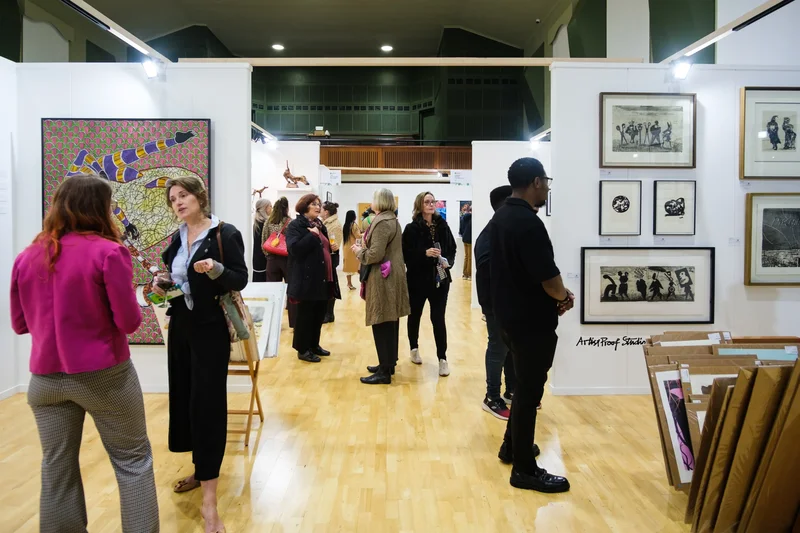
The most revealing thing about the inaugural KZN Art Fair happened before I had even seen the art.
I took a group of students from the Durban University of Technology to the fair. I wanted them there. As crusty as the scene is here, they study art. They should see the things I spend the rest of the year telling them exist: galleries, collectors, artists, dealers, curators, professional networks, the strange machinery through which artworks become cultural objects and, eventually, commodities.
As a member of the press, the fair was happy to allow me complementary access. I suppose they had no idea who I was and expected a fluff piece. Little did they know. I cheekily asked them whether they could allow my students complementary access too. It was a hard no. Not even a group discount. That answer told me almost everything I needed to know about the fair.
Not because R50 is an outrageous amount of money. It isn’t. That is precisely the point. It is small enough for someone with money to dismiss. It is large enough for a student to be excluded. And when you multiply R50 by a department, a generation of potential artists or audiences, the apparently insignificant amount starts looking rather different.
I bought the tickets. Twenty-two of them. Twenty-two students at R50 each. Fifty rand is a lot for them. It could have been the difference between being there and not being there.
I found myself thinking: “Oh. So this is who the new KZN Art Fair is not built for.” It arrives with big language, describing itself as a vehicle for exploring and maintaining an “unexplored frontier” of the South African art market on the east coast. Its promotional material speaks of connecting galleries with talent and new markets, creating sustainable careers for emerging and established artists, retaining talent, sustaining momentum and growing the creative industry in KwaZulu-Natal. It calls itself a historic first. It describes itself as a critical intersection for the province’s “diverse creative communities and contributors”.
Wonderful.
But if that is the mission, then I have a basic question: How do they perceive my students? Simply as customers? As constituents? As future artists? As future curators? As future collectors? Because there is a difference between cultivating an audience and simply charging admission. Cultivating an audience is cultural development. Charging admission is a transaction.
Enough pieces have been written critiquing the art fair as a business model. We all know art fairs are commercial endeavours. In fact, let them be. Artists should be paid. Galleries need to survive. Staff need salaries. Transport, insurance, security, marketing, installation and venue hire all cost money. Nobody serious about the arts should pretend otherwise. But if you are going to be a business, then be a business. Say: “We are here to make money.” There is nothing embarrassing about that. What becomes embarrassing is when the language of commerce gets dressed up as the language of transformation.
After the apparent failure of the Durban Art Fair, staged in the thick of the city, the KZN Art Fair relocated more than an hour away to Hilton College, piggybacking on the established Hilton Arts Festival. Hilton is undeniably beautiful: manicured lawns, impressive facilities and an audience reportedly approaching 25 000. Even en route, East Coast Radio cheerfully advertised the festival. But as I approached, it felt less like entering an art fair than crossing a border: colonial architecture, carefree seclusion and an unmistakably affluent crowd.
There is an obvious practical logic to placing a new art fair inside a cultural event with established infrastructure, traffic and visibility. I wouldn’t dream of arguing that the fair should not be at Hilton. But location is never merely location in South Africa. Hilton is not a neutral white box floating above history. Let’s be honest, it is quite white.
It is a private school environment in the KwaZulu-Natal Midlands. It carries a particular social geography and a particular relationship to wealth, education and privilege. That does not make the school bad. It makes the location meaningful. If you are going to build a new art market there, you cannot simultaneously pretend that geography has nothing to do with access.
At the ticket desk, I heard a rather posh older white woman ask the price, then exclaim at the R180 full ticket: “What a bargain!” Indeed.
Yet despite the conspicuous wealth on show, I heard persistent rumblings that sales were slow. I asked award-winning photographer Cedric Nunn, who offered a dark reading: “It’s a true reflection of where we are. Where we are in Hilton and where we are in South Africa. One of the reasons they’re not buying is they are shitting themselves because they can see that the wealth they’ve created is disappearing before their eyes … They are busy trying to make sense of the madness. The madness they created.”
The fair had an education programme. It had talks, panel discussions, workshops, book launches and opportunities for discourse. Education is explicitly part of the proposition. That makes university students rather important. Yet the students I brought were not treated as people in whom they might want to invest. They were treated as paying customers. Just show up with R50. Consume. Leave.
Another industry colleague who prefers to go unnamed, said R50 was “nothing” to students at Hilton. I’m sure it isn’t. Perhaps it is nothing to some students. But the assumption is precisely the problem. South Africa is one of the most unequal societies in the world. A private-school student in the Midlands and a public-university student arriving from a township or rural community do not inhabit the same economic reality. The difference between them is not solved by putting “student” on the ticket category. Student is not a socioeconomic class. There are students who can spend R50 without thinking. There are students who cannot.
I do not think the KZN Art Fair is uniquely bad; that would far be too easy. It is doing what commercial art fairs do. I was pleased to encounter bangers like Kentridge and Pierneef, big names such as Candice Berman Gallery and Strauss & Co and artists and galleries new to my students. I spoke to Mzoxolo Vimba, the founder and curator at Studio Sunday Best, which he described as “a collaboration network that deals with bridging access gaps for young artists, specifically those who are unsigned”. Definitely some promise.
But overall, it was two thinly dressed exhibition halls of mostly mediocre art — hardly a revelation. If anything, the fair has jumped the gun: before making its mark, it has said the quiet part out loud. Its crude objective appears to be money. That is fine. I want KZN’s art economy to become robust enough that artists no longer have to leave the province for serious opportunities. But economic growth is not the same thing as cultural transformation. South Africa has demonstrated that repeatedly.
The irony is that the KZN Art Fair does not need to be less commercial to become more inclusive. It needs to become more imaginative. If it can imagine a new market, it can imagine new audiences. If it can imagine sustainable careers, it can imagine sustainable access. If it can imagine international recognition, it can imagine provincial accountability. And if it can imagine KZN as an “unexplored frontier” for capital, it can perhaps even imagine the people living here as more than just paying customers.
This is where the fair’s real opportunity lies. Not in proving that KZN can imitate Johannesburg or Cape Town. Not in creating a smaller version of the international art-fair machine and hoping that money follows. The opportunity is to build something that responds creatively to KwaZulu-Natal.
Yes, I went to the KZN Art Fair. And yes, there were conversations worth having. There is clearly talent in KZN. There is clearly energy. There is clearly an appetite for a stronger visual-art economy. I am not interested in pretending otherwise because I am critical of commerce. The fair has potential. But a decent first fair is not automatically an exciting cultural opportunity. The test will be what happens next.
Will the fair hold itself accountable to the people whose cultural economy it claims to be building? Or will it become another annual occasion at which people with money meet people who make things for money? Because if the latter is the model, then I have no objection.
Just call it what it is.