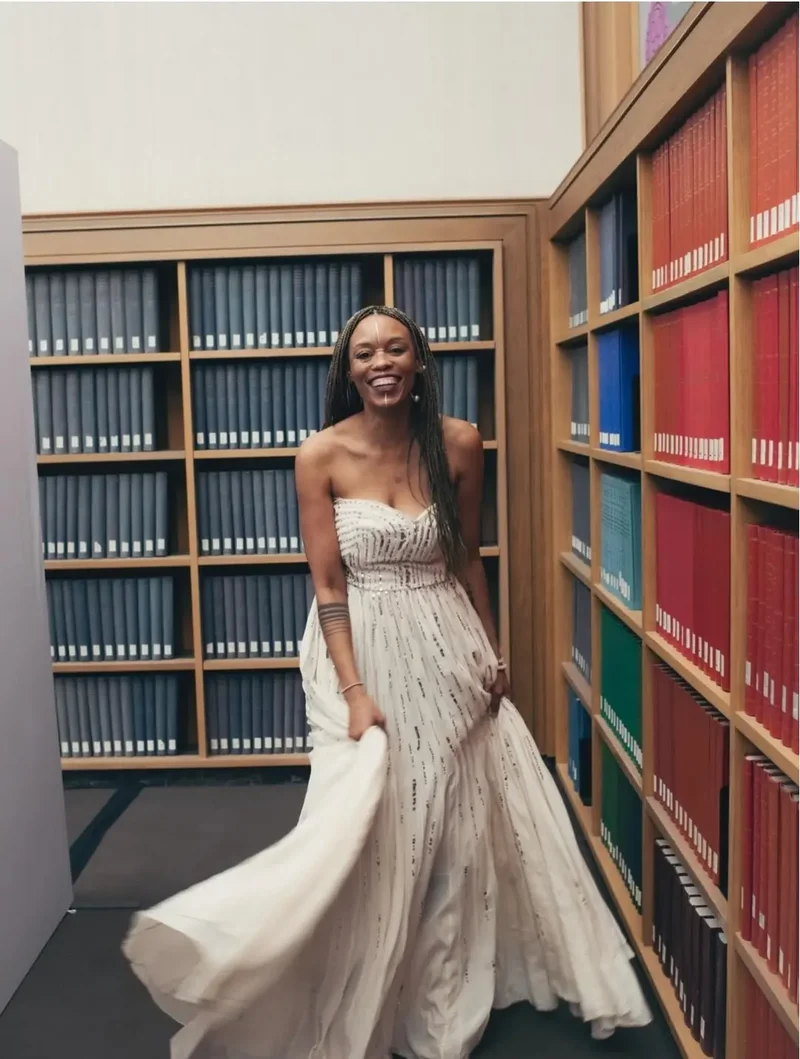
The devastating impact of apartheid on families, particularly black women, is a theme Kagiso Lesego Molope explores throughout her work. Her latest novel, We Inherit the Fire, continues the exploration.
The South African-Canadian novelist and playwright’s work resurrects memory, restores hope and reminds readers that even in the face of adversity, a people can rebuild again.
“I write apartheid not only to document the past but to ask questions that are relevant to today. That forces us to decide how we want our future to look,” Molope says during our interview.
One of the most anticipated feminist books of 2026, We Inherit the Fire examines the complex relationships of daughters and mothers amid a shifting political landscape.
Set in late-1980s South Africa, the novel follows teenage Kelelo’s complex relationship with her mother Kewame “Dolly” Malaka, a celebrated freedom fighter. While the community see her as a symbol of progress, Kewame is emotionally unreachable, haunted by the violence and deprivation she endured as a political prisoner under apartheid.
Kewane’s story is relatable to many of the 20 000 or so women who marched to the Union Buildings in Pretoria in 1956 to protest against apartheid pass laws, some of whom were incarcerated.
It’s a story of the insecurities and inadequacies of motherhood and wifedom in the face of unresolved traumas. It also speaks to the many black families battling with generational trauma, hidden histories and the responsibility to find healing.
As our interview progressed, I was reminded of the first time I was introduced to Molope’s work. I discovered The Mending Season (2005) at a library during my high school days in Pretoria and I was intrigued by how she wrote about my surroundings with clarity and curiosity. Apart from that novel, Molope has also written Dancing in the Dust (2002), This Book Betrays My Brother (2012) and Such a Lonely, Lovely Road (2018).
Born and raised in South Africa, Molope graduated from the University of Cape Town and moved to Canada at age 21. She obtained her master’s degree in English literature from Carleton University in Canada.
I had the wonderful opportunity to catch up with Molope during her book tour, to learn more about her latest novel, her life in Canada and her views on her legacy.
**No Child’s Play (1988) by South African activist Mme Caesarina Kona, served as inspiration for your latest novel. What else inspired you to pen the project? **
Molope: I hadn’t intended to write about a former political prisoner. In fact, I had submitted a first draft of a collection of short stories to my publisher. They had asked me to rewrite and resubmit. In that time, I visited Constitutional Court in Johannesburg and walked through the old prison. I had been reading Mme Kona’s book anyway. From there, from my experience of being in the old prison, the character of Kewame just came to me.
Your novel stretches between four generations of women, with themes of motherhood, marriage and trauma. What makes the latest offering different from your previous novels?
My first few novels were Young Adult (YA) because for a long time I was concerned with the experiences of young people under apartheid. The thing that makes this a departure from my previous work is that you have a mother and wife. It’s different in that yes, I’m still exploring the experiences of young black women in South Africa but this time it’s with the question: What happens when trauma follows you into adulthood? Into a world where you’re now having to come to terms with, having grown up scarred by apartheid?
**You have written several powerful books. Which one was the most challenging to write regarding the subject matter? **
Probably This Book Betrays My Brother. I struggled with making it challenging. I hate being didactic. I want my work to ask questions and I want the reader to be an active participant. This Book Betrays My Brother was a challenge because I didn’t want the book to immediately pass judgement and give easy answers. I wanted the reader to earn the conclusion, to work for it, which means, of course, that as a writer, I had to earn it too.
Which book remains your most cherished?
Oh, I cherish them all. They are all my babies!
**You moved to Canada in your early 20s. How has being in a foreign country influenced your writing about South Africa over the years? **
Distance is important. I see South Africa from afar and it allows me a clarity I couldn’t possibly afford if I were in the country, if I were that close to it.
When you take a step back, you can see your country from many different angles. It makes me a better writer. I don’t feel I have to defend one particular thing. I can see many different people’s perspectives.
**As an author, you have won numerous awards in Canada. How did you overcome the challenge of finding your place as a migrant writer? **
My heart is always in South Africa, meaning I have a solid base. I know where I belong. I don’t fight to belong in Canada. I create from an authentic place as I believe the best literature comes from authenticity.
If I had concerned myself with what being a migrant writer looks like, I might have sought to conform to a certain set of rules. If I had been conscious of not being Canadian, I might’ve given the reader something forced and lacking in authenticity. In short, I just remained true to myself and my roots.
**What lessons can South Africa learn from the Canadian literary scene to improve the reading culture? **
It’s the Canadian literary scene that needs to learn from South Africa. We use colonial measuring tools for literature. We say: “If you can read and write, then you qualify as literate.” But I come from a centuries-old tradition of storytelling.
I love that view, however, research shows that South Africa’s reading culture is in crisis, with data showing that 80% of grade 3 learners cannot read for meaning for instance.
The statistics on reading in South Africa are telling one story only. They are telling the story of what colonialism has or hasn’t achieved in colonising minds. I would bet that most people who are questioned on their literacy are excellent at oral literature (orature) and can run circles around people who read the written word.
This is why I am who I am as a writer. I draw from stories I was told by people who were considered illiterate but who taught me more about storytelling, about being a writer, than anyone else has. That any book ever has.
**Across Southern Africa and in parts of Europe, your works are read in schools in several languages. Is this the legacy you always wished to leave? **
It’s hard for an author to think about what they want their legacy to be as they’re writing, so it’s not what was on my mind when I wrote The Mending Season for instance.
However, now we’re doing this interview in dark times and we all have to think of what we leave, even those of us who are not writing.
**Fair enough. If you were to put your legacy in one sentence, what would that be? **
I’d like my legacy to be that I spoke honestly about the times we live in. That I rose to meet the moment when that was what was required of me.