Where we are from, it is easy to watch your dreams slip through your fingers. Not because we do not dream big enough or believe in ourselves enough but because of how stifling the environment can be.
For Mbalenhle Mkhatshwa, the founder of Mballet Dance Academy, the answer to the stifling environment was not to escape it. It was to build something inside it.
From her grandmother’s backyard in Tembisa, Mkhatshwa has created a ballet academy that is giving children an opportunity she once lost herself: the chance to dance.
“I started dancing when I was five years old,” she says. At the time, ballet was an innocent love she wanted to explore. With her mother’s support, she was able to join a ballet class and began falling deeper in love with the art form.
But that love was interrupted by something familiar to many young people growing up in townships: money.
“My love for it developed even more when the opportunity for me to dance was basically taken away because of the financial constraints at home,” she says.
Yet ballet did not disappear from her life. It followed her into the streets of Tembisa.
While other children dropped their schoolbags and headed outside to play, Mkhatshwa turned the streets into an imaginary dance studio. She would pretend to be a ballet teacher, teaching her peers what she understood of the discipline.
“We would just pretend we were in a ballet class,” she recalls.
What might have looked like childhood play was, in hindsight, an early indication of what was to come.
As she grew older, her fascination with ballet became more serious. In high school, she started a ballet initiative. Her principal recognised her commitment and helped sign her up for ballet classes.
She has not stopped dancing since.
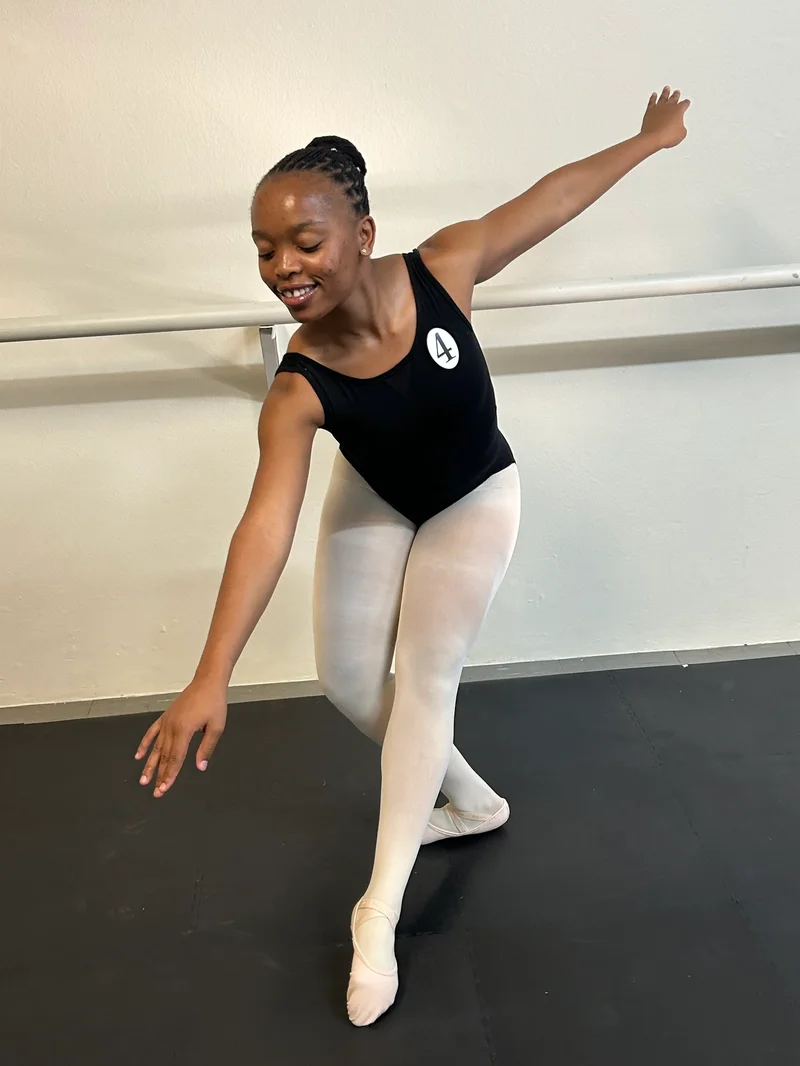
Now, at 20, Mkhatshwa is a dancer and the founder of an academy that is challenging the perception of where ballet belongs and who gets to participate in it.
Mballet is based in Tembisa and was deliberately established there.
For Mkhatshwa, location is not a limitation — it is the point.
“I wanted it to be accessible to the children in and around Tembisa,” she says. “I feel like if eight-year-old me, who stopped dancing because of finances of getting to a ballet class, didn’t stop, maybe my whole life trajectory would have been a whole different story.”
That question of what might have been possible if access had not been the obstacle sits at the heart of Mballet.
For a child living in Tembisa, travelling to Centurion or Sandton for regular ballet classes can be expensive, time-consuming and difficult to sustain.
And ballet, Mkhatshwa points out, requires commitment.
“You need to be committed, you need to go to all your ballet classes in order for you to see the results,” she says.
“There is no ballet studio in Tembisa besides Mballet right now,” she says. “That was my biggest ‘why’. Why would you introduce something that’s already somewhere else? It needed to find a space there in Tembisa as well.”
The academy’s beginnings were as unconventional as its mission.
When Mkhatshwa turned 18, her parents bought her a car. But without a permanent facility for the academy, she found herself driving around looking for spaces where she could teach.
Then came a decision that could easily have been interpreted as sacrificing a dream for another dream: the car was sold.
The money helped Mkhatshwa and her family build a functioning dance studio and changing room in her grandmother’s backyard.
“I thought … it wasn’t reasonable that I was driving around looking for a place to teach in and around Tembisa, whereas I could have the place in the comfort of my grandmother’s backyard,” she says.
The decision came before she even had students.
“Maybe many people would have given up on the dream. I didn’t even have students at that time,” she says. “I was just building on what I knew my heart wanted and what I stood for.”
Her conviction was simple: even if only 10 children eventually walked through the doors, there would be a place for them.
That determination has been tested repeatedly.
One of the challenges has been convincing people that ballet is for them.
When Mballet started, Mkhatshwa says, there was curiosity but also scepticism.
“Many people would make comments such as: ‘This is not for our kids. Why would you even want to do this?’” she says.
But attitudes have begun to change.
As the academy has received publicity and its young dancers have demonstrated their commitment, parents have become more trusting. Some are enrolling children as young as three, understanding that becoming a dancer is not an overnight process.
“They just want to invest in them becoming ballerinas over time,” Mkhatshwa says.
The community, too, has begun to embrace the academy. Residents help keep the area around the studio clean and contribute to creating a safer environment for the children.
It is a small but significant transformation: a ballet studio in a township becoming a community project.
But Mkhatshwa’s ambitions extend beyond simply teaching children how to dance.
She wants Mballet to become a professional dance company — one that can take young dancers from Tembisa to stages across South Africa and eventually the world.
“I’m seeing ballet as a dance company that gives more than just the opportunity of dancing in a township. It’s a platform where young dancers can become professionals and they can have opportunities in and around the world,” she says.
Her ambition is beginning to materialise.
Recently, some of Mballet’s dancers competed at the South African International Ballet Competition. For one student, the experience resulted in three scholarship opportunities.
It should have been a straightforward moment of celebration. Instead, it highlighted another reality facing young dancers from under-resourced communities: opportunity can arrive before you have the money to take it.
“We are seeking assistance because we need to get this child out,” Mkhatshwa says. “She’s worked hard, she’s showed her capabilities through the studio and now we need to just find a way to make sure that we get her to go and pursue her dreams.”
Funding remains one of the academy’s biggest challenges.
Yet Mkhatshwa speaks about the obstacles without sounding defeated. There is a practicality to her optimism. Problems, she says, are things to be worked around.
“I don’t think there’s any problem that’s going to come our way that we can’t work around here,” she says.
Perhaps her resilience comes from understanding what it means to have an opportunity disappear.
Mkhatshwa could have left Tembisa and pursued ballet elsewhere. She could have taken the opportunities that came her way and never looked back.
Instead, she chose to return.
“I firmly believe that in order to be successful, you need to help out other people,” she says.
For her, ballet is more than an art form. It is a language of possibility.
“A lot of potential is wasted on young children because of their background,” she says. “And I didn’t want that to be a limiting factor for anyone.”
Her vision is collective. If she makes it out, she does not want to make it out alone.
“If I was going to make it out of the township somewhere or another through dance, I knew that I didn’t want to be alone,” she says. “I knew that I wanted to have an impact on other children.”
There is urgency in the belief, too — ballet careers can be short, particularly for professional dancers. Mkhatshwa understands that opportunities cannot always be postponed until some imagined future when circumstances are perfect.
“I don’t think there is a later for me,” she says. “My time is now to be building ballet. And later, ballet would have been built.”
That may be the most powerful thing about Mballet. It is not waiting for the perfect studio, the perfect funding, the perfect neighbourhood or the perfect circumstances.
It began in a backyard because that was what was available. It grew because a young woman refused to let the limitations of her surroundings become the limits of her imagination.
And now, children who might never have seen themselves in ballet are beginning to see a different version of themselves.
For the girl watching from the sidelines, Mkhatshwa has one message: do not allow your surroundings to determine your destination.
“We don’t need a perfect background,” she says. “Just like you said, we’re basically a garden in a concrete place. We don’t need to be from perfect backgrounds to ensure that we build ourselves something that is worth or meaningful to us.”
It is an apt description of what she has created.
In a place where dreams can so easily be narrowed by circumstance, a garden has taken root in concrete.
And Mkhatshwa is inviting a generation of young dancers to step into it, take up their space and imagine beyond the borders of where they come from.
“Tell that little girl to take up her space and see what it is that they want to become,” she says. “And it shouldn’t really matter where they come from.”