Can one speaker really replace a hi-fi system? We test five premium models
Bang & Olufsen, Bowers & Wilkins, Devialet, Naim and Sonus Faber take different approaches to the all-in-one speaker – from discreet furniture piece to unapologetic showstopper.
There was a time when a decent hi-fi meant a rack of separates, a thicket of cables and a room built around the equipment. That era is disappearing. The systems reviewed here belong to a newer category: furniture that happens to make sound. Each was designed by people who clearly spend as much time thinking about oak veneer and woven cloth as they do about drivers and amplifiers.
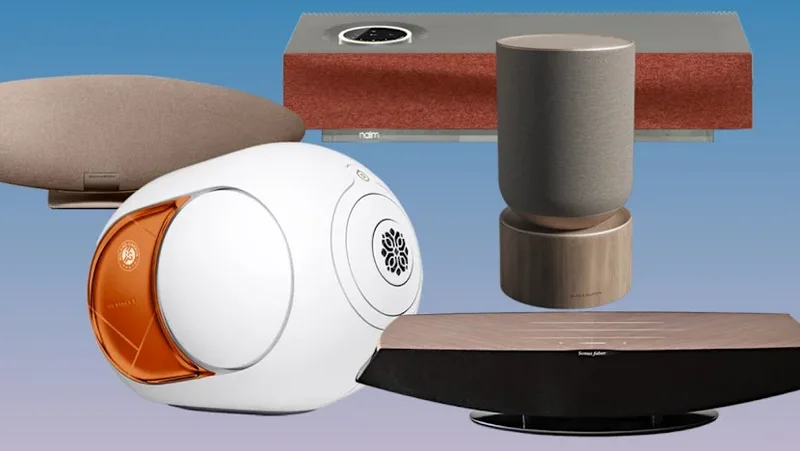
We put five of them through their paces with a single, deliberately eclectic playlist: Beethoven’s Moonlight Sonata, the overture to Mozart’s The Marriage of Figaro, Dave Brubeck’s Take Five, Snarky Puppy’s Lingus, BTS’s Butter, Billie Eilish’s Birds of a Feather, Guns N’ Roses’ November Rain, Michael Jackson’s She’s Out of My Life, Bonnie Tyler’s Total Eclipse of the Heart and Queen’s Somebody to Love. The five single-speaker systems were Bang & Olufsen’s Beosound Balance, Bowers & Wilkins’ Zeppelin Pro Edition, Naim’s Mu-so 2nd Generation, Sonus Faber’s Omnia and Devialet’s Phantom I 108 dB in its Roland-Garros edition.
The objective was not simply to identify the best speaker, but to understand how each shapes both the music and the room it inhabits.
BANG & OLUFSEN BEOSOUND BALANCE
B&O has spent the best part of a century learning how to make electronics disappear into a room, and the Balance is that education paying off. A timber base, a textile-wrapped body, nothing that shouts. Set it on a stone console or Scandinavian-style shelving and it simply belongs.
The sound follows the same instinct: unhurried, generous and more interested in filling a room evenly than throwing detail at the listener. Mozart’s overture arrives with warmth. The Moonlight Sonata has rounded, forgiving bass that gives the piano heft without tipping into muddiness. This is a speaker for rooms where music is part of the atmosphere.
It does jazz especially well. Paul Desmond’s saxophone on Take Five has a burnished, woody tone, while the cymbals fade gracefully. Lingus stays open and spacious even as Snarky Puppy pile on the layers, with the attack of Cory Henry’s organ solo softened at the edges. Pop fares just as well: Butter sounds polished, while Eilish’s close-miked vocal sits comfortably over tactile bass.
Rock is where the Balance’s generosity really shows. November Rain gains scale and warmth, while Somebody to Love becomes a wash of harmony rather than a study in studio separation. Michael Jackson’s She’s Out of My Life is among its finest moments: voice and electric piano rendered with real proportion, nothing oversold.
Anyone chasing forensic detail or nightclub bass should look elsewhere. For sheer ease of coexistence with a considered interior, few speakers manage it as well.
Suits open-plan living rooms with more Le Klint than LED. Less suited to anyone hoping to hear the click of a plectrum.
BOWERS & WILKINS ZEPPELIN PRO EDITION
Nearly two decades on from the original iPod dock, the Zeppelin’s elongated silhouette remains one of the most recognisable shapes in consumer audio. It still photographs beautifully on a media console. This is a speaker built for people who care about how it sounds from directly in front and how it fits into their home.
The Zeppelin favours precision. Titanium-dome tweeters bring real sparkle to the top end, and the Moonlight Sonata has a clarity that borders on forensic. The trade-off is a narrower sweet spot: sit off-axis and the soundstage collapses somewhat.
This is a speaker that likes to show its workings. Take Five delivers crisp snare hits and beautifully resolved cymbal decay. Lingus holds its composure through a genuinely demanding arrangement. Electronic and pop tracks benefit from tight, disciplined bass, giving Butter an agile, rhythmic quality.
Vocals are its strong suit. Eilish’s layered harmonies are placed with near-surgical precision, and Michael Jackson’s inflections come through with something close to studio-monitor accuracy. Somebody to Love cleanly separates Freddie Mercury’s lead from the choir behind him.
The limits appear with scale. Big orchestral passages and bass-forward productions expose the cabinet’s limits. For anyone who values imaging and articulation, this remains a serious performer and arguably the most “hi-fi” object in the group.
Suits the listener who sits rather than potters, though it works perfectly well as a background speaker too.
DEVIALET PHANTOM I 108 DB ROLAND GARROS EDITION
This is design provocation dressed as a speaker: futuristic, spherical and entirely uninterested in blending in. You’d recognise it even if you couldn’t pronounce its name. It asks the room to make space for it and, in this Roland-Garros edition, does so in clay-court orange, seemingly built to be photographed, discussed and probably tagged on a design blog.
What’s more surprising is how disciplined it sounds once the volume comes up. Bass arrives with real authority, reaching into registers most one-box systems don’t attempt, while Mozart’s overture stays composed even through thunderous timpani. The Moonlight Sonata emerges from an unusually black silence, each note left to hang before fading.
Contemporary and electronic material is its natural territory. Lingus fills the room with scale while keeping the keyboard textures intact. Butter gains real physical drive, while Eilish’s Birds of a Feather pairs its ethereal vocal with bass you can feel through the floor. This is a speaker built for the streaming era. Rock turns appropriately monumental. November Rain takes on arena proportions, though the densest passages can feel congested at higher volumes. Bonnie Tyler’s Total Eclipse of the Heart tips into theatre, trading some refinement for outright drama.
The Phantom would want a big room to match its personality, with polished concrete or exposed brick for company. Put it in a small flat and both its looks and low end will fight the walls. Suits loft conversions and people who enjoy being asked what that is.
NAIM MU-SO 2ND GENERATION
This is the handsome box for media rooms, open-plan living spaces and homes where music, television and weekend entertaining share the same furniture. An understated aluminium chassis, an illuminated volume dial, nothing that asks for attention. This is a speaker designed to be used every day.
Its defining trait is momentum. Classical material has proper orchestral weight without losing coherence. Take Five is a lesson in timing, the double bass anchoring that famously odd time signature with real calm. Lingus gains an energetic, almost live-performance feel.
Modern productions suit it just as well. Butter combines firm bass with clearly articulated vocals, revealing production detail that some rivals gloss over. Eilish’s fragile vocal stays firmly centred even as the low end builds substance beneath it.
Rock is arguably its best genre. November Rain builds toward its climax with real conviction, and Somebody to Love balances choral grandeur against rhythmic drive. She’s Out of My Life gains an intimacy that never tips into sentimentality.
It will not win a design contest against the Balance, nor will it turn heads like the Phantom. But as an all-rounder – the speaker most people would actually want on most days – it is hard to beat. Suits people who want one speaker for everything and few regrets.
SONUS FABER OMNIA
Sonus Faber has built its reputation on Italian cabinetmaking as much as acoustics, and the Omnia, wrapped in walnut and woven fabric, is the most tactile object in this lineup. It looks like something a furniture maker built on commission because, in spirit, it was.
Its sound follows suit. The strings in Mozart’s overture flow naturally. The Moonlight Sonata captures the physical sensation of felt hammer on wire with real intimacy. This is a speaker interested in texture rather than technical fireworks, and it delivers plenty.
Jazz is where it feels most at home. Take Five sounds relaxed and unforced, with a burnished sax tone and cymbals that decay gently into nothing. Lingus trades some transient snap for tonal richness, losing a little edge and gaining plenty of warmth.
The same character suits contemporary material surprisingly well. Butter is smooth rather than punchy. Eilish’s vocal floats above lush instrumentation. November Rain takes on a cinematic warmth that lets Slash’s guitar line sing.
Its finest moments are the emotionally direct ones. Michael Jackson’s vocal on She’s Out of My Life feels genuinely human, and Queen’s stacked harmonies gain richness without turning to mush. It is less convincing with aggressive electronic music or metal, where a bit more bite would help.
For listeners whose digital libraries lean toward jazz, classical, and classic rock, this is arguably the most naturally musical speaker in the group. Suits vinyl collectors who have reluctantly gone digital. Less suited to the club-music crowd.
CAN THEY GO STEREO?
Each of these was conceived as a single object, but a pair is worth considering in a larger room. The Devialet makes the strongest case: two Phantoms run as dedicated left and right channels turn an already capable speaker into something close to a conventional hi-fi system. The Beosound Balance also rewards pairing, gaining dimensionality and low-end authority suited to bigger, open-plan spaces.
The other three are best left as they are. Their wide cabinets and internal processing already do a convincing job of creating a stereo image from a single footprint. Adding a second unit mostly adds cost and clutter.
THE FINAL NOTE
What stands out after living with all five is how little any of them ask you to compromise. A decade ago, a design-led speaker usually came with an apology for the sound. Those days are behind us.
The Beosound Balance is the interior designer’s pick: warm, forgiving and built to vanish into a considered room. The Zeppelin Pro Edition rewards close listening with real precision, at the cost of a narrower sweet spot. It could occupy pride of place or sit unobtrusively on a side table. The Phantom I is the unashamed showpiece, pairing extraordinary bass with unmistakable visual presence and best suited to a room with the scale to match its ambition. The Mu-so 2nd Generation is the sensible, versatile choice – the one most people would recommend to a friend without knowing much about their taste. The Omnia is the romantic of the group, favouring craft and warmth over spectacle.
The best one-box speaker, in the end, is the one whose character complements both your music collection and the home it lives in. The finest examples earn their keep by becoming part of everyday life: objects as satisfying to live with as they are to listen to.