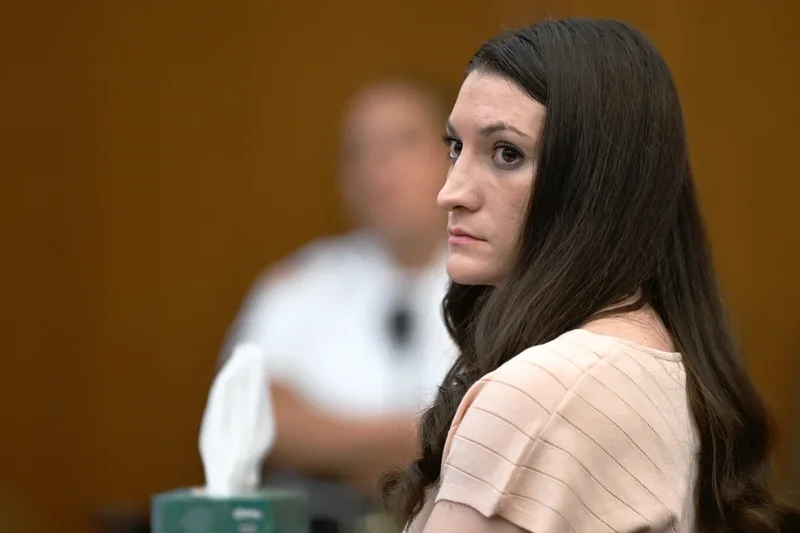
As testimony continues in the Massachusetts murder trial of Lindsay Clancy, social media is divided. Some call for maximum punishment for a calculated crime, while others argue the former nurse was trapped in a devastating psychiatric crisis.
Clancy, 36, a former labor and delivery nurse from Duxbury, Massachusetts, is charged with first-degree murder in the January 2023 deaths of her three children: 5-year-old Cora, 3-year-old Dawson and 8-month-old Callan. Prosecutors allege she acted deliberately, sending her then-husband, Patrick Clancy, on an errand before using exercise bands to strangle the children in the family’s basement.
The case has ignited arguments on social media over whether the killings were a tragic result of severe psychiatric illness or a calculated act demanding maximum legal retribution.
“When you murder a child -- let alone three children, your children -- you must be punished to the fullest extent of the law,” conservative commentator Matt Walsh posted on X. “Justice demands nothing less. My sympathy for your depression dries up completely the moment you strangle your child to death.”
Defense attorneys do not dispute that Clancy killed the children, but contend she was in the grip of postpartum psychosis and severe medication-induced mental deterioration, rendering her lacking criminal responsibility. Clancy, who remains paralyzed from the waist down after jumping from a second-story window in an attempted suicide that same evening, claims a voice commanded her to kill the children and herself.
In court, Duxbury Police Officers Stephen Hall and Brian Josephine testified regarding the scene on the night of the killings, recounting how Patrick Clancy screamed for help after finding his children in the basement. Patrick Clancy, who previously said in interviews that he’d forgiven his ex-wife and viewed her as ill rather than evil, testified earlier in the week about her deteriorating mental state before prosecutors played his emotional 911 recording for jurors.
But while jurors evaluate medical records and testimony, online platforms have become a primary arena for debate surrounding the case.
Walsh later expanded on his position during an episode of his show, asserting that the insanity defense is “nonsensical” and arguing it is applied unevenly, claiming women are more likely to benefit from it.
The comments drew pushback online, including from user Ren (@ElleRen7), who questioned Walsh's standing to comment on postpartum conditions.
“This woman hater is OBSESSED with this case,” Ren wrote. “Despite not being a woman, having never given birth, never been postpartum.”
Walsh responded directly, calling critics “morally deranged” for defending a person accused of child murder.
The commentary has also prompted responses from medical professionals seeking to separate emotional reactions from legal proceedings.
Dr. Sanil Rege, a psychiatrist, cautioned against conflating public moral judgment with a medical and legal evaluation. Rege noted that criminal responsibility is not determined by public outrage, but by evidence analyzed through distinct lenses, including the phenomenology of illness, quality of psychiatric care, systemic context and legal standards of causation.
Others online highlighted Clancy’s prior efforts to seek treatment. Jo Kaur (@SikhFeminist) cited emails in which Clancy expressed gratitude for her family and hope to overcome postpartum anxiety, writing that these were “not the writings of a monster.”
Trial observer Brandi Churchwell noted that prosecution witnesses had testified to Clancy being a loving mother who actively sought help.
“She checked herself into hospitals, went to the ER, reported the intrusive thoughts, and when she started to spiral, she even called crisis hotlines,” Churchwell wrote on X, questioning arguments that Clancy acted out of pure malice rather than complex mental illness.
But critical voices online insist Clancy acted with calculation. X user Shiloh (@ShilohxxJulia) posted that Clancy was “calculated” rather than psychotic, pointing to her preparation, the timing of the errand and reports of her asking for legal representation after waking in the hospital.
The case has also gained significant momentum on TikTok, where viral videos range from vocal support to alternative theories regarding the events of January 24, 2023.
Users on the platform have posted videos with captions declaring “You'll never make me hate Lindsay Clancy” and “I wanna become a lawyer to defend women like Lindsay Clancy,” while others contend she is “about to be jailed for life for something her husband did.”
Some have put forward theories questioning Patrick Clancy’s timeline. TikTok user Elle Marino posted a video outlining what she described as inconsistencies in the timeline, pointing to changes in attire between errand stops, alleged Wi-Fi outages affecting 911 calls and security cameras, and questions regarding how first responders described Clancy’s condition upon arrival.
If convicted of first-degree murder, Clancy faces a mandatory sentence of life in prison without parole. If found not guilty by reason of lack of criminal responsibility, she would be committed to a state psychiatric facility.