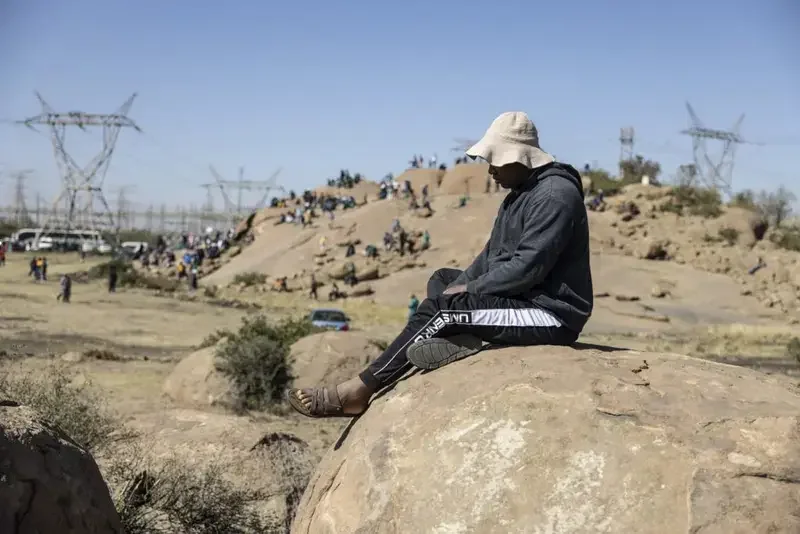
Fourteen years after 34 mineworkers were killed by police at Marikana, families are still waiting for accountability, while the National Union of Mineworkers (NUM) says the deaths and violence that preceded the massacre have also been overlooked.
The Socio-Economic Rights Institute of South Africa (Seri), which represents the families of the 34 mineworkers killed during the August 2012 violence, said there had been no successful prosecutions arising from the police shootings.
Seri attorney Thato Masiangoako said it was “quite appalling” that 14 years after the killings, there had been no successful prosecutions.
“All nine police officers who were initially charged have all been acquitted. There has been a failure to make progress. It is hard to understand how something of this magnitude after the Soweto unrest in 1976 has become a gross miscarriage of justice,” she said.
Masiangoako said it was unclear which recommendations of the Farlam Commission of Inquiry had been implemented, although she pointed to changes in the South African Police Service’s approach to public protests since the Marikana shootings.
She said the state had the primary responsibility for pursuing criminal prosecutions, while Seri’s role was to represent the families in their pursuit of justice.
Advocate Dali Mpofu SC, who has represented some of the Marikana families, said the state had failed to secure the prosecutions needed to hold those responsible for the killings accountable, although some civil claims had been settled.
Mpofu said questions of accountability involving private parties, including Lonmin and President Cyril Ramaphosa, remained before the courts.
“The cases which deal with the accountability of the company and the president, which deal with the civil cases those civil cases are still ongoing,” he said.
Mpofu said the victims of Marikana should be remembered as symbols of what he described as an “unholy alliance” between big business and the state.
“Big business together with their BEE proxies and the state shows that comically nothing has changed. It’s only a few black faces that have been empowered and they do the dirty work of their masters,” he said.
The Economic Freedom Fighters (EFF) also used the anniversary to renew its calls for justice for the mineworkers killed at Marikana and their families.
The party said the 34 mineworkers killed on 16 August 2012 were workers demanding a living wage and accused the state of protecting the interests of big business.
The EFF has continued to link the Marikana killings to its criticism of Ramaphosa, who was a director and shareholder of Lonmin at the time. The party said Ramaphosa had placed his interests in Lonmin above the lives of mineworkers and called for those responsible for the killings to be held accountable.
EFF leader Julius Malema also reiterated the party's position at its Workers’ Day rally in Marikana in May, saying the party would continue to keep the issue of justice alive.
African Transformation Movement parliamentary leader Vuyo Zungula said Marikana remained an indication of state failure and what he described as the selective application of justice in South Africa.
“Marikana is an indication of state failure and the unfortunate reality that justice is selective in our country,” Zungula said.
He said corruption and patronage had weakened the state's ability to deliver justice and argued that those with political and economic power should be held accountable.
“Until we work on making our justice system to be purely justice-driven and the powerful being held to account, we shall never enjoy peace in our country.”
RISE Mzansi said the 14th anniversary of the Marikana massacre should also prompt a broader discussion about the future of South Africa’s mining industry.
The party said rising labour costs, operational challenges, including Transnet rail constraints and volatile commodity prices were placing pressure on mining companies and could contribute to job losses and mine closures.
RISE Mzansi called for the mining sector to be modernised, including through an electronic mining cadastral system, streamlined licensing and greater local mineral beneficiation. It said South Africa needed a stronger and fairer regulator to support sustainable mining while protecting workers and creating safe, lasting jobs.
National Union of Mineworkers (NUM) spokesperson Livhuwani Mammburu echoed Seri’s concerns about the lack of prosecutions but said the union’s concerns extended beyond the 34 mineworkers killed by police on the fateful day.
Mammburu said NUM remained dissatisfied with the way the deaths preceding the police shootings had been remembered, arguing that workers and union representatives killed in the violence had been “airbrushed” from the history of Marikana.
“Our members have been butchered in the most cruel manner. A lot of our members and leaders were killed for associating with the NUM. Even after the massacre our members were assassinated,” he said.
Mammburu said NUM would remember those who died as “brave soldiers” who had defended the union and workers’ rights.
The Marikana Commission of Inquiry was established to investigate the events surrounding the deaths of about 44 people between 11 and 16 August 2012. Thirty-four mineworkers were killed by police on 16 August, while 10 other people died in the violence preceding the police shootings.
The commission recommended that the killings and assaults committed between 11 and 15 August be investigated further to determine whether there were grounds for prosecution.
Its findings also placed responsibility for failures leading up to the tragedy across several parties.
The commission criticised Lonmin for failing to take adequate steps to resolve the dispute and for failing to ensure the safety of its employees, while also making findings concerning the roles of the police, NUM, the Association of Mineworkers and Construction Union (Amcu) and government.
Mammburu also disputed what he described as a misconception about Amcu’s role in the events leading up to the massacre, saying the workers gathered at the koppie were represented by what was known as the “strikers’ committee”.
The dispute over how Marikana is remembered comes as the anniversary again raises questions about whether the lessons and recommendations arising from the tragedy have been fully acted upon.
For the families of those killed and for the survivors, however, the central issue remains accountability. Fourteen years after the killings, Seri said the absence of successful prosecutions remains a profound failure of justice.