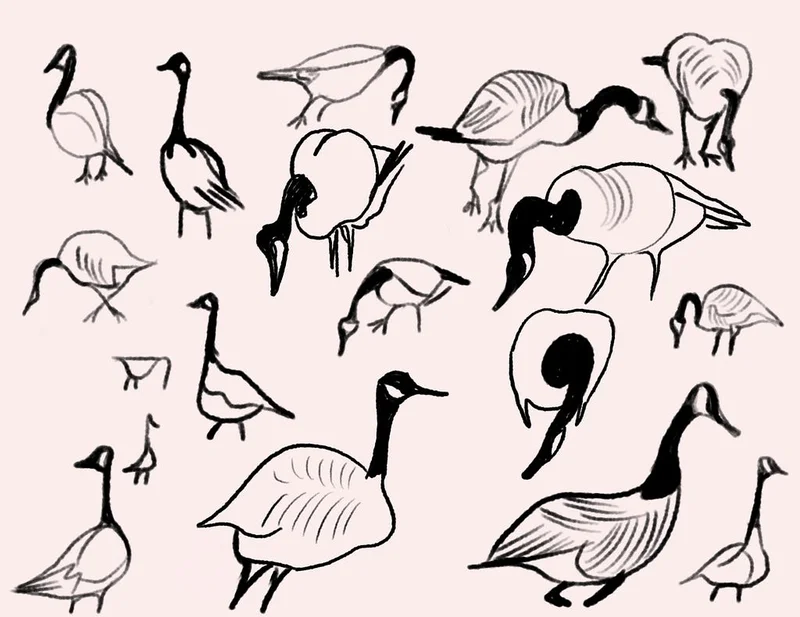
How structured emergence solves manager burnout, team bottlenecks, and systemic design debtObserving the flock based on how individual biological behaviors aggregate into structured group intelligence (image source: Asa Leonard)Molly Graham wrote an essay a week ago that ruined the traditional management approach for me. In it, she asked what would happen if we stopped long-term systematic planning like a set of stairs and started treating them like starling murmurations.It hit a nerve because design leadership is currently suffering from a bad case of mechanical thinking. We talk endlessly about cross-functional alignment, product development and operations, and predicting roadmaps. But mechanical systems are brittle. They crack the second an executive stakeholder pivots strategy, a competitor drops a new AI feature out of nowhere, or a team loses a seasoned designer in a month.Thousands of individuals operating as a single organic system without a central commander (image source: van IJken)Starlings don’t crack under sudden stress. Tens of thousands of them fly in tight formation without a single leader, a flight plan, or a manager giving orders from the front. They rely on emergence: a complex group behaviour created by simple, local choices.If we pair that fluid intelligence with the raw endurance of migrating Canada Geese, we get a far better model for running design teams: Structured Emergence.1. Pure Emergence (And Why Starlings Aren’t Enough)Local interaction rules in action when individual agents compute directional changes based on nearest-neighbor states rather than central control (image source: zamani)In a landmark 2010 study published in PNAS, complex systems researchers at Rome’s Institute of Complex Systems proved that a starling does not track the whole flock. Instead, each bird continuously adjusts its speed and direction based solely on its six or seven nearest neighbours, regardless of flock density. They stuck to three subconscious habits:Stay close to your neighbours.Don’t collide.Move in the same direction.When you bring this mindset into a product team, it’s liberating. Instead of waiting for top-down direction, designers align directly with their immediate squad… their PM, their engineer, and their design partner. They move fast, pivot on a dime, and iterate based on immediate user signals.This works brilliantly during 0-to-1 discovery, hackathons, or early prototyping. But pure emergence has a fatal flaw in product development: it has no destination.A starling murmuration can sweep across a field with incredible agility, but it doesn’t fly three thousand miles across a continent. A design team operating only on pure emergence quickly devolves into frictionless noise. Designers create a hundred frames, pivot with every single piece of feedback, and build a graveyard of brilliant, disconnected Figma components that never actually ship.2. The “Lone Goose” Anti-PatternHow structured positioning with aerodynamic draft dynamics reduces drag for trailing team members while preserving total formation endurance (image source: Mirzaeinia)When Canada geese fly across continents, they do not fly in chaotic swarms. They fly in a precise V-formation. A study published in Nature demonstrated that birds flying in formation save up to 14% of their metabolic energy and lower their heart rates compared to flying solo, thanks to the aerodynamic updraft created by the wingtips ahead of them.However, in order to fix that lack of direction, organisations usually overcorrect into a classic management trap: they set up a lone goose.We’ve all seen the corporate playbook of a brave leader breaking the wind at the front so everyone else can glide easily behind them. In design orgs, this turns into the Design Director or Principal Designer who feels obligated to act as the “Forever Lead".They review every frame at 11:00 PM, approve every pull request, make every key decision, and absorb all the organisational politics.(The Lead: Burned out, bottlenecked) ★ / \ / \ / \ / \ (The Team: Passive, coasting, / \ waiting for permission)This structure fails three ways:The lead collapses. Nobody can break wind at the front indefinitely without burning out.The team stops growing. The designers behind the lead never learn to navigate or handle wind resistance. They become passive pixel-pushers waiting for approval.Everything slows down. Every decision sits in a queue waiting for the point bird’s blessing.According to research on organisational efficiency from McKinsey & Company, centralised design bottlenecks cripple execution velocity. Thus, the fix isn’t to get rid of structure. It’s to realise that real geese don’t actually fly like this.3. How Real Geese Build “Structured Emergence”In nature, a goose flock is actually a self-organizing feedback loop engineered for long-distance execution. They don’t rely on a permanent boss; they rely on shared habits.By combining the starling’s local fluidity with four real behaviours from migrating geese, we can build a hybrid team model that scales.Rule A: Replace Status Meetings with “In-Flight Telemetry”The honking sound you hear from a flock of migrating geese doesn’t come from the bird in front. It comes from the birds in the back. As detailed in a 2014 Nature study on avian flight coordination, trailing birds honk constantly to let the lead birds know their velocity, distance, and position.In a healthy design org, information moves bottom-up. Designers close to the work send quick, asynchronous telemetry up to leadership: short daily standups, Slack updates, or open Figma critiques. Leaders don’t need to micromanage status; they simply adjust their strategic trajectory based on the signals coming from the team.If you’re an IC: Don’t wait for your manager to ask what you’re doing. Send a weekly, two-minute sync or bulleted update highlighting what you’re seeing at the user level, what’s working, and where you need cover.If you’re a Manager: Stop pulling status through live meetings and status spreadsheets. Reward bottom-up telemetry by responding asynchronously to Slack within 24 hours, and adjust strategic priorities based on the ground-level friction your team reports.https://medium.com/media/188eaa9bd9ec5fccf02be900db0cd169/hrefRule B: Practise Rotational StrainThe lead position in a V-formation is exhausting. When the point bird gets tired, it simply glides back into the formation to rest in the updraft, and another bird steps up to take the point.Rotational strain in action happens when birds continuously swap point positions to redistribute fatigue and sustain formation velocity (image source: Mirzaeinia)Leading a major launch, an app redesign, or a design system overhaul takes a toll. Design teams need to normalise rotating the point position. A senior designer might break wind on a heavy three-month discovery and shipping phase, then intentionally drop back into a support or contributor role for the next sprint while someone else takes the lead.If you’re an IC: If you’ve led two major launches back-to-back, speak up and help set up the next lead. If you haven’t led yet, ask your manager for a small, bounded project where you can take the point position with a safety net.If you’re a Manager: Actively protect point rotation during performance reviews and calibrations. Explicitly tell your leads when it’s time to step back into the draft, and make sure stepping out of the point position for a quarter is recognized as healthy pace management, not a loss of scope or ownership.Rule C: Build Design “Crèches”During breeding season, geese pool their goslings into large shared groups called “crèches” or “gang broods". A couple of adult guardians stay behind to watch over the entire group while the other parents feed.Protecting the pod: Communal guardianship in natural crèches (image source: petitsmantras)Isolated designers stuck inside cross-functional feature pods often lose touch with their craft. Try grouping 3-4 designers into a shared domain pod (like Activation or Checkout). A lead acts as the protective guardian, guarding craft quality and shielding the pod from bureaucracy, while the designers collaborate and move fast together.If you’re an IC: Create an informal craft pod. Find two other designers working on adjacent features and set up a recurring 30-minute sync to critique each other’s work before you show it to stakeholders.If you’re a Manager: Group isolated squad designers into functional domain pods. Assign a Staff or Lead Designer to act as the “guardian” who protects the pod’s time, maintains craft standards, and handles cross-functional stakeholder pushback so the pod can focus on execution.Rule D: Establish Philopatric AnchorsFemale Canada geese have a trait called 'philopatry'. No matter how far they fly during winter, wildlife research shows they always return to their exact native nesting grounds to reproduce, reducing environmental risk.Starlings fly anywhere, but geese are anchored. To give designers total freedom to experiment, you need 2–3 non-negotiable universal principles. Whether it’s “sub-100ms response times", “accessibility by default", or “zero hidden UI clutter", designers can explore wild solutions as long as their final work lands back on those foundational anchors.If you’re an IC: Learn your team’s core principles inside out. When you present a bold, radical design concept to executives, anchor your pitch around how it directly honors those non-negotiable principles.If you’re a Manager: Limit your team’s core anchors to no more than 3 non-negotiable truths. Use these principles as your primary evaluation criteria during design reviews , giving designers complete creative autonomy on execution as long as the work honors those anchors.No matter how far the flock explores, non-negotiable anchors always bring the work back home (image source: Roberts)4. The “Design Molt”: Scheduled GroundingThere’s one more detail about geese that corporate managers usually ignore: they lose their feathers every year.According to the Cornell Lab of Ornithology, waterfowl undergo a remigial moult each summer, shedding all their primary flight feathers simultaneously. After a full year of long-distance migration, a goose’s primary flight feathers become frayed, split, and degraded. Flying on damaged feathers takes double the metabolic energy. So every summer, adult geese undergo a synchronous moult. They drop all their primary flight feathers at once, leaving them completely flightless for 4 to 6 weeks.They don't fight this period of vulnerability. Rather, they lean into it. The flock stays grounded together near safe water sources, focusing entirely on feeding, raising their young, and growing pristine new plumage for the winter flight ahead.Shed Deprecated Components ──► Stay Grounded / Fix Debt ──► Resume Long-Distance FlightIn tech, we expect designers to fly at maximum speed 52 weeks a year while somehow rebuilding the design system, fixing component tech debt, and updating documentation on the side. It’s the equivalent of demanding a bird fly through a winter migration while pulling out its own wing feathers.High-performing design teams schedule an explicit design moult:Pause long-distance shipping: Take two weeks a year (or one week a quarter) where feature development pauses.Fix the foundations: The whole team stays grounded together to refactor design tokens, archive broken Figma components, clean up documentation, and resolve design debt.Grow together: Senior and junior designers use this time to pair, mentor, and level up craft without deadline pressure.If you’re an IC: Treat molt periods as protected time to eliminate the daily friction in your workflow. Pick one systemic bottleneck you hit every week (e.g., broken form components or outdated icon sets) and fix it during the molt so you can fly faster during the next sprint.If you’re a Manager: Defend the molt from executive scope-creep. Frame it to product leaders not as “downtime,” but as necessary infrastructure maintenance — if you don’t schedule your molt intentionally, your system’s decay will eventually force an ungraceful crash landing anyway.The Flight Checklist for Design LeadersIf you want to move away from top-down management and build a team based on structured emergence, run through these questions once a quarter:Telemetry: Is your team sending asynchronous updates up to you, or are you pulling status out of them through meetings?Rotation: Has the same designer been taking the heat on major projects for more than two quarters in a row?Collision Avoidance: Is your design system clear enough that designers can build fast without stepping on each other’s toes?Anchors: Can every designer on your team name your 3 core design principles from memory?Moulting: When was the last time you officially paused feature work to clean up design debt together?Managing from the BackThe real lesson from watching birds fly is simple: the smartest systems don’t have a single driver.A design leader isn’t to draw every screen, approve every pixel, or break every wave of wind yourself. Instead, our job is to set up the rules, protect the feedback loops, schedule the moults, and give people space to lead.If we stepped away from our team for a month, would everything fall apart, or would the next bird simply step up into the point position?When we stop trying to control every move the flock makes, we’ll find our team flies a lot further than we thought they could.The ultimate goal of structured emergence is done by synchronising flight sustained by shared effort, trust, and clear alignment (image source: Chee Chee)ReferencesAll About Birds. (2008). The basics: Feather molt. In All About Birds. https://www.allaboutbirds.org/news/the-basics-feather-molt/Cavagna, A., Cimarelli, A., Giardina, I., Parisi, G., Santagati, R., Stefanini, F., & Viale, M. (2010). Scale-free correlations in starling flocks. Proceedings of the National Academy of Sciences, 107(26), 11865–11870. https://doi.org/10.1073/pnas.1005766107Graham, M. (2026, August 4). What if you’re not supposed to have a long-term plan? Lenny’s Newsletter. Lennysnewsletter.Com. https://www.lennysnewsletter.com/p/what-if-youre-not-supposed-to-haveMcnay, S., & Voller, J. (2011). The journal of wildlife management. Journal of Wildlife Management. https://doi.org/10.1002/(issn)1937-2817Portugal, S. J., Hubel, T. Y., Fritz, J., Heese, S., Trobe, D., Voelkl, B., Hailes, S., Wilson, A. M., & Usherwood, J. R. (2014). Upwash exploitation and downwash avoidance by flap phasing in ibis formation flight. Nature, 505(7483), 399–402. https://doi.org/10.1038/nature12939Sheppard, B., Sarrazin, H., Kouyoumjian, G., & Dore, F. (2018). The business value of design. In McKinsey & Company. https://www.mckinsey.com/capabilities/tech-and-ai/our-insights/the-business-value-of-designWeimerskirch, H., Martin, J., Clerquin, Y., Alexandre, P., & Jiraskova, S. (2001). Energy saving in flight formation. Nature, 413(6857), 697–698. https://doi.org/10.1038/35099670Rethinking design leadership with swarms and flocks was originally published in UX Collective on Medium, where people are continuing the conversation by highlighting and responding to this story.
Rethinking design leadership with swarms and flocks