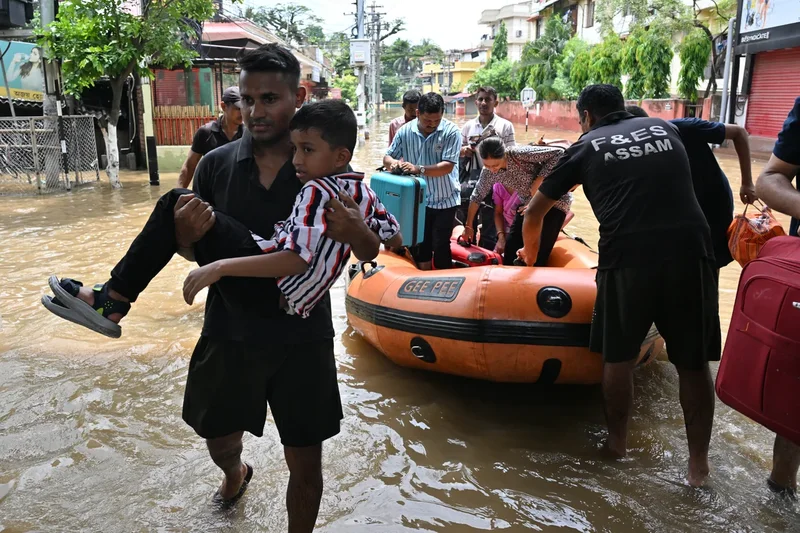
The floods that have killed 103 people in the north-eastern Indian state of Assam this summer were not made worse by the climate crisis, but rather more immediate human errors such as unchecked deforestation and poor flood defences, a new analysis has found.
The death toll continued to rise in Assam in Thursday’s update on the flooding, which began in late June across the northern part of the state, with multiple rivers remaining above danger levels. The floods have displaced more than 700,000 people and submerged vast stretches of farmland. Although many residents have begun returning to their homes as floodwaters recede, at least 49,000 remain housed in 125 relief camps and distribution centres, officials said earlier this week.
The loss of animal life has also been stark, with tens of thousands of farm animals and pets washed away, according to the Assam State Disaster Management Authority. With cattle sheds and grazing land badly inundated, the floods will have a long-lasting impact on livelihoods in a region heavily dependent on livestock for incomes, said Sneha Ganguly of the Red Cross Red Crescent Climate Centre, a co-author of the new study.
The floods also exposed weaknesses in Assam’s healthcare system, cutting off primary care clinics behind submerged roads, interrupting medicine supplies to people with long-term conditions and raising the risk of disease outbreaks in crowded relief camps.
The rainfall that set off the flooding was ordinary by the standards of the region, according to World Weather Attribution, an international team that assesses the role of global warming in extreme weather.
Downpours of that size are expected roughly every one to two years, they found. However, what turned routine monsoon rain into a disaster that displaced hundreds of thousands and submerged 45,000 hectares of cropland was the state of the land it fell on.
"Unplanned urbanisation, deforestation, poor drainage, inadequate structural flood management measures, and other anthropogenic changes now outweigh natural rainfall variability in explaining flood frequency," said Ms Ganguly.
"While climate change is making life harder for most Indians, not every disaster is a climate change disaster," said Friederike Otto, professor of climate science at the Centre for Environmental Policy at Imperial College London and another co-author.
"The devastating flooding in Assam was instead driven by extreme human exposure, environmental degradation, and infrastructure limitations."
Assam lies in the floodplain of the Brahmaputra, one of the largest rivers in Asia, which rises on the Tibetan plateau and descends through the eastern Himalayas carrying enormous quantities of sediment.
That silt steadily raises the riverbed and reduces the channel's capacity to carry water, so seasonal flooding is close to inevitable in a state of about 31 million people. The cost of flooding damage over the past decade has been put at Rs 100-150bn, between about £860m and £1.3bn.
The team examined the heaviest three-day rainfall and the heaviest 30-day total during the monsoon, comparing today's climate with one 1.4C cooler. Neither analysis found a difference had been made by warming.
Dr Otto said the absence of any impact from climate change was itself informative, because a change of that kind should have been visible.
"If you have no information whatsoever, no observations, you would expect that with the 1.4C of warming that we have already, you would expect to see an increase of over 10 per cent in intensity of heavy rainfall," she told a press briefing. "And we don't see that in the region."
She added that the team was "quite confident that at this point in time, climate change is not a big driver of the current flooding, but it is natural variability and exposure and vulnerability", while warning that larger trends could emerge as warming continues.
"Low station coverage and climate models struggling to capture processes in hilly regions creates high uncertainties in the results," said Mariam Zachariah, a research associate at Imperial College London and the study's lead author. The five datasets the team used disagreed with each other, with the India Meteorological Department's own records, which draw on the most weather stations, showing rainfall decreasing rather than rising.
“However, a lack of a clear trend today does not make the region immune to future warming,” Ms Zachariah said. “As global temperatures continue to climb, monsoon dynamics across South Asia will keep shifting, making proactive land and river management even more urgent.”
While the July flooding was not increased due to global warming, it is still affecting the region in different ways, experts warn.
Dr Otto said temperatures were rising through the year and altering the glaciers and snowpack of the Himalayas, and therefore how meltwater drains into the rivers, which will affect flooding even where rainfall has not changed.
The study’s authors noted that almost all of India had seen higher maximum temperatures before the monsoon. "Hundreds of thousands of people have been affected, with low-income agricultural families and displaced communities paying the highest price," said Emmanuel Raju, director of the Copenhagen Centre for Disaster Research at the University of Copenhagen.
"Marginalised populations living on flood-prone sandbars and reliance on rigid concrete embankments can be a recipe for disaster."
In recent years, Assam has invested heavily in embankments, along with anti-erosion spurs and town protection walls, but the report finds that rigid concrete engineering traps silt, raises riverbeds further and blocks natural drainage, making catastrophic breaches more likely.
"True adaptation requires moving towards living with rivers through wetland restoration and proactive early action before floodwaters strike," Dr Raju said.