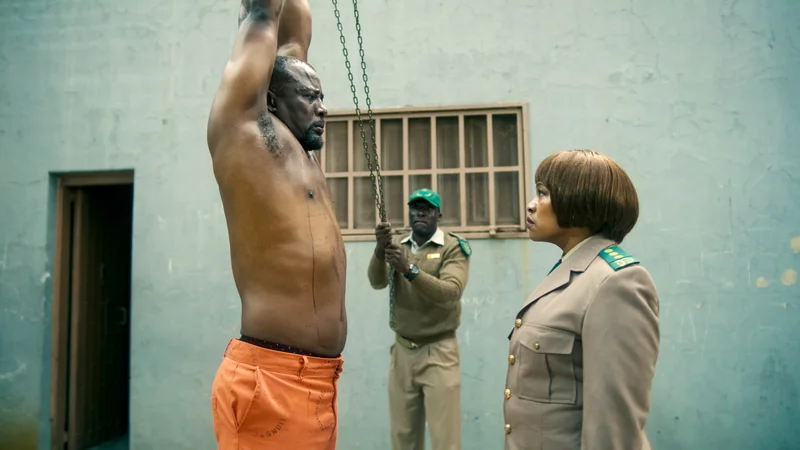
I’m four episodes into Umthetho, Netflix’s new South African crime series and I’m trying to figure out how I feel about it. When it commits to being a crime thriller, it’s genuinely gripping and the show uses Johannesburg so well that the city practically becomes a character of its own.
When it swings into the family melodrama around Mbali’s household, it loses me a little. But four episodes in, I’m showing up for it, which is more than I can say for a lot of shows I’ve dropped halfway.
I got the chance to sit down with the two leads Nqobile “Nunu” Khumalo who plays public prosecutor Mbali, and Tony Kgoroge, who plays her long-lost brother and prison crime boss, Moses.
We talked about how they landed the roles, how they prepared and how they’ve come to understand
two people who could easily have tipped into caricature in someone else’s hands.
“I heard about Mbali before I was introduced to Mbali,” Khumalo tells me. “I was aware that Black Brain was holding auditions for a huge show but nobody had called me.
“And I had a friend who auditioned. She was just chatting, saying the queues were so long and they were auditioning for two months. And nobody called me. And, you know, when she spoke about it, I didn’t know anything about the project. She wasn’t sharing much.
“But I felt something. I felt like
this sounds like something I’d really love to be a part of but, of course, I can’t do anything about it if no one’s called me.”
Two months of silence later, an email finally landed. “So I went in, I auditioned, I did a chemistry read and they confirmed me a while later. And I just knew that this was going to be one of my dream characters come to life.”
Kgoroge’s version is a lot less romantic. “I was in the middle of a class and I was contacted by the director and the producer, Mandla N,” he said. “He was asking me if I’m busy or anything like that. And he asked me to come in and do a test.
“So I was like: ‘Hey, I don’t think I can be able to. I’m far away and whatever.’ And the next thing is like: ‘Okay, fine, we’re starting to shoot on such and such a day.’ I’m like: ‘My guy. Are you okay?’”
What Kgoroge did with the weeks he had before shooting is one of the more striking things he told me. Playing a man who’s spent 14 years inside and run a criminal network from behind bars, he went looking for the real thing.
“We also had a chance to speak to the guys who actually have spent more than 18 years in jail,” he said, mentioning well-known figure in South African prison-life content Sylvester Mofokeng. “It also helps to understand the mentality and the outlook of this guy, you know, by grabbing from these guys.”
He was just as deliberate about keeping Moses specifically South African, given that Umthetho is adapted from a Brazilian series. “We don’t step out of the boundaries or be influenced by the Brazilian one that we had. So it had to have that feeling that the guy becomes a true South African with true South African problems and has all the elements that a South African prisoner has gone through.”
I asked him whether Moses is a different person in his family relationships or whether that softer side and the crime boss are inseparable. His answer went somewhere I didn’t expect.
“I always liken it to what is happening between Ghana, Nigeria and South Africa with this whole debacle that is happening now,” he said.
“I call them the three brothers. The older one being Ghana, who got their first independence, the second one being Nigeria and then the third brother in South Africa, which is the youngest. These two brothers come from wherever they come from, then they come and visit the younger brother in his house and they mess up certain things.
“The younger brother gets very upset. And out of all that, it’s still family. We’re still family. So in that, I say, when it comes to family, it is the same thing. We might have our own differences. Your mother can walk away from your life but it doesn’t mean that it’s not your mother anymore. Still your mother. That bond does not really break. Emotions can try to break the bond but that will always forever be with you.”
He tied it back to iGazlam. “The prison guy, his prison comrades, also becomes his family. He calls it ‘Gazlam, my blood’.”
Khumalo’s preparation for Mbali went in a different direction. “My experience was that in my research I could tell and my acting coach could advise as well, that Mbali doesn’t have an emotional centre at the time that we meet her,” she said. “But what she does have is very clear anchors and her clear anchors are rooted in love for family, responsibility and this critical need to serve. And Mbali serves for the good and sometimes she serves for the not so good.”
She pushed back gently on the idea that Mbali is hard to read. “Everyone says that to me. She’s not complicated to me. I understand something that other people haven’t brought up — nobody touches on the fact that Mbali saves a lot of lives and she protects people but she also has a responsibility to protect herself. Had she not done things a certain way and protected herself, she herself wouldn’t have survived.”
She spent much of her prep studying courtroom scenes and lawyers with her performance coach, then working out what to hide. “She seems sure, even when she’s not sure. We needed to find that balance and choose specifically where are we going to show her vulnerable, where is she still going to be in control and create a beautiful arc, a beautiful wave of ups and downs but in a controlled manner, because that’s part of Mbali’s delivery, that’s part of Mbali’s presentation to the world.”
The sibling chemistry between Moses and Mbali is meant to be the engine of the whole show. It turns out its backstory has an odd real-life echo. Kgoroge and Khumalo aren’t strangers off-screen.
His wife and her aunt have been close friends for decades. Rather than lean into that, Kgoroge kept his distance on set. “I didn’t actually want it to be too close to her on set because I wanted to keep that whole strange relationship between me and her,” he said.
“Even when we’re chilling during lunchtime, I always walk away and just sit far away so that the familiarity between me and her does not become part of our characters. I needed her and me to be strangers. It must always be that whole thing that I haven’t seen this person in the past 15 or 17 years.”
Khumalo only found out why once shooting was under way. “When I saw him and he sat down in Moses’s chair, I just thought: ‘This is meant to be. This is crazy. I actually love the choice of avoiding actor Nunu outside scenes to create that tension because I 100% felt so much warmth when I saw you’. But I think that serves the longing that Mbali has when she discovers that Moses is still alive. It’s a beautiful coincidence.”
On the physical side of things, Kgoroge told me he insists on doing his own stunts. “I don’t have a stunt double. Usually they get paid for doing nothing, they just come in and stand there,” he said, laughing. Filming inside a working prison added its own danger.
“Those benches are steel. So any mistake, whether you fall or you hit [something], you will hit the thing by mistake. It’s just prone to injury.
“But to do them without any injuries, it’s the most beautiful thing. It gives you a little touch of adrenaline. I thought maybe at my age I will not be able to do them but hey, I go to the other side.”
Khumalo described the shoot-out differently. “It was very real. Sometimes a bit too real. I mean, Mbali is trained to fight it out in the courtroom, not for physical direct contact, life-or-death scenarios. So it made sense for it to feel that way for the actor. It was an absolute adventure but it felt very real sometimes.”
Given everything that’s come out through the Madlanga Commission this year about corruption reaching deep into institutions South Africans are meant to trust, I had to ask whether either of them saw parallels while shooting a show about a crime syndicate operating from inside the system.
Kgoroge didn’t hesitate. “If you look at the story of Katiso Molefe, the stories that were being told through the commission about who was facilitating what and how, then you read the script and you kind of realise that there’s a reflection of what is happening in the country.
“It was just to see how, when the system is corrupted, it makes the good that we’re trying to do become useless. Something good is being considered as bad and bad is considered as good.”
Khumalo went further. “I haven’t yet decided whether it’s a blessing or it’s something else that I’m often given roles that are a hard mirror reflection of some of the most impossible to navigate scenarios and injustices happening in our society.
“It’s crazy to have artistic material that you are about to create in script form in front of you and then also turn on the television and the news is so parallel and so similar to whatever it is that you’re creating. It is a weird and humbling thing to confront.”