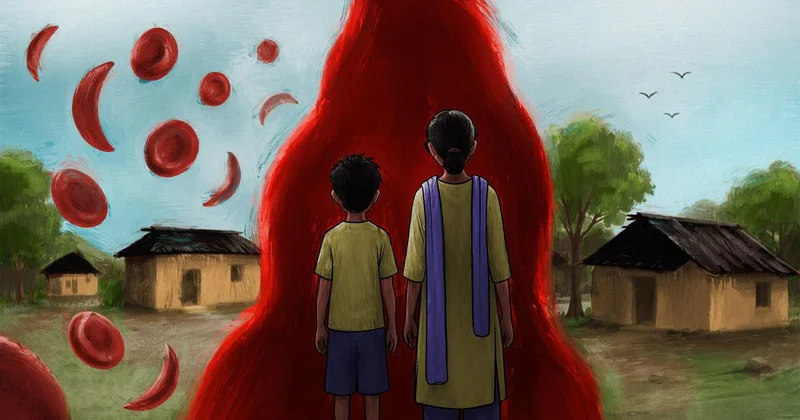
Suryodaya Kumhar’s medical diagnosis came about through a stroke of luck. The six-year-old, who lives in Dhatkidi village in Jharkhand’s West Singhbhum district, periodically suffered from severe joint and muscle pain, and extreme fatigue. His parents had taken him to numerous doctors, but they had not been able to provide a clear diagnosis or treatment.
His eldest sister Soni, who is 16 years old, had also shown the same symptoms for years. She was often confined to her bed, and missed out on a few months of school every year. “I love to study, so I still manage to do well,” Soni said. “But will such episodes continue for the rest of my life?”
The Kumhars’ village is in the middle of a jungle, around 5 km from the town of Goilkera. Sunil Kumhar, the father, works as a mason and earns between Rs 12,000 and Rs 15,000 a month. “We are poor people but we love our children,” he said. “We have taken loans and spent lakhs on their treatment, but nothing seems to help.”
The children’s mother, Hiramani Kumharin, echoed this despair.
“We’ve taken them to multiple doctors and clinics in Goilkera, and across the state border to Rourkela in Odisha, but to no permanent avail,” she said. “They have grown tired of seeing doctors. Suryo refuses to take any more medicines.”
In early June, the family visited an Aadhaar enrollment camp in Goilkera, the town neighbouring their village, to apply for an Aadhaar number for Suryodaya. As they stood in queue, workers at the camp noticed that he looked quite unwell. They suggested that the family take him to a health camp being held next door.
“He had a sallow face and frail body,” said Dr Jayshree Pardiha, the medical officer in-charge at Goilkera’s community health centre, who met the family at the camp. “He looked so small for his age. I thought he would be three or four years old, but he’s actually six years old.”
Pardiha suspected sickle cell anemia, and conducted a “rapid test” on Suryodaya, which indicated that he had the disease. After this, the entire family was tested. While the father and Soni also tested positive for the sickle cell trait, the mother and the second daughter did not. “For someone to have sickle cell anemia, both their parents have to be carriers of the trait,” said Pardiha. “But rapid test kits aren’t the most reliable, so we will have to send their blood samples for an electrophoresis test to Chaibasa to confirm the diagnosis.”
As it turned out, the process of diagnosis had already been delayed because of an oversight. On June 14 when I visited the Kumhar family at their home, they brought out the medical files of the two children. Upon inspection, I noticed that Suryodaya had tested positive for the sickle cell trait last July at a private clinic in Rourkela. But the doctor had not informed the family of the diagnosis, or explained the disease to them. While the Kumhars are fluent in Hindi and Odiya, their knowledge of English is limited, so they could not understand the report.
Such failures and challenges of diagnosis and treatment of sickle cell anemia persist despite the fact that on paper, India has been working towards tackling the disease. Crucially, 10 years ago, the government expanded the range of disabilities recognised under the Rights of Persons with Disabilities Act to include disability caused by sickle cell anemia, as well as thalassemia and hemophilia.
Sickle cell anemia and thalassemia are haemoglobinopathies – among the most common genetic disorders in the world, in which the blood’s haemoglobin is affected.
India has a high burden of these diseases. According to the Indian Institute for Integrative Medicine, approximately 5 lakh children are born with sickle cell anemia worldwide every year, of which nearly 50% are born in India. India also has more children with the most severe form of thalassemia, known as thalassemia major, than any other country in the world – between 1 lakh and 1.5 lakh children as per the Ministry of Health and Family Welfare.
As part of its efforts to tackle sickle cell anemia, the government launched the National Sickle Cell Anaemia Elimination Mission in July 2023. It aims to eliminate the disease by 2047 through measures such as conducting awareness programmes and large scale screening drives, and reinforcing diagnostic services at laboratories.
Thalassemia has no such comparable programme, but is included in the National Health Mission’s 2016 guidelines for the prevention and management of haemoglobinopathies. These guidelines recommend population screening, genetic counselling for at-risk couples and community education to combat stigma and misinformation.
But after travelling through Jharkhand’s East and West Singhbhum districts, Scroll found that stories like the Kumhars’ are not uncommon. The lack of knowledge about haemoglobinopathies, and poor healthcare infrastructure and support systems to tackle them, have meant that patients and their families are often left to fend for themselves.
The testing at a government health camp may finally help the Kumhar children obtain proper treatment. This would involve various processes, including the prevention of infections through pneumococcal immunisation and administering prophylactic penicillin, as well as blood transfusions.
But such an opportunity evades hundreds, perhaps thousands of Indians living in the interior regions of rural India. “We don’t receive enough funds for testing diseases like sickle cell anemia,” said Pardiha. “It is given secondary priority when compared to other diseases.”
This story is part of Common Ground, our in-depth and investigative reporting project. Sign up here to get the stories in your inbox soon after they are published.
In 2009, Shekhar was born to Bablu Lohra and his wife, who are from the Lohra Adivasi community and live in Jamshedpur. From infancy, he fell sick frequently. He was eventually diagnosed with sickle cell anemia and started obtaining regular blood transfusions. A year later, the Lohras had another child Suman, who was also diagnosed with the disease.
Though Shekhar had already been diagnosed, nobody informed the Lohras that this meant that both of them were carriers of the trait, and that their future children had a high chance of inheriting the disease. According to the National Health Mission’s guidelines, in couples where both the partners carry a mutated gene, there is a “25% risk in each pregnancy of giving birth to a child with disease state” and a “50% chance in each pregnancy to give birth to a ‘carrier’ child”.
“Nobody told us about these risks. I also have a brother whose daughter has SCA, we often advise each other about how to take care of our children – what works and what doesn’t,” said Bablu.
He added, “We have also had conversations with our extended family to get tested before initiating any marriages.” In 2014, the Lohras had a third child who did not inherit the disease.
The family also struggled with medical expenses. This was despite the fact that National Health Mission guidelines state that budgetary support is “required from both the State and Central governments to facilitate prevention and treatment of patients with thalassemia and sickle cell disease”.
Indeed, doctors Scroll spoke to noted that medicines for sickle cell anemia, such as hydroxyurea and deferasirox, are available for free in specific government hospitals. But the Lohras, a working-class family whose income is between Rs 12,000 and Rs 13,000 a month, said these medicines were often unavailable at Jamshedpur’s Sadar Hospital. “Even if they are available they only give us a week’s worth of medicine,” said Suman. “So, we mostly end up buying the medicines, which come up to Rs 2,500 a month.”
The family’s costs have also spiraled because of complications the siblings face as a result of the disease. When Shekhar was six, he developed gallstones and required surgery. Hospitals in Jamshedpur told the Lohras that they lacked the necessary facilities, and so Shekhar had to be rushed to a facility in Kolkata.
About two years ago, Suman had developed septic arthritis in her left arm, which left her unable to raise it. She was rushed to a private hospital where she had to undergo a surgery.
Both operations cost the Lohras lakhs of rupees, which they raised by taking loans. “I have had to leave multiple jobs in the past because I was running around for the children,” said Bablu, who works as a daily wage labourer. His wife also does occasional shifts of similar work to supplement their income.
In January, the siblings received their government-issued Unique Disability ID cards, under which they are eligible for Rs 1,000 per month as a disability pension. “But we have not received any money so far,” said Bablu. “Even Rs 1,000 goes a long way. I could buy better food – fresh fruits and vegetables – for my children with that money.”
They also still struggle with a lack of information. As I was about to leave the Lohras’ house, Bablu had questions for me. “Does sickle cell anemia occur because of living in dirty and polluted places?” he said. “And is it mostly tribal communities where it’s prevalent?”
I assured Bablu that sickle cell anemia was a genetic disorder and that scientists surmise that the sickle cell trait developed as an evolutionary response to combat malaria.
The question about the prevalence among tribal communities reflected a particularly serious and widespread confusion. While even the health ministry has repeatedly stated that sickle cell anemia is more common amongst tribal populations, doctors note that there is no large-scale study to prove this.
“We should let go of the bias that sickle cell anemia is particularly prevalent in tribal populations,” said Dr Akash Satpathy, a public health doctor with the Tata Steel Foundation’s sickle cell anemia programme, run in collaboration with the National Health Mission. He pointed out that the National Health Mission mandates screening the entire population up to 40 years.** **
“Consequently, we have come across people belonging to OBC communities who have the disease,” he said. “As screening expands, we may get a more complete picture of its prevalence across different populations.”
Over our conversations, Dr Jayshree Pardiha revealed that she, too, was a carrier of the sickle cell trait. She explained that though carriers of the trait have traditionally been asymptomatic, she had faced some health troubles.
“I only have the SCA trait, but I undergo several difficulties like joint pain, sleeplessness, low immunity and fatigue. My case is probably exceptional,” she said. But she then added that her sister, who also has the sickle cell trait, suddenly developed pain last year, after which her leg swelled and turned black. “We have had several tests done, but we haven’t been able to figure out what’s wrong,” she said.
Internationally, research suggests that carriers of the sickle cell trait have a higher risk of blood clotting and developing exertional rhabdomyolysis, a condition where skeletal muscle breaks down.
Both Pardiha and Sathpaty agreed that more research needed to be conducted about the experiences of sickle cell trait carriers. “Sickle cell anemia is not understood homogeneously within the medical healthcare system,” said Sathpaty.
On June 22, I met Stella and Shipra Minz in Jamshedpur – the mother and daughter are both carriers of the sickle cell trait, and described similar experiences.
In 2010, Stella, then working as ground staff for an airline company in Kolkata, developed severe diarrhoea at work and had to be rushed to the hospital. While doing routine tests, her haemoglobin level was found to be significantly low. Acting on instinct, she said, her doctor decided to test her for sickle cell anemia – it turned out that she carried the trait. Following this, Shipra also got tested and learnt that she, too, had the trait.
Mother and daughter now connect many health troubles they have to the diagnosis. For instance, Stella cannot tolerate extreme heat or cold – research has found that extremes of temperature can cause pain for those with the disease. In summers, both Stella and Shipra are prone to dehydration and heat exhaustion, both symptoms of sickle cell anemia. “During summers, I develop breathing issues and I sweat excessively,” Stella said. “I have been advised to drink plenty of fluids and get adequate rest. It was difficult to follow this when my job required me to stand on my feet and run around all day, but I manage better now when I’m retired.”
Her daughter, on the other hand, still develops pain in hot weather. “I get a tingling feeling all over and my hands and legs swell up,” said Shipra. Around three days before I met them, both Stella and Shipra had to be administered saline at a private clinic. “It has been very hot in Jamshedpur and we had been taking precautions by not going out in the heat and drinking coconut water and ORS,” Shipra said. “And yet we still got dehydrated and had to get saline.”
In rural areas, the large majority of people with hemoglobinopathies simply lack the resources to take care of themselves.
Further, in a low-income state like Jharkhand, proper medical treatment for diseases like thalassemia and sickle cell anemia are hard to come by. Several patients and parents noted that they had not come across a single haematologist in the state.
On June 16, I met 18-year-old Amrita Karwa at the Sadar Hospital in Chaibasa, along with her mother Abouni Karwa. This was their third day at the hospital and they were waiting to see a doctor before they returned home. Amrita had been diagnosed with sickle cell anemia as a child, and had been receiving treatment for several years.
Three years ago, on a hot day in March, Amrita was on her way to a school in her neighbourhood to write her Class 8 board exams, when she fainted. “I was nervous about the exam and I hadn’t had food or water properly,” she recounted. “I remember I started sweating a lot and felt dizzy.”
Two of her friends rushed her to the hospital. She spent a few days at the hospital and then required rest for several weeks before she felt better. But Amrita dropped out of school after that.
“My teachers tried to encourage me to appear again, but I am too scared that something like that will happen again,” she said.
The Karwa family lives in a small one-bedroom-and-kitchen house in a basti in Chaibasa. Amrita’s father passed away a decade ago, as a result of complications arising from alcoholism. Since then, her mother has raised her five children singlehandedly, while working as a domestic worker. “The two eldest daughters have been of support since they grew up and got married, but we still struggle a lot,” Abouni said. “I earn only Rs 800-Rs 1000 in a week, and I’m getting along in years.”
It was a sweltering 37 degrees Celsius when I visited the Karwa family at their home. Amrita sat on a bed in front of a large cooler. “Every year, it keeps getting hotter and hotter. My daughter keeps complaining about the heat, so I bought this second-hand cooler from my employers,” Abouni said. “I owe them Rs 5,000 for this, which they will cut from my salary.”
In order to keep well, Amrita requires blood transfusions almost every month. But getting blood has been especially difficult this year. “There was no blood available from February to May,” Amrita said. “It is only from this month that blood was available again, and then, too, I had to wait two days to get a second unit of blood.”
The low supply is linked to a crisis that unfolded last year. In late October, five children with thalassemia in Jharkhand tested positive for HIV – the infection was traced to blood transfusions at the blood bank at Chaibasa’s Sadar Hospital.
A probe revealed that the blood bank was operating without a license, and led to its temporary closure. Thus transfusion services were shut down for a while, and blood from donation drives was being processed by blood banks in Jamshedpur. “We had to go to Jamshedpur to get blood,” Abouni said. “My son would have to take someone to donate blood. At times, we have also had to pay money to people to get them to donate and receive blood.”
These struggles came at the end of an already tragic year for the family – in January last year, they lost their third daughter, Madhu, who was 21 years old, and also had thalassemia. They recounted that Madhu was the stronger of the two sisters.
“She was strong and healthy, the brightest of us all,” Amrita said. “She used to motivate me to take care of myself, and gave me hope about life.”
The family noted that Madhu had appeared healthy over the years and only required a blood transfusion once in six months. However, in January last year she complained of severe chest pain and was rushed to the hospital. The family alleged that they reached the hospital in the late morning, but that no doctor came to see Madhu for hours – she died in the early evening.
The family still does not understand what happened. “The doctor said her body didn’t accept the blood transfusion properly,” Abouni said, tearing up. “I already lost one daughter, I can’t afford to lose another.”
Our conversation also indicated that in some respects, Amrita might not be receiving the appropriate advice from the doctors she had met. Satpathy explained that when thalassemia and sickle cell anemia patients obtain frequent blood transfusions, they are at increased risk of developing excess iron in their blood, which can lead to liver damage and cardiac complications. To remove this excess, they require iron chelation therapy. But Satpathy noted that in workshops with frontline workers such as ASHA workers and auxiliary nurse midwives, when he asked what they would prescribe to someone with sickle cell anemia, their responses were indicative of a general lack of awareness. “Often, the first thing that comes out of their mouth is to give patients iron pills,” he said. “And then we have to tell them they should absolutely not do that.”
Amrita said she had not heard of iron chelation therapy. But, she added, she was taking iron and folic acid pills daily as a doctor had advised to. She did not have a prescription for the pills.
The struggles of poorer patients was underlined by contrast, when I met Basanti Biruly, who is from a better off family in another part of Chaibasa town.
Basanti, the only child of a ration dealer and a school teacher, was diagnosed with thalassemia major as a child – but, she said, her parents never let her feel that she was disabled.
I met Basanti at around noon on June 17. Though it was hot, she came out in the sun to show me the way to her house. “I don’t really have issues with the heat,” she said. “It is during winter when I feel more sensitive to the cold.”
Basanti said that with the right kind of support and resources, thalassemia patients could live a healthy life.
“I have always had a lot of support from my parents,” she said. “I make sure to eat a healthy diet. I maintain a stable haemoglobin level and take medicines to balance my iron levels.”
Basanti’s sound management of her health was apparent from her glowing skin and cheerful disposition.
Basanti noted that it was difficult to find good doctors in Jharkhand, but that through the NGO Anurag Foundation, which works with thalassemia patients, she had received access to haematologists from Kolkata. “They fly them down regularly for health check-ups and advice,” she said. “I have been going there as a child, and seen older people with thalassemia live full lives.”
Basanti was also the only patient in Chaibasa I met who had successfully managed to obtain a disability identity card, and also received a disability pension. She is currently in her second year of an undergraduate programme in economics, and hopes to be a teacher someday. “I want to be a role model for people with thalassemia and show them that we too can live good lives,” she said.
This story was supported by the International Foundation for Disability Inclusion’s (IFDI) Journalism Fellowship on Disability Inclusion.
We welcome your comments at letters@scroll.in.