12 international students at Calgary protest referred to CBSA office after status check
Local police asked Canada Border Services Agency to check immigration statuses
A dozen people who took part in a weeks-long international student protest in northeast Calgary have been flagged as "being possibly inadmissible" and, according to an immigration lawyer, could be forced to leave Canada.
Canada Border Services Agency (CBSA) confirmed officers were called to attend the protest site on Wednesday to check attendees' immigration statuses.
According to a CBSA spokesperson, officers verified the statuses of 20 people, and 12 were identified as being possibly inadmissible under the Immigration and Refugee Protection Act.
“The individuals were asked to attend the CBSA office later that day for a follow-up interview. Due to privacy legislation, no additional details on these cases will be provided,” said the spokesperson.
The agency says everyone who's subject to immigration enforcement action, including those ordered to be removed from Canada, "have access to due process before the law."
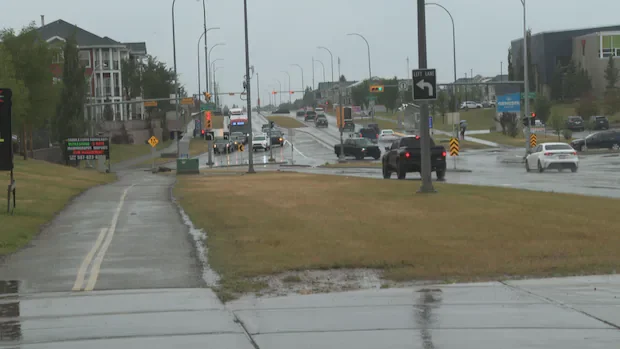
International graduates and others in support of their cause had been protesting issues with work permits at Saddletowne Circle, down the street from the Genesis Centre, for weeks.
Similar protests are happening in Edmonton, with some Alberta students participating in hunger strikes to draw attention to the issue.
Protesting work permit denials
Some graduates who studied at Portage College say they were under the impression they would be eligible for post-graduation work permits when they finished school.
But once they applied, many of their permits were denied.
Portage College says it’s seeking clarification from Immigration, Refugees and Citizenship Canada (IRCC).
“Portage College's understanding was that students enrolled in non-credit public-private partnership programs prior to May 15, 2024 would be eligible to apply for a Post-Graduation Work Permit, if they were enrolled before the May 2024 changes, consistent with the information available at the time and the way these applications had historically been administered by IRCC,” said spokesperson Andre Delaire.
CBC News has reached out to IRCC for comment.
Calgary police requested status check
It was the Calgary Police Service that called the CBSA for help on Wednesday.
In a statement to CBC News, a police spokesperson said the demonstration began on July 24 and “has largely been peaceful in nature,” but police had received complaints about excessive noise, obstructing businesses, disturbances and public intoxication.
On Wednesday, police responded to a report of people blocking parts of the sidewalk and impeding pedestrians.
“During that interaction, officers requested identification from individuals who had set up tents or other structures without a permit on city property,” said a CPS spokesperson.
“As a result of concerns related to the identification provided, officers contacted the Canada Border Services Agency for verification.”
The CBSA said officers were initially called to check the status of four people, and after two of them were “not in compliance with their immigration status,” they did a broader check.
‘Like sheep waiting for the fox’
Jatin Shory, a Calgary immigration lawyer with Shory Law, is representing roughly a dozen students challenging their work permit denials in federal court. He advised them not to attend any public protests.
“This situation is unique in the immigration context because it is a large group of now officially undocumented individuals effectively advertising that they’re undocumented,” said Shory.
“It’s like sheep waiting for the fox to come into the den.”
Shory said CBSA has the right to investigate any tips it receives, and it’s likely the agency wanted to send a message “that immigration in Canada is fully transforming and you have to kind of get used to it.”
LISTEN | Canada's immigration 180:While the CBSA wouldn’t say whether the 12 people attended their interviews or what the outcome of those meetings was, Shory said there’s a common next step.
“It’s very common that if you were without status inside of Canada, you’re called in for an interview with CBSA, that you will be issued an exclusion order,” said Shory.
An exclusion order “means an individual must leave Canada immediately, confirm departure with the CBSA and cannot return to Canada for one year,” according to the CBSA website.
Shory said there are legal avenues people can take to fight that order, but they’re tough to win. Removal could be enforced within weeks, he said.
With files from Chelsey Mutter, Amir Said, Katie Teeling