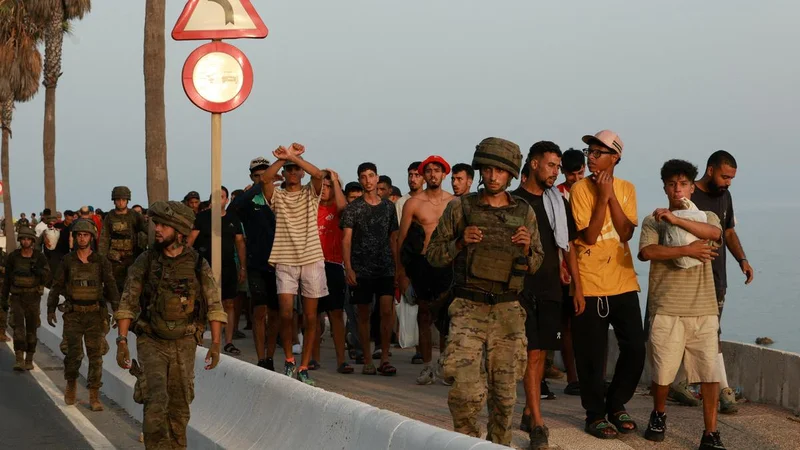
Between July 30 and 31, approximately 72,000 people from Morocco arrived at Ceuta, Spain’s island territory and one of the EU’s only land borders with Africa, in hopes of making it to Spain. Pictures and videos of the event flooded the Internet, and within hours, 22 European Union (EU) leaders signed a letter to the European Commission, criticising Spain and demanding an emergency meeting of interior ministers, regarding migration.
Morocco’s government has repeatedly stated that a large majority of the people who swam for hours and got to Ceuta, voluntarily returned to Morocco. About 11,000 persons still remain on the island, according to the city’s mayor. More than 80 people lost their lives in this incident.
While the reasons for this unprecedented inflow of Moroccans to Ceuta over two days remains unclear, data shed light on the underlying causes that could be driving the youth towards such risky endeavours.
Morocco’s economy has improved and poverty has been on the decline over the past few years. However, this has not resulted in reduced unemployment, specifically among its youth population, who comprised a majority of those who fled to Ceuta.
The African country’s unemployment rate has only increased in the quarters following the pandemic, and stood at 13% as of Q3 of 2025. Its youth unemployment rate is nearly three times its overall employment rate. About 37% of Moroccans, or two in five persons between the ages of 15 and 24 are not employed. This is nearly 20 percentage points higher than it was a decade ago. Further, about 24.5% of the youth were neither pursuing education nor were employed.
Data also show that higher education is not necessarily rewarded with better job prospects in Morocco. More than half of Morocco’s youth who have reached higher levels of education are unemployed, with nearly 65% of young women who have completed higher education and about 54% of young men at the same level left unemployed (Table 1).
According to the information released by the Morocco’s Interior Ministry, in 2024, the country stopped almost 80,000 attempts by people to reach the EU. In fact, Moroccans made up about 20% of Spain’s land and sea arrivals in 2026 so far, according to the UN Human Rights Commission (UNHCR). A majority of arrivals into Spain came from Ceuta and the Balearic Islands via the Western Mediterranean route.
Post the Ceuta migration crisis, Italy’s conservative Prime Minister Giorgia Meloni, imposed travel restrictions on travellers arriving from Spain from August 1, to which Spain responded with similar restrictions. These moves are symbolic of a broader disagreement between Ms. Meloni and Spain’s left-leaning Prime Minister Pedro Sánchez on the issue of immigration. The letter signed by the EU Commission argued that Madrid’s migration policies had undermined the EU’s security.
However, UNHCR data show that out of the 54,316 persons who arrived in the EU by land or sea, about 8% arrived in Ceuta, while about 22% arrived in the Spanish mainland. Italy made up about 30% of these arrivals, while Greece made up 36%.
The chart below shows the people arriving via land and sea into Italy, Spain, and Greece, as per their country of nationality, as of June 2026. Most of the 2,589 persons from Morocco who entered the EU via land or sea, arrived in Spain. The same data shows that 586 persons are missing or have died while on the Mediterranean and West African Atlantic routes.
Published - August 14, 2026 07:00 am IST