It wasn’t unlike a solitary vigil.
On August 1, a social media post appeared showing a woman standing outside the Karachi Press Club, holding a painted portrait of Imran Khan, bearing the words: “Imran Khan ko riha karo”, free Imran Khan, and “Hamara leader hamen wapas dedo”, give our leader back to us.
The image of her quiet defiance elided with the Pakistan Tehreek-e-Insaf’s reignited street mobilisation, marking their leader’s three-year anniversary in prison.
Together, these instances illuminate a peculiar paradox: three years of incarceration instead of diminishing the former Pakistani prime minister’s symbolic appeal seem to actually have bolstered it.
Pakistan’s political playbook has long been recycled. Something drives a wedge between a political leader and the establishment. What follows is familiar: some combination of dismissal, disqualification, imprisonment or exile, with the eventual aim of irrelevance. Once enough time has passed and the political storm settles, an accommodation is usually reached.
The case of Khan somewhat unsettled the playbook. Khan’s own ascent to power was hardly predictable. Cricketing fame was followed by philanthropy and eventually politics, despite his initial reluctance to enter the field. After struggling to be taken seriously as a politician – a single seat in Parliament, boycotting a general election and some electrifying rallies – Khan’s party formed a provincial government in Khyber Pakhtunkhwa in 2013.
The 2018 elections eventually offered a breakthrough, as Khan became Pakistan’s prime minister.
Four years in, amid escalating confrontations with the establishment, Khan became the country’s first premier to be removed from office through a vote of no-confidence. Sixteen months later, he was behind bars.
Following his conviction by an Islamabad trial court for selling state gifts he had received during his time in office, the police arrested Khan in Lahore. He has been in prison since, over a series of cases. Meanwhile, the 2024 elections in Pakistan resulted in the Pakistan Muslim League-Nawaz forming a coalition government with the Pakistan Peoples Party. They remain in power, on the “same page” with the establishment, which is also firmly in the picture.
As prime minister, charisma before the crowd became Khan’s thing. In the lead-up to Pakistan’s 2013 elections and after, Khan appeared most at home on stage: speeches atop containers and at the United Nations General Assembly, hand movements timed to punch-lines, crowds roaring “Kaun bachaye ga Pakistan? Imran Khan, Imran Khan.” Who will save Pakistan? Imran Khan, Imran Khan,
He appeared equally at ease in smaller settings, whether with social media influencers at his home in the Islamabad neighbourhood of Bani Gala or during X Spaces surpassing 165K listeners.
In August 2023, when Khan was arrested on charges of corruption, his stage was snatched away. Three years in prison stripped him of the machinery that he had harnessed so well: videos, public meetings, interviews, television and tweets. Yet he did not disappear. The intended irrelevance somehow rendered him more relevant than ever.
Eight months ago, a post appeared on Khan’s Instagram account: “My name is Imran Khan. I don’t need a throne, my people are my power.”
An act of co-creation
In one sense, Khan was correct.
What had set his Pakistan Tehreek-e-Insaf apart from other political parties was its invitation to citizens to enter the story of change: let’s co-create a Naya Pakistan, a New Pakistan. That felt different from politicians dispensing promises to eager-eyed citizens from behind bullet-proof shields, or the familiar accounts of rally-goers enticed by free biryani and cola.
Khan’s political premise relied as much on citizens’ getting their hands dirty, as it did on his own capacity to deliver. For a supporter base accustomed to dynastic politics and despair, young citizens felt implicated and surprisingly empowered in Pakistan’s political project.
So they jumped right in.
Digital politics – the Pakistan Tehreek-e-Insaf ’s métier – gave Khan’s invitation new meaning and momentum. Pakistani politics had once unfolded largely within the halls of parliament, in villages, at urban rallies, shrines, country estates or under the glare of television studios. But it now leaked into tweets, memes, reels, WhatsApp forwards, hashtags, X Spaces, and TikTok clips. Anyone with a smartphone thought they had a say.
When Khan was arrested, his supporters were put to test. Before long, they had come up with funny, poetic and poignant ways to weaponise his absence. His prison number, 804, became currency – remixed, subverted and endlessly circulated by citizens.
A rhyming chant swiftly emerged: “Tera yaar, mera yaar, qaidi number aat sau char” – your friend, my friend, prisoner number 804.
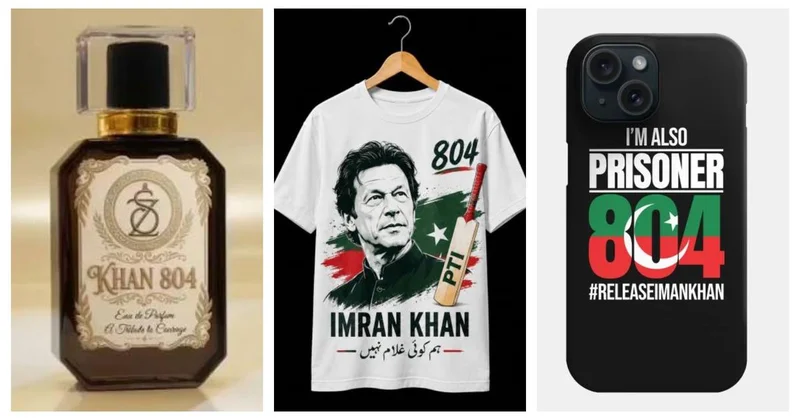
The three-digit number made a prison break and began percolating everywhere. Memes, stand-up comedy and merchandise transformed 804 into a full-blown identity.
Fragrances with the brand names I’m Khan 804 and Qaidi No 804 appeared on the shelves. Amazon, Etsy and other online vendors began selling collectibles, t-shirts, hats, mugs and hoodies with the legend “Prisoner 804”. Restaurant names and menus were rebranded with “804”.
Chants at cricket stadiums became difficult to quell. Automotive marketplaces began wondering if “Imran Khan 804” may become the country’s most expensive numberplate. Bakeries were receiving cake orders requesting Qaidi #804 and Khan’s photo on them. Custom-made “804” kites with images of Khan were prepared for Basant, before a ban was imposed.
Whatever one makes of Khan as a politician, his imprisonment had begun generating an unusual phantom presence. But simultaneously, the state was pushing back. When Khan was first arrested on May 9, 2023, riots broke out across the country. What followed resembled a media blackout for Khan and the Pakistan Tehreek-e-Insaf.
PEMRA – the Pakistan Electronic Media Regulatory Authority – issued a notice to electronic media, asking them to stop giving airtime to “hate-mongers, perpetrators and their facilitators”. Although the directive didn’t explicitly refer to the former prime minister or his party, Khan’s speeches, photos and statements stopped being aired on television. “Bani PTI” became a stand-in for the man no one was naming any longer on the airwaves.
In an Independence Day video released in August 2023 by the Pakistan Cricket Board, celebrating accomplishments from Pakistan’s cricketing history, Khan was barely visible, if at all. The pushback from citizens came strong and relentless. A little later, the cricket board replaced the original video with an unabridged version that included additional footage of Khan’s contributions to Pakistan’s 1992 World Cup victory, among the country’s other cricketing milestones and figures.
Political disappearance was one thing. But how do you speak of cricket, in a cricket-crazy country, without crediting the politician who happened to have captained Pakistan for a decade and also to World Cup victory?
Wiping out Khan wasn’t proving to be child’s play.
Airbrushing him from news screens and posters wasn’t the same thing as scrubbing him from the affections of his supporters. Each time someone visited him in prison, anticipation for an X update hung in the air. A single glimpse from his jail cell became a source of longing for his supporters: reassurance that he was well, still among them.
There was, nonetheless, a catch.
The Pakistan Tehreek-e-Insaf might have mastered digital activism, but the establishment wasn’t stalling on the sidelines either. As citizens networked, the state networked back. With internet firewalls, channel bans, surveillance, arrests linked to online activity, Pakistan appeared to be descending into something more and more Orwellian.
Pakistan’s most networked movement was at loggerheads with an increasingly networked state.
Had they finally managed to corner the tiger?
Last week, I heard Khan’s sons, who live in the United Kingdom, speak about their father to two international journalists. Despite the countless memes, X spaces, 804 chants and cakes, Khan remains out of their reach. Months have lapsed since their last phone call with him, administrative hurdles prevent them from visiting Pakistan, Khan seems to have limited access in prison to doctors, lawyers and family members, and nothing material ensues from the statements offered by human rights organisations.
Their helplessness hints at a sobering truth beneath Khan’s remarkable online afterlife: absence and upgrading politics for our feeds, may have deepened Khan’s appeal, but translating those into his release requires political capital of a different kind.
Part of the problem possibly lies in Pakistan’s restless straddling of strongman politics and democracy. Traditional institutions of authority remain deeply entrenched. Three years in, Pakistanis can endlessly circulate Khan through reels, voice-overs, and victory speeches. What dreams and hashtags will find harder to topple, however, is political power.
It doesn’t help that the demands for Khan’s release have been sporadic and scattered. Hooks such as prison anniversaries become knee-jerk occasions to fight the street fight but the momentum quickly dissipates. Still, the recent protests at Jantar Mantar in India lend young Pakistanis some hope. We are, after all, as one Pakistani called it, “children of divorced parents”.
Across the border, young Indians have been out on the streets defending freedoms they fear might disappear. Khan, who spent years inviting citizens to come front-and-centre, would have leaned into that.
Which brings us back to the image of the solitary figure outside the Karachi Press Club: staging her protest by herself, holding a portrait of the man forbidden. The numeral 804 seems to be everywhere, on screens, streets and stadiums. Just not where his loyalists hope he will be.
Yet, somehow, against all odds, apparently this woman showed up.
Saba Karim Khan is a writer, filmmaker and educator whose research tracks what happens when old politics collide with new screens.
We welcome your comments at letters@scroll.in.