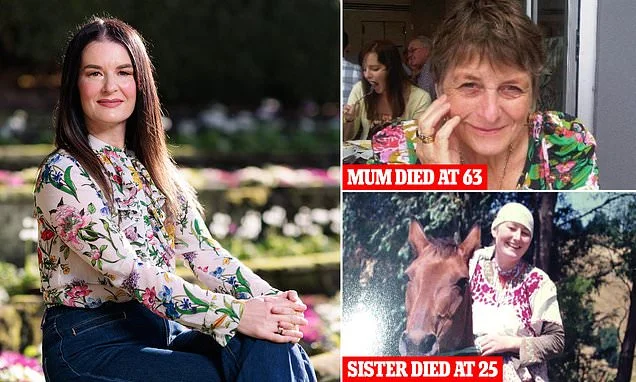
Tracy Hutchinson was 14 when her big sister Rebecca became sick. Until then, life in New Zealand, where the family had moved from Hounslow in west London, had been idyllic. There were barbecues, bare feet and all the ease and freedom life in the sunshine had promised.
‘Rebecca was 21 and she started to get very tired and bruise really easily and she’d feel cold even in hot weather,’ recalls Tracy.
Doctors initially thought it was glandular fever, but the symptoms persisted and eventually the girls’ mum, Jan, insisted on taking Rebecca back to the GP. She was sent straight to hospital where blood tests confirmed the worst. Rebecca had acute lymphoblastic leukaemia and within days was undergoing rigorous chemotherapy.
For the next two years, Rebecca was in and out of hospital. Tracy remembers her devoted parents arguing a lot because they were under enormous stress. It was 1990, a time before a family could opt for counselling, and so Tracy, her other sister Sally and brother Stewart retreated into themselves.
But there were also happy moments. ‘One day Rebecca picked me up from school on her horse, Stacey. She was shouting, “I’m in remission, I’m in remission”.’
The joy didn’t last. Before long Rebecca became fatigued again. The cancer had returned. What she now needed was a bone marrow transplant. The family was tested and Tracy was found to be the best match. She remembers being in hospital after the general anaesthetic to remove bone marrow from her sacrum [a bone at the base of her spine], eating sandwiches and watching Rebecca receiving the cells she’d donated.
‘I was a little sore but it felt like a really good thing I was doing for my sister because I wanted to give her the best shot at life,’ she recalls.
Yet what none of the family knew back then was that Rebecca’s illness was not a random and unfortunate event. Rather, it was the forerunner to a series of heartbreaking discoveries that, 35 years later, are still reverberating through the Hutchinson family.
Tracy Hutchinson says her condition has made her more appreciative of moments in her life
One after another, members of the family have been struck down by cancer and, in a harrowing turn of events, Tracy, now 50, has learned she has a 100 per cent chance of getting the disease.
At the root of it is Li-Fraumeni syndrome – a rare mutation of a gene called TP53 – which means she is certain to get the disease somewhere in her body.
You’d think such a diagnosis would be terrifying, but for Tracy, having an explanation for decades of suffering and grief has brought clarity even if the path ahead is uncertain. ‘I’m surprisingly at peace with it because I’ve finally got an answer for all the troubles in my family,’ she says, sipping tea on a chilly Sydney evening. ‘Basically my TP53, which [normally] functions as a cancer-suppressing gene [helping to control the growth and division of cells], is a dud.’
To truly understand the magnitude of the discovery we need to backtrack to the 1980s when the Hutchinson family was unaware of their genetic legacy and scientists were only just identifying mutations in the tumour-suppressing gene.
First came a cancer diagnosis for Tracy’s maternal grandmother. Jan flew back to Hounslow to be with her mum but she died in 1986. She was only in her 60s. The Hutchinsons mourned but had no idea how the disease would soon ricochet throughout the family. When Rebecca was two years into her leukaemia battle, and riding the rollercoaster of her relapses, Jan found a lump in her breast. Tracy was 16. ‘I remember mum getting off the phone to the doctor and going, “Oh f***, it’s cancer”,’ she says. ‘I was distraught and went to my friend’s house because I didn’t know what to do.’
Jan was then 45 and underwent a mastectomy and treatment, while continuing to care for Rebecca. Tracy can’t begin to imagine her mum’s fear at the prospect of not being around for her sick daughter, but she does remember her strength. ‘Mums are just troopers aren’t they? My Mum was such a strong, amazing woman.’ As for her dad, Brian, she recalls him being a rock, too.
Two years later, aged 25, Rebecca relapsed again.
Her mother Jan died nearly 15 years ago at the age of 63
Sister Rebecca died at the age of 25 after a battle with leukaemia
‘She decided she wanted quality of life over quantity because the treatment was so brutal. We all had to respect that decision,’ recalls Tracy. ‘One day she had a bowel haemorrhage and was crying on the bed and in pain. My parents took her to hospital and she passed away.’
Yet for Jan and Brian there was barely time to grieve before they were hit by another shocking diagnosis. As Jan underwent tests for a breast reconstruction, it was revealed she had cancer in her other breast.
A mastectomy and chemotherapy followed, but the TRAM flap reconstruction, where tissue is taken from the tummy to rebuild the breasts, was challenging. ‘She got shocking infections and it was horrific for her,’ recalls Tracy.
The run of diagnoses seemed to be horrifically bad luck – but only that – and, for the next nine years, family life was peaceful. Tracy spent 18 months living in London, then settled in Australia, where she worked as a massage therapist before moving into corporate life where she works as an executive assistant.
But one bright, sunny day as she was walking to work in Sydney, she received a devastating phone call. Now her mother Jan had been told she had oesophageal cancer. ‘I collapsed onto the ground in shock,’ she recalls. ‘There’s this naiveté where you think because you’ve already gone through so much, you’re not going to get anything else.’
Jan underwent major surgery followed by ‘brutal’ chemotherapy. When she was well again, she visited Tracy in Sydney in March 2011. But, by August, the cancer was back. It metastasised quickly and Jan, 63, died six weeks later.
‘I was with her those last weeks right through until the end,’ says Tracy. ‘I even jumped into the hearse after her funeral so she wouldn’t have to make that final journey on her own.’
Tracy as a baby, centre, with siblings Stewart, Rebecca and Sally
For Brian, a pattern maker from Chiswick, who had met Jan when she was working as a pharmaceutical assistant in London in the 1960s, the grief of losing his daughter and then his wife was unbearable. Tracy remembers him tormenting himself. ‘I remember him saying, “why us, what have we done to deserve this?” and “we should have stayed in England”.’
After her mum’s death, Tracy felt uneasy. It seemed like too much aggressive cancer for one family. Was something more sinister at play than luck?
‘I spoke to my doctor about having a preventative mastectomy. I hated my boobs, I had an instinct they were ticking time bombs and I just wanted the bloody things off. She told me I was too young and to explore it down the track.’
But in 2020, sister Sally, then 45 and just a year older than Tracy, was diagnosed with fast-growing triple-negative breast cancer. Both women were distraught. ‘I remember thinking, “This can’t be happening, I’m not losing my other sister,”’ says Tracy. ‘I was literally walking round in circles.’
Sally was tested for the BRCA mutations – variants of the BRCA1 and BRCA2 genes which lead to increased breast cancer risk – but the results came back negative. Around the same time, Tracy saw her GP and was referred to the Sydney Cancer Clinic, where geneticist Dr Mathilda Wilding suggested Sally was tested for Li-Fraumeni syndrome.
A parent with the mutation, which Jan clearly had – presumably from her mother – carries a 50 per cent chance of passing it to her own children. When the results came back positive, Tracy took the same test. ‘I didn’t want my sister to go through this journey on her own,’ she says.
The news that she also had the syndrome was crushing and she broke down in bitter tears on being told. But it also made sense. ‘I finally had an explanation for Rebecca fighting, then mum fighting and now Sally fighting. The jigsaw came together.’
It’s one thing to understand why such an insidious disease has felled multiple members of your family, but quite another to process that you are headed for the same fate. Every niggle, every ache, comes with portent and Tracy says there’s barely an hour when she doesn’t think about it. ‘I’ve had a damn good dress rehearsal for cancer,’ she says wryly.
Sally, left, and Tracy have annual whole-body MRIs in the hope tumours can be spotted early
Li-Fraumeni most frequently causes soft tissue sarcomas, brain tumours, leukaemia, rare adrenal gland tumours and pre-menopausal breast cancer, which is very common in young women with the mutation. Within months of discovering she had the mutated gene in 2022, Tracy had a preventative double mastectomy. Two ductal carcinomas in situ – early forms of cancer – were found in her left breast tissue after it was removed.
She was adamant she didn’t want a reconstruction after seeing what her mum and Sally had been through. ‘People were a bit worried for me because I do like to glam up. But I was more upset for my partner Chris. I was worried I was going to look like a freak, but he said that life isn’t a fairytale, I just have to deal with the facts and do what I can to survive. I found that very empowering.’
Now 50, she recognises that she and Sally, 51, have different experiences. ‘I’m what’s called a “previver” rather than survivor. I haven’t stared death in the face like Sally. I’ve made the decisions, I haven’t had decisions taken from me.’
As she says, cancer is personal; her brother Stewart has chosen not to get tested. Neither she nor Sally has children so they haven’t had to contend with the syndrome being passed on.
Both women now have annual whole-body MRIs in the hope that any tumours can be spotted and treated at the earliest stage. All they know is that they will find further cancers.
‘The first MRI in 2022 was normal. But in the second year, they found a 9mm meningioma – a tumour in the tissue covering the brain,’ says Tracy. ‘I was distraught but, fortunately, it’s benign and they’re monitoring it.’
She adds: ‘My “scanxiety” sets in around this time of the year before my MRI in November. I could get a clean scan but every year I go into this with a little bit more trepidation because I worry whether this is going to be the year when everything changes.’
Tracy also has an endoscopy and colonoscopy every two years along with annual blood tests and check-ups with a dermatologist. Polyps have been removed from her bowel and doctors are keeping an eye on atypical cells in her oesophagus. She also has an annual chest ultrasound because there’s still a 2 per cent chance she could get breast cancer in the chest wall or in the tissue and skin which is left.
While health hypervigilance can be wearying, Tracy says her condition makes her more appreciative of moments and places. She and Chris love spending time on their country property south of Sydney and the couple’s motorbike trips make her feel fully alive.
She finds support among other Li-Fraumeni sufferers – they call themselves ‘mutants’ – but was distressed when Lainie Jones, a 41-year-old advocate who had endured seven types of cancer, died last year.
‘Whenever I feel myself falling into a slump, I pull myself back up and think about how she turned her story into purpose. I’ve had really heavy times processing what’s happened to my family and my brain can go down a rabbit hole, but there’s so many people who are really sick in hospital so I put it into perspective.’
As for lifestyle, she says she now lives more deliberately. Big gatherings are out but she cherishes her girlfriends, has a committed gym routine and avoids cured meats. She loves an occasional glass of Champagne: ‘I won’t have anything less than Moet or Veuve and if I’m feeling down, I go and get more Botox!’ As she says: ‘It’s more enjoyable being happy. I don’t get too obsessive about things and I don’t do things to please others anymore.’
Having witnessed so much death, Tracy is considering training to be a death doula – a person who assists in the dying process. As she says, it’s the one thing that’s going to happen to all of us.
In the meantime, she wants to raise awareness about Li-Fraumeni and help others to feel less alone. She doesn’t see her diagnosis as a death sentence, more a stepping stone in life. ‘I get into the “now” and value each day because you don’t know what’s going to happen.’