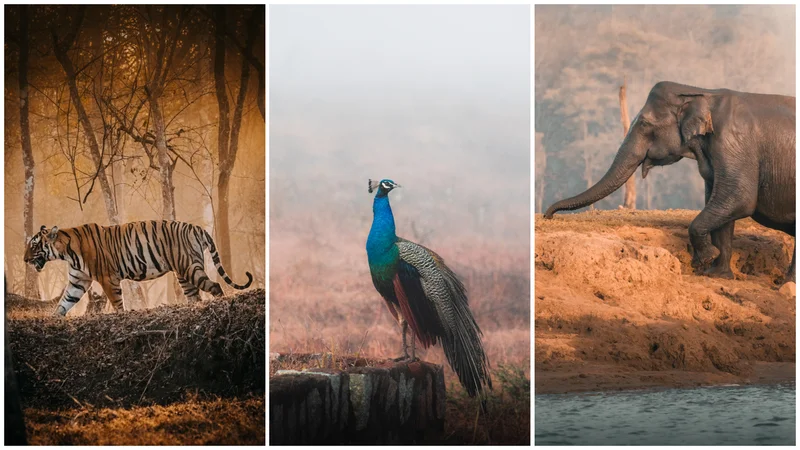
Going on a safari is like visiting someone’s home uninvited. You are not quite sure whether they will be home, and even if they are, you can never really tell whether they will greet you.
My first visit to the Nagarhole Tiger Reserve — an approximately five-hour drive from Bengaluru — this monsoon was a similar, bittersweet experience. I was up before sunrise, and a steaming cup of black coffee later, boarded a jeep to the State-run Jungle Lodges and Resorts, from where all safaris embark. From there, I, along with several others, bundled up in canters and drove into the woods with Chamaraj, a naturalist with The Serai Kabini, and the driver, Abhi.
As the sun rose on the horizon, winding roads led us to the entrance of the Nagarhole Tiger Reserve. With tiger sightings reported from safaris on the previous day, we charged ahead, our excitement mounting at every turn.
Over the next 3.5 hours on the chilly morning, the very able duo whizzed past the forest as we spotted peahens, a peacock plume dance, several spotted deer, owlets, a serpent eagle, and monkeys. The reserve is home to 149 tigers, said Chamaraj, as we continued driving, eyes peeled for the elusive big cats.
Safaris in Karnataka officially resumed recently following a temporary Government ban late last year due to human-animal conflicts. The first monsoon safari season after lifting the ban has been promising, with tourists flocking to the region to experience the lush monsoon and thriving wildlife.
Our safari, however, was a series of ups and downs. As drivers and naturalists exchanged calls and WhatsApp voice notes to trace tigers and other predators, the coordinated mission had us racing through the jungle following pug marks and elephant dung.
Two hours in, it was time for a short tea break, and off we went again. We drove, paused at certain intersections, and greeted fellow safari-goers with disappointed looks as their canters and buses crossed paths. Then, at one such junction, a sudden call from a fellow driver at the other end of the forest sent Abhi into a speeding U-turn. We sped off, flying off our seats, hopeful that the big cat was ready for us. “A tiger has been spotted! If you see it, no videos, please!” said Chamaraj, as the canter made its way to the spot. Alas, we were met with pugmarks by the side of a waterbody where a tiger was spotted moments ago. With no tiger gracing us with its presence, the safari was a thrilling experience nonetheless, and I kept my hopes up for the afternoon boat safari that was to follow.
Back at The Serai Kabini overlooking the swollen Kabini River, a lavish baale yele oota (a traditional Karnataka meal served on the plantain leaf) by Sous Chef Mudhassir awaited me. After a refreshing neer moru, I made my way through the cosumbari salad, Maddur vada, masala vada, obbattu, bisi bele bath, vegetable palya, poori, sambar, and a range of accompaniments: a perfect reset to tune in to the upcoming boat safari.
Serai, by the river
Led by naturalist Shekar and his able captain Krishna, we gently waded down the Kabini River, passing tribal villages, to enter the Nagarhole National Park. The river, said Shekar, originates in Wayanad and divides the Nagarhole National Park to the North and the Bandipur Wildlife Sanctuary to the South.
The 3.5-hour experience was much calmer than the land safari and had a charm of its own. We spotted kingfishers, spotted deer, langurs, ospreys, a family of otters, a pack of wild jackals, and a pair of crocodiles basking in the warm afternoon sun. “It is not common to spot otters and crocodiles during the monsoon; we are lucky!” announced Shekar. With neither of the 149 tigers willing to make their appearance, he can sense the disappointment but continued regaling us with stories and videos from previous sightings. “A mother and two cubs were spotted a few days earlier, and one tiger was spotted swimming across the river last week,” he said.
Shekar has been with The Serai as a naturalist since 2007, two years after the property launched. On our Nature walk through the property the next morning, he shared insights on the region’s biodiversity and how locals and tribal communities continue to thrive off Nature’s bounty. “Tribals rely on the forest for natural remedies: herbs and fruits,” he said, pointing to the jatropha plant whose milk is used to treat fevers and joint pains. On the hour-long walk, we spotted several trees: red silk cotton, jamun, mahogany, gulmohar, and wild neem. With peacock calls for company, we spotted white-cheeked barnets, green bee eaters, a spotted dove, weaver birds busy stitching their nests, common swallows, and kingfishers.
Byre Gowda, a local boatman — who takes guests on coracle rides and the sunset boat ride — has been with the resort since its inception. “Even when the jungle safaris were temporarily closed, we conducted Nature walks, bird safaris, and took guests on boats to experience the region’s biodiversity,” he said on a coracle boat ride.
With birdsong and the riverfront for company, my visit to Kabini is complete. I may not have spotted a tiger, but the solitude, warm hospitality, and thrilling jungle rides were worth every minute. As front office manager Abdul Saleem advises every guest. “Go into the jungle with zero expectations, and come back with many memories.” I certainly did.
The writer was in Kabini on invitation from The Serai Kabini
Published - August 14, 2026 10:55 am IST