48% of waste generated daily ends up in bodies of water, streets – DENR
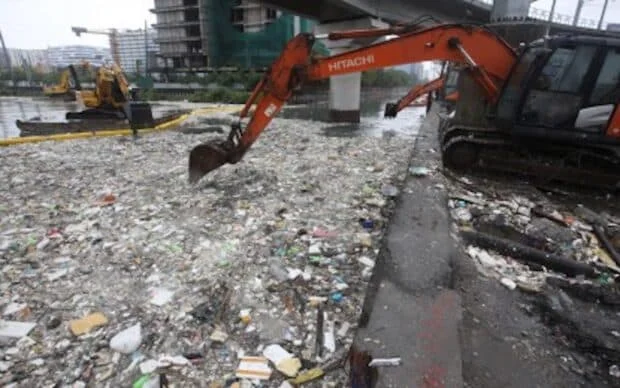
MANILA, Philippines – The Department of Environment and Natural Resources (DENR) on Thursday said at least 48 percent of the 65,000 tons of waste generated daily nationwide ends up in waterways, bodies of water and streets.
In a television interview, DENR Undersecretary Jonas Leones said the Philippines generates an estimated 61,000 to 65,000 tons of waste every day, but only about 52 percent is collected.
“Medyo seryoso yung ating problema sa basura. Base sa aming data, at least 52 percent of our generation, yun lang yung nakokolekta natin. But the rest, about 48 percent of our garbage generation, either napupunta sa waterways, napupunta sa water body, at yung mga iba naman nakakalat sa daan (Our problem with waste is quite serious. Based on our data, we collect only at least 52 percent of our generation. But the rest, about 48 percent of our garbage generation, either ends up in waterways, ends up in bodies of water, and the others are scattered on the streets),” he said.
In Manila Bay alone, Leones said there are 333 creeks connected to it, including 17 major tributaries, noting the seriousness of the problem.
He explained that every person in the country generates approximately 0.7kg of waste every day, based on conservative data, resulting in very high waste generation.
During the summer season, he said garbage doesn’t flow with the water and mostly remains in the drainage or in bodies of water.
“But pagdating ng malakas na ulan at yung tubig talagang umaagos na, dala-dala na yung mga basura. So ganoon kaseryoso. Kung di talaga magkaroon ng magandang programa para dito, talagang magtutuloy-tuloy at magiging seryoso ito (when the heavy rain comes, and the water really starts to flow, it carries away the trash. So that’s how serious it is. If there really isn’t a good program for this, it will definitely continue and become serious),” he said.
Long-term solutions
He said the DENR is pushing a mix of recycling, waste reduction, private sector participation, and possible waste-to-energy technologies as long-term solutions to the country’s worsening garbage problem.
Leones said the shift from what he described as a “linear economy,” where waste is discarded after use, to a circular economy that focuses on recycling and recovering materials is one of the long-term solutions.
He said many sanitary landfills are reaching their maximum capacity, with some already becoming large mounds of garbage.
To address this, he said the DENR is promoting the conversion of landfills into integrated facilities that can recover value from waste, instead of serving solely as disposal sites.
“Meaning, hindi na lang siya disposal (it is not just disposal), we are reintegrating it with facility that can recycle and repurpose or upcycle this solid waste, event plastics,” he said.
The goal, Leones said, is to extend the life of landfills while reducing the volume of garbage that ultimately requires disposal.
Cutting at the source
Through the implementation of the Republic Act 11898 or Extended Producer Responsibility (EPR) law, the DENR is also working with the private sector, specifically the manufacturing companies, to reduce waste before it enters the waste stream.
The EPR law requires companies to take a greater role in managing the waste generated by their products, particularly plastic packaging, including sachets.
The agency is also encouraging manufacturers to reduce the amount of plastic used in packaging to prevent additional waste from accumulating.
Exploring waste-to-energy technology
During an inspection of the garbage-clearing operation at the Baclaran River in Parañaque City on Wednesday, President Ferdinand R. Marcos Jr. thumbed down calls for stiffer penalties for improper waste disposal, saying that the government must first ensure that there are adequate garbage facilities.
Marcos said the administration is pursuing a waste-to-energy program that would process collected garbage and convert it into electricity, reducing the country’s dependence on landfills.
Leones said countries like Singapore and the United States generate more waste than the Philippines, but noted that they have adopted technologies to address their solid waste.
“They adopt waste-to-energy technology and may facilities sila for effective recycling and recovery facilities. Dito sa atin kulang yon. So bagamat maliit ang ating generation per capita, pero yung atin medyo nalilimit (they have facilities for effective recycling and recovery facilities. Here, we lack that. So even though our generation per capita is small, ours is somewhat limited),” he said.
Leones also noted the need to revisit RA 9003, or the Solid Waste Management Act, to strengthen the country’s approach to waste management.
With some groups raising concerns about compliance with the Clean Air Act (RA 8749 and the Ecological Solid Waste Management Act, he said there are Supreme Court rulings that have clarified that waste-to-energy facilities may be allowed if they meet environmental standards.
“Ang sabi ng SC sa interpretation sa mga batas natin, (The SC said in the interpretation of our laws), for as long as the technology will not violate our emission standards, may thresholds tayo dyan, pwede naman din, ina-allow (we have thresholds for that, it is allowed),” he said.
He added that the DENR, the Department of Energy (DOE), and the Department of the Interior and Local Government (DILG) are discussing possible policy measures and legislation that could help advance technologies that comply with environmental regulations.
Proper waste disposal
Leones emphasized that addressing the garbage problem in the country will also require changing public behavior.
He stressed that proper waste disposal habits should be developed at an early age and reinforced through education.
Leones said environmental awareness and proper waste management should be taught to children until it becomes their habit.
“Dapat ito talaga behavioral change. Even sabi nga ni Mayor (Francis) Zamora, talagang disiplina, magsisimula yan dapat sa kabataan pa lang (This should really be a behavioral change. Even Mayor (Francis) Zamora said, discipline should really start at a young age),” he said.
“So kailangan dito pa lang sa level ng kabataan sa ating curriculum, dapat na-instill na natin itong mga disiplina particularly sa mga environmental laws, itong pagdidispose ng mga waste. Dapat alam nila na may mga lugar na dapat pagtapunan at hindi basta-basta kung saan-saan lang tinatapon (So it is necessary that at the level of the youth in our curriculum, we should have already instilled these disciplines, particularly in environmental laws, waste disposal. They should know that there are designated places for disposal and that waste should not just be thrown anywhere),” he added. (PNA)
Disclaimer: The comments uploaded on this site do not necessarily represent or reflect the views of management and owner of Cebudailynews. We reserve the right to exclude comments that we deem to be inconsistent with our editorial standards.