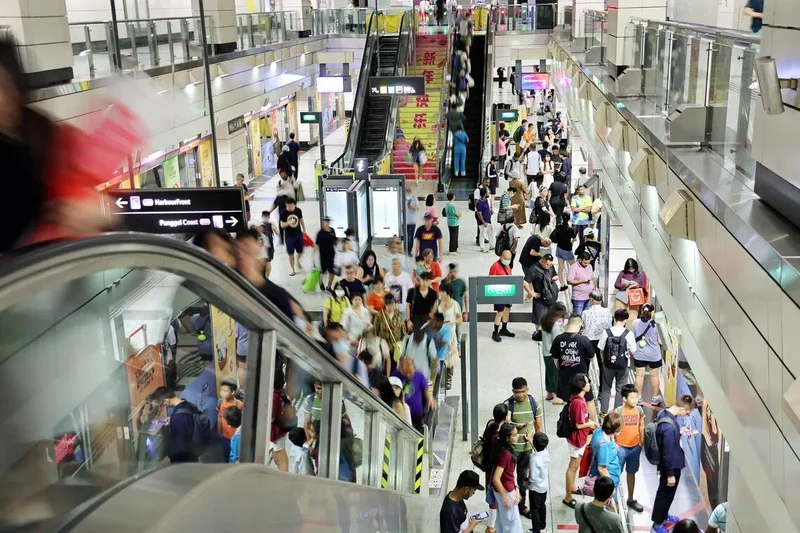
MRT reliability figures improve for all lines; record 9 months without major delay of 30 mins or more
AI generated
SINGAPORE –MRT reliability numbers improved across all train lines in July, without a single delay of more than 30 minutes for a record nine months since the last one in November 2025.
On average, MRT trains clocked 2.37 million train-km between delays lasting more than five minutes between August 2025 and July 2026, said the Land Transport Authority (LTA) in its latest rail reliability report on August 14.
That means the MRT network’s reliability metric exceeded the two million train-km mark for the fourth month in a row.
This is above Singapore’s rail reliability target – measured by mean kilometres between failure (MKBF) – of one million train-km for the entire MRT network.
Overall train punctuality dipped slightly across the five lines to 99.29 per cent in July, from 99.32 per cent the previous month, the report said.
MKBF is a widely used engineering measure of rail reliability, and shows how far a train travels before it encounters a delay lasting more than five minutes. LTA figures are based on a 12-month moving average.
Train punctuality is measured as the percentage of trips completed within two minutes of the scheduled time.
Rail reliability figures for the SMRT-operated Circle Line (CCL) registered an improvement from 2.4 million train-km to 2.45 million train-km in July.
Similarly, the North East Line (NEL) – operated by SBS Transit (SBST) – remained the most reliable MRT line, averaging 4.47 million train-km between delays in July, up from 4.46 million train-km in the previous month.
Reliability for the other lines held steady.
DTL remained at an average of 4.2 million train-km between delays, while the East-West Line (EWL) stayed the same at 2.02 million train-km.
The North-South Line (NSL) remained the least reliable MRT line, recording 1.65 million train-km between delays in July. Both NSL and EWL are Singapore’s oldest MRT lines.
LTA said there was no major delay exceeding 30 minutes on the MRT lines since November 2025 – the nine-month period being the longest without such a delay since the figure was first tracked in 2011.
It added that the results achieved over the last four months reflect the sustained effort and dedication of transport workers and rail operators. It also showed the impact of recommendations made by a task force in February, aimed at improving rail reliability.
For train punctuality, NSL registered a drop from 99.75 per cent to 99.69 per cent while DTL similarly dipped from 99.83 per cent to 98.84 per cent. The other lines saw improvements in their punctuality scores.
The proportion of train services that operated on schedule also inched downwards, from 99.82 per cent to 99.71 per cent.
Two of the five MRT lines – the NSL and CCL– recorded improvements on this measure, while the EWL, NEL and DTL experienced marginal dips.
The punctuality of trains and proportion of train services operating on schedule for the DTL were lower in July due to planned system integration testing.
The reliability of the Thomson-East Coast Line (TEL), which is excluded from the overall reliability report, improved in July, averaging 373,000 train-km between delays.
The TEL also did not encounter a major delay exceeding 30 minutes in July.
The TEL, which is operated by SMRT, is not included in the report because MRT lines in their early stages tend to have significantly lower mileage because of relatively low ridership and trains not running at typical frequencies, said LTA previously.
At the time, LTA added that the line’s performance is expected to improve after it fully opens in 2026 and operations have stabilised.
The fifth and final stage of the TEL, comprising Bedok South and Sungei Bedok stations, will open later in the year.
The LRT network’s overall reliability also improved in July, with trains averaging 670,000 car-km between delays, up from 533,000 car-km in the previous month.
The SBS Transit-run Sengkang-Punggol LRT recorded 898,000 car-km between delays, improving from 892,000 car-km.
The Bukit Panjang LRT, operated by SMRT, was also more reliable in July, clocking 441,000 car-km between delays, up from 293,000 car-km.
The report also compared how Singapore’s MRT system fared against other global metro systems in terms of MKBF figures.
Singapore placed second after Taipei, and ahead of Hong Kong and New York City.
Taipei’s metro system averaged 23 million car-km between delays lasting more than five minutes from January to December 2024, while Singapore’s MRT system recorded 11.42 million car-km between such delays from August 2025 to July 2026.
The Hong Kong MTR registered 4.53 million car-km from April to June 2026 and the New York City subway system clocked 201,000 car-km from July 2025 to June 2026.