Save
You have reached your maximum number of saved items.
Remove items from your saved list to add more.
AAA
It’s taken its sweet time to get there, but I reckon Silo, now in its third season, is a serious contender for best sci-fi show on TV. At any rate, it’s almost certainly the best show you’ve never heard of.
That’s at least partially because it’s on Apple TV, which in the Australian market remains a minnow. If it were on Netflix, we’d all be talking about it. Except I suspect Netflix would never commission a show like this.
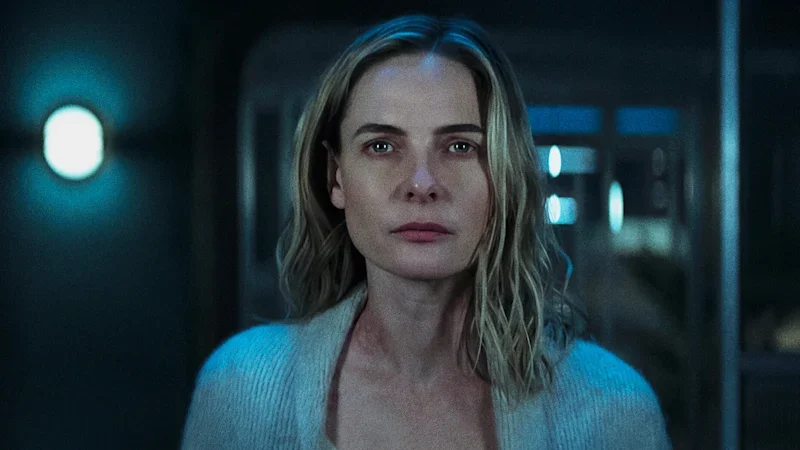
A sci-fi suspense thriller in which the mystery is existential, it is expensive, ambitious, niche, achingly slow – and all the more delicious for it. It also boasts some of the best production design I have ever seen, though the fact a good deal of it is shot in murky half-light means you often have to squint to make out the detail.
That might make it hard to love for some viewers, but if you can dwell in the depths a little the rewards are enormous.
What’s it about?
Silo is set a long way into a post-apocalyptic future, inside a self-sustaining vertical city that’s been bored 144 storeys down into Earth.
At first, we’re led to believe it’s 140 years after an uprising of some sort, though whether that marks the start of silo life or merely a rupture in it is unclear.
Later we learn the silo has been inhabited for at least 352 years. Later still, we learn the silo has the capacity to support life for around 500 years. It’s a mystery how far along that timeline we are; but given the sense of impending doom that surrounds everything, you’d go all in on a minute to midnight.
As the leaders of this 10,000-strong community intone at various points, we don’t know who built this structure, or when, or why. We only know that going outside – as miscreants are sometimes forced to do, in a ritual known as “cleaning” – is a death sentence.
It’s called a cleaning because that’s what the expelled are asked to do – to wipe the smudge off the lens of the video camera above the exit hatch, so that everyone inside can see just how unsuited to life the outside world remains. Yes, it’s a mode of control, but it’s also key to the survival of this remnant civilisation.
Most people sent out to clean vow they won’t do it. They are generally evicted, after all, for being in some way oppositional to the rules of the silo. But once they’re out there something changes. They do clean. Because they want everyone to see what they have seen, which is not the same as the image from inside.
Silo’s production design is superb … if you can make it out in the dark.Apple TV+
OK, but what’s it really about?
Hugh Howey, who wrote the trilogy of novels on which the series is based (Wool, Shift and Dust), has said the huge communal screen was his initial inspiration.
“I just wanted people trapped in a world where they only had one view of the outside and that was through a screen, and the screen was telling them bad news every single day of their lives. What did that do to their psyche?” he told an interviewer on the eve of season two. “Because I felt like that’s what my TV, my laptop, my phone, my computer [were doing] … Our screens were telling us mostly bad news. This can’t be good for us.”
That first novel was published in 2011, before AI and deepfake technology began to erode our faith in the image as vessel of the real. Imagine how glum Silo might be if Howey were to start writing the books now.
The image on the screen in Silo is both threat and promise. Break the strict rules of the community, and you will be banished to a desolate wilderness and near-instant death. Conform and you will live in safety, albeit one that is tightly controlled. It’s a devil’s bargain not unlike that which real people around the world seem increasingly willing to make.
Beginning to see the light: Rebecca Ferguson is on a quest to discover the truth about the place she calls home.Apple TV+
The world of Silo is a lot like that of Bong Joon Ho’s Snowpiercer (2013), only here the class system is organised vertically rather than horizontally, in a tower rather than on a train. At the base are the miners, the mechanics, the cleaners; in the mid-tiers are other workers, the security staff, and their families; at the top are the administrators, the mayor and judiciary, and IT.
What to expect each season (mild spoilers below)
Season one was all about the world building, establishing our characters and the limits of their knowledge – ignorance really is the glue that binds this society. It also posed plenty of questions that remained largely unanswered by the end of its 10 episodes.
Season two found our heroine, Juliette Nichols (Swedish actor Rebecca Ferguson, who is also a producer), going outside and not only surviving but discovering there’s a whole other silo out there. But rather than answering the mysteries – the who, the when, the why – it only served to extend and deepen them.
In season three, we finally have some answers.
Juliette is a lowly mechanic when we first meet her. We see her for the first time at the end of the pilot episode, silhouetted against a flaming generator, wearing dungarees and a grubby singlet, wielding an oversized wrench. She looks marvellous, like the female hero of some pride-stirring piece of Soviet-era socialist realism.
The first time we see Juliette, she looks like a figure from Soviet-era socialist realist art. Screengrab
She’s smart, inventive, morally upstanding – and inevitably an inspiration to her fellow workers and a thorn in the side of the ruling class, especially Bernard (Tim Robbins), the shadowy head of IT and later mayor. Of course, she has to be evicted. And of course, she has to return – with information that changes everything, but potentially spells disaster.
Trouble is, she can’t remember what that information is.
If what people are told is a major focus in Silo, so is what they remember. In a sense, both are versions of knowledge – and knowledge is power. Power can free and it can destroy.
In season three, the revelations come mostly via a parallel storyline set in the before times. Congressman and engineer Daniel Keene (Australian actor Ashley Zukerman) – introduced right at the end of season two – starts digging into a failed military mission in Iran that almost had his pilot sister killed. He’s aided by an investigative journalist (Jessica Henwick) whose desire to uncover the truth is unwavering.
Ashley Zukerman stars in the new season of Apple TV’s dystopian drama Silo.Apple TV
The plot weaves in AI, nanotechnology, a conspiracy of government and tech billionaires, and a whole lot more. It’s complicated and murky and unravels slowly – as is the way with this show – but it’s utterly compelling.
I’ll say no more, because the joy of Silo is the slow reveal. And with one more season to come, I can’t wait to be drip-fed the resolution. Yes, it demands patience. But my goodness, it rewards it too.
Silo is streaming on Apple TV now.