‘They’re all catastrophic’: The paediatric war wounds Dr Abu Sittah tries to heal in Lebanon
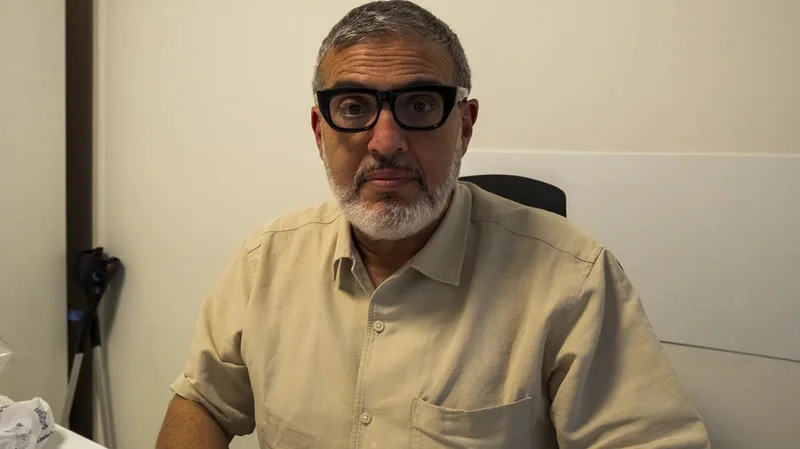
In his Beirut office, Dr Ghassan Abu Sittah is going over his operating list for the weekend: 11 children in total, with life-altering injuries from Israel’s wars on Lebanon and Gaza.
“There are two siblings who have shrapnel from the 2024 war that is now causing medical problems,” the prominent British-Palestinian plastic and reconstructive surgeon told Middle East Eye.
“A boy with a partial amputation of his foot that needs reconstruction, from this war, and another boy with an amputation.”
Dr Abu Sittah hopes to finish the stump so that the patient can begin prosthetic rehabilitation.
Another boy with an elbow injury needs a prolonged reconstructive procedure to salvage his elbow joint.
“And so on, they are all like that… catastrophic,” the surgeon added.
One of his patients is Fatima al-Jabal, 12, the youngest of three sisters who survived an Israeli strike on their house in the small mountain village of Libbaya, in the Bekaa Valley, on 7 March.
The body of their fourth sister was blown to pieces in the attack, while their mother was seriously injured and later succumbed to her wounds in hospital.
Fatima has already undergone multiple surgeries on her foot and jaw, which was dislocated in the blast. She also lost an eye.
Now Abu Sittah must extract more shrapnel from her face and back to avoid further infection.
Life‑altering war wounds
Days earlier, MEE met with Fatima, her older sisters Malak, 16, and Kawthar, 14, in their hotel in the neighbourhood of Hamra, in the Lebanese capital, where they have been living while undergoing treatment at the American University of Beirut Medical Centre (AUBMC).
Inside the two-bedroom apartment, the fragrant aroma of caramelised onion filled the air. Their father, Hassan Ali al-Jabal, 60, was cooking moudardara, a Lebanese dish made of green lentils and rice.
‘It was like something was eating off her body because of all the shrapnel’
– Hassan Ali al-Jabal, father of wounded children
Still in their pyjamas, the three girls were sitting together making blue and pink beaded bracelets and phone straps, which they hoped to sell, while eating a bag of BBQ-flavoured crisps – their favourite snack.
On the balcony, folded against the wall, was a wheelchair. Until recently, all three sisters needed it.
Malak, the eldest, instinctively pulled down her lavender nightdress to hide the extensive burns covering her legs before her father gently reassured her that there was nothing to be ashamed of.
The teenager suffered catastrophic wounds – that is, ones that have serious, long-term consequences, often causing permanent disfigurement, disability or loss of independence – including a traumatic brain injury, and multiple fractures.
Months of physiotherapy have helped her regain some independence.
“I can now go to the bathroom on my own, so I have improved a lot,” said Malak, who spent weeks in intensive care following the Israeli strike.
Kawthar can now also move more freely with the help of a walker.
A finger on her right hand and her left leg are still held in place by a rigid external frame and metal pins driven through the skin and into the bone. A scar also stretches across half her face.
“All three have progressed a lot, but they still have a long road ahead and it can take a long time,” Hassan said.
He explained that each girl faces different challenges.
“Kawthar’s leg still needs great improvement. And Malak, only her left arm and face were not injured. She still has a lot of bruising from the needles. And her back still has a lot of injuries.
“For two and a half months, someone had to help her move because of all the broken bones in her back. It was very difficult. We always had to turn her on her sides as she was going through a lot of pain. Her skin was all shredded,” he said.
The father explained that doctors had to transplant skin from the back of her leg to the front, and because her thigh bone was missing, she required a graft.
“Fatima still has to have her eye, teeth and foot fixed. She suffered a lot of infections, which is normal because the wounds were exposed,” he added.
“It was like something was eating off her body because of all the shrapnel.”
None of the girls wished to discuss the weeks they spent in hospital.
‘Wars keep happening’
However, giggles filled the room when Hassan talked playfully about their different personalities. As the eldest daughter, Malak is naturally more responsible and sympathetic than her siblings, while Kawthar is pensive and stubborn. Fatima was described as “very rambunctious”.
For a moment, the apartment felt like any other family home – three sisters making bracelets together, eating crisps and teasing one another, while their father was telling anecdotes about their life before the war.
‘We used to love our lives before […] We will certainly go back, carry on, and love life. But, of course, things won’t be the same as before’
– Malak al-Jabal, wounded child
Then Hassan began to talk about the day he found his daughters among the mountain of rubble that their home was reduced to. Their smiles quickly vanished.
His youngest, Zainab, was missing, and her remains were never recovered.
On the mantelpiece behind the girls’ beds was a portrait of the child, the frame decorated with blooming flowers.
“There is no point in a nice picture,” the father said, angrily. “People tell me that my daughter is in heaven. I want her here, with me, not in heaven. I raised her for 10 years.”
Hassan said his brother was killed the same way during the 1982 war, when Israel unleashed a major military invasion of southern Lebanon – a painful family memory that has resurfaced with the death of his daughter.
Past and present are separated by 44 years, but not by much else, and he is still grappling with making sense of this multigenerational tragedy.
The family had spent years building a life in the village. Hassan’s dream was to build four apartments, stacked on top of each other, for his daughters to always be close to one another.
Reflecting on his life, the father told MEE he never once considered leaving his homeland, until the fatal attack.
“Kawthar said no. She doesn’t want to live elsewhere,” he said.
“It is nice in Lebanon, but you need a future. And wars keep happening. I am 60, so I have lived my life. I don’t know how long I have left.”
Malak, Kawthar and Fatima are yearning to leave Beirut and return to the Bekaa Valley to see their friends, even though life will be vastly different from what they recall. Israeli hostilities and demolitions have continued in southern Lebanon and Israeli officials have repeatedly said the military will not withdraw from land it has occupied during the offensive.
“We used to love our lives before,” the eldest said, with a weight in her voice that did not match someone so young in life.
“We were all good students in school… We will certainly go back, carry on, and love life. But, of course, things won’t be the same as before,” she added.
“We want to be a support system to each other and want to go back and divide the work in the house and be like our mum would want us to be.”
Children face years of surgery
The three sisters are among the over 400 children in Lebanon that have been treated by the Ghassan Abu Sittah Children’s Fund, established by the surgeon in January 2024 to help provide medical treatment in Gaza and Lebanon.
For decades, Abu Sittah, who has his main residence in London, has operated under fire, while treating the youngest, most fragile victims of war during the First Intifada in Gaza, the Gulf War, in Yemen and Syria.
‘Being a spectator is probably the worst thing that you can do when you are watching this horror unfold’
- Dr Ghassan Abu Sittah, surgeon
The scenes in Lebanon – and the paediatric cases – he says are “almost identical” to what he witnessed in Gaza at the onset of Israel’s genocidal war in 2023.
Israel has killed more than 73,200 Palestinians in Gaza since 7 October 2023 – including more than 1,250 after a ceasefire was announced in October – with thousands believed to be dead under the rubble; and more than 4,330 people have been killed in Lebanon since 2 March. Combined, the Gaza and Lebanon fronts have seen over 185,000 people wounded by Israel.
“These children were wounded when Israel bombed their homes… so all of their injuries are either a direct result of the blast wave – shrapnel injuries, burns and tearing of tissue – or they were pulled under the rubble and they have crush injuries,” Abu Sittah told MEE.
“And you rarely get a child with a single injury. It is usually a head injury and a fracture and a burn and other things, and they are all severe.”
All of his patients have suffered “life-altering” injuries, leaving them with permanent disability or deformity. He estimated that around 80 percent required intensive care.
Saving a child’s life is only the first stage. His work then turns to reconstruction. On average, Abu Sittah says that children will require 12 to 16 surgeries until they reach adulthood.
“As a child grows, we need to re-intervene because their body increases in size disproportionately. Scarred and injured parts of the body do not increase in size at the same rate,” he explained.
Despite the US-brokered ceasefire on 16 April, the scale of injuries confronting medical teams in Lebanon, where the healthcare system is heavily privatised and under severe strain, has continued to grow.
For children like Malak, Kawthar and Fatima, a ceasefire cannot erase what has already happened, nor does it necessarily mean that danger has disappeared.
Abu Sittah says the cumulative effect of working amid such suffering is hard to process.
“I deal with it by seeing it within the bigger picture and by being grateful that I have ended up in a junction in my life that I am able to not feel paralysed and not feel like a spectator,” he added.
“Being a spectator is probably the worst thing that you can do when you are watching this horror unfold.”