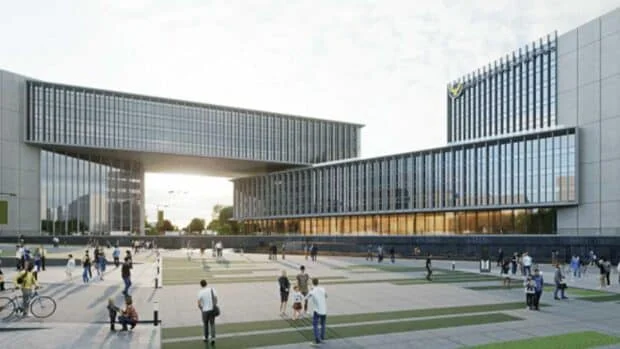
New BSP currency hub: A push for resilience
MANILA, Philippines — The new Bangko Sentral ng Pilipinas (BSP) complex rising on 31.3 hectares in New Clark City is more than a bet on a world-class facility for printing banknotes and minting coins.
It is also a hedge against the risks of keeping the country’s monetary infrastructure concentrated in Metro Manila.
The project in Capas, Tarlac, is the central bank’s contribution to the government’s plan to decongest the capital and establish a modern National Administration Center in New Clark City.
Article continues after this advertisement
The complex will eventually house the BSP’s currency production operations, replacing its roughly 50-year-old facility in Quezon City, a sprawling gray structure that would be costly to retrofit.
But location is as important as the facility itself.
The new site was chosen with business continuity in mind, giving the central bank an alternative base outside Metro Manila in the event of a major disaster that could disrupt its headquarters and existing security plant at the same time.
Acclaimed design
“If you will notice, both the head office and the security plant are in the same area,” BSP Deputy Governor Elmore Capule says in an interview with the Inquirer. “So, if we will have a major earthquake—because the two are on the same fault line—both will be paralyzed.”
The project has also earned recognition for its design. Its conceptual plan was among the winners at the 2022 Architecture MasterPrize design competition, where it was recognized under the Architectural Design-Institutional Architecture category.
Article continues after this advertisement
The project is now edging closer to construction after Aidea Inc., its architectural and engineering consultant, finalized the detailed architectural and engineering design documents in the previous year.
That cleared a key hurdle before the central bank could procure a general contractor. The hunt for a builder is now about to begin.
Article continues after this advertisement
“We are now transitioning to that stage,” Capule says.
The move to New Clark City has been years in the making. The BSP initially targeted 2022 for the transfer of its minting and printing operations, a timeline that ultimately slipped.
It later aimed to complete the new complex by 2028, although that target remains fluid. The final timetable will depend largely on the contractor’s ability to deliver what will be a massive and highly specialized facility.
“Maybe once we come out with a winning bidder, then we can talk with the bidder if the timeline is realistic,” Capule says.
The project itself has also been scaled back since it was first conceived, as the BSP sought to contain construction costs.
The original vision went well beyond a new security plant. It included enhanced cybersecurity for the central bank’s data center and information technology (IT) systems, a research academy, facilities to preserve and promote culture and heritage, as well as sports and employee wellness facilities.
Those ambitions have since been pared back.
Capule says the complex will now focus on the “more basics”—the minting and printing facility, IT infrastructure and skeletal office space that could serve as a backup if the BSP’s Manila headquarters becomes inaccessible.
“When we started the planning, there were a lot of buildings that we were supposed to place there. But then the Monetary Board decided, ‘Let’s just go to the basics,’” he says. “Some areas will no longer be developed. Some structures will no longer be built.”
For a central bank whose mandate depends on the uninterrupted flow of money and payments, the redundancy may ultimately prove more valuable than a grander complex.
“So, it will serve dual purpose,” Capule adds. INQ