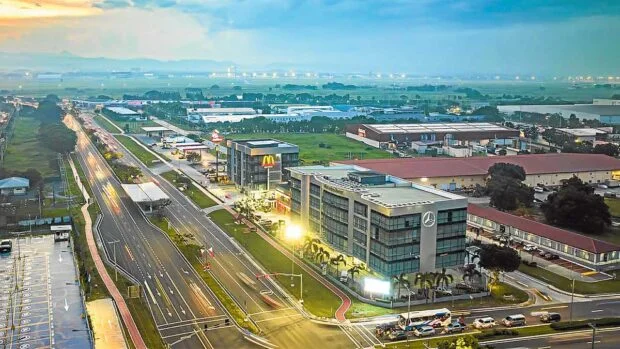
Clark makes its case as next big thing for PH
MANILA, Philippines — There has been no shortage of buzz around Clark lately, nor of reasons to pay attention.
What was once best known only for housing the largest United States military air base outside American soil is now rapidly carving out a new identity as one of the Philippines’ most attractive and fast-growing investment centers.
Businesses, both local and foreign, are already there by the thousands. So are factories, aviation and logistics facilities, hotels and sprawling leisure developments. World-class sporting venues have risen, too. And now, advanced manufacturing and artificial intelligence (AI) are being drawn into the picture.
Article continues after this advertisement
As President Marcos himself puts it, “the Clark metropolis has what it takes to be a Mecca for tourists, a magnet of investments, and a market of goods and services.”
Ultimately, his government wants to turn Clark into “Asia-Pacific’s next investment hub.”
Much of that ambition rests on the Clark Freeport and Special Economic Zone, an expansive 35,300-hectare (ha) enclave that sits in Pampanga and spills over into Tarlac. Roughly half the size of Metro Manila, the area is positioning itself to capture investment opportunities that have traditionally gravitated toward the capital.
Clark International Airport already hosts facilities operated by global names such as Federal Express Corp., United Parcel Service, Inc. and Lufthansa Technik Philippines. A few kilometers away, New Clark City is taking shape with sprawling leisure and gaming developments, world-class sports facilities and, soon, a massive new industrial hub built around the technologies powering the AI age.
In Clark Freeport Zone alone, there are already 1,300 business locators that employ more than 150,000 workers, with some the biggest names being SFA Semicon Philippines Corp., Yokohama Tire Philippines, Hann Casino, Hilton Clark and Marriott Hotel.
Article continues after this advertisement
Behind much of this transformation is the Bases Conversion and Development Authority (BCDA), the state-run corporation created to turn former military properties into economic growth centers. Its subsidiaries, the Clark Development Corp. and Clark International Airport Corp., oversee key parts of the Clark estate.
From air base to investment hub
Since its creation in 1992, the agency has helped transform John Hay Air Base into what is now Camp John Hay in Baguio and Fort Bonifacio into the upscale Bonifacio Global City. In Clark, the former air base has given way to a freeport and special economic zone that the government now wants to push into its next phase of development.
Article continues after this advertisement
Over time, that transformation has allowed Clark to offer more than its history or sheer size.
Clark sits within the Luzon Economic Corridor, a strategic growth belt that also encompasses Metro Manila, Subic and Batangas and that collectively accounts for about half of Philippine gross domestic product and roughly 80 percent of the country’s port traffic.
Since 2024, the corridor has enjoyed the backing of the United States and Japan, which teamed up with the Philippines to develop what they describe as the country’s “largest economic engine.” Just this May, Australia, Canada, Denmark, France, Italy, South Korea, Sweden and the United Kingdom joined the initiative, bringing with them billions of dollars worth of investment commitments.
Clark stands to benefit from some of the corridor’s most ambitious infrastructure projects.
These include the 212-kilometer Subic-Clark-Manila-Batangas Railway, the North-South Commuter Railway envisioned to eventually extend to Tarlac, and a Subic-Clark fuel pipeline aimed at modernizing the movement of fuel between two of Luzon’s major growth centers.
But within that broader economic corridor sits an even more ambitious vision for Clark: an advanced manufacturing hub geared toward AI, to be realized through the United States-led Pax Silica initiative.
AI age
The Philippines joined Pax Silica only in April. Already, the government is proposing to devote 1,619 hectares of New Clark City to an industrial hub that would dwarf many existing economic zones.
According to the BCDA, the site would occupy part of the 9,450-hectare New Clark City and seek to capitalize on something the Philippines has long struggled to fully exploit: its own mineral wealth.
Much of those resources currently leave the country in raw form. Through Pax Silica, the Philippines aims to capture more of their value at home by building the industries that process materials and turn them into higher-value products.
In that sense, the project is also an attempt to pull the Philippines deeper into the industrial supply chains ushered in by the AI age.
While the project is at times misconceived as a sprawling collection of data centers, its true north lies in advanced manufacturing, including the production of semiconductors and electronics, which remain the Philippines’ biggest export products.
Even the kind of companies the Philippines wants to attract affirms the scale of that ambition.
Among the names being courted are Foxconn, the Taiwanese electronics manufacturing giant known for assembling much of the world’s iPhones, and Amazon Web Services Inc., the cloud computing arm of Jeff Bezos’ Amazon.
And although the project has inevitably drawn comparisons to America’s Silicon Valley, BCDA president and CEO Joshua Bingcang has a different comparison in mind for what the broader development could eventually become: a “little Singapore.”
Getting there, however, will take time, as Bingcang says Pax Silica’s full development can take as long as 30 years.
BCDA estimates that a fully developed Pax Silica could draw $40 billion to $70 billion in infrastructure investments and generate $200 billion in annual exports. Over the same period, the agency projects the AI hub could create between 130,000 and 190,000 direct jobs, along with another 500,000 to 800,000 indirect jobs.
For Bingcang, however, the ultimate goal goes beyond investments and exports. It is also about spurring a “brain gain.”
Home to local talent
“Instead of us sending our best talents abroad to work in the biggest companies abroad, let us work in our own homeland, with foreign investments providing the opportunities,” he says.
Indeed, Clark’s biggest promise rests as much on what it could become as on what it already is.
Both the scale of what is already taking shape there and the much bigger plans still ahead show just how big a wager the government is placing on Clark to become the Philippines’ next big thing: an alternative growth center beyond Metro Manila capable of catching the next wave of investment.
Whether Clark can fully live up to that ambition may take decades to answer.
But for a place whose tagline declares that “It Works. Like a Dream,” Clark appears closer than ever to realizing that promise — that beyond the capital can rise another economic center capable of carrying ambitions just as big. INQ