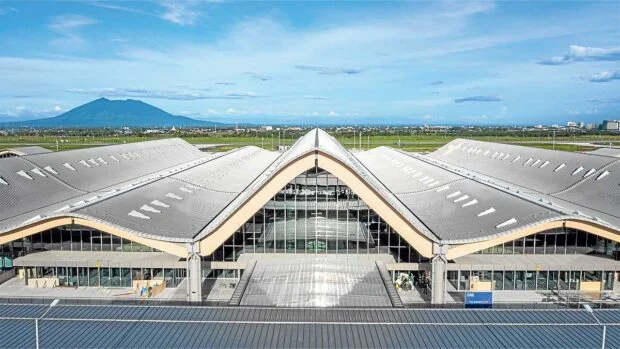
Thriving in the skies, then and now
MANILA, Philippines — Clark in Pampanga and Tarlac may have left its military aviation past behind decades ago, but that place has never quite lost its affinity for the skies.
Thirty-five years after outgrowing its roots as the United States’ Clark Air Base, Clark is again being defined by what happens above it. This time, through a bustling commercial aviation ecosystem built to move both people and cargo.
Anchoring the area’s growing proposition as an aviation investment destination is Clark International Airport, which sits at the heart of the 2,367-hectare (ha) expanse now known as the Clark Aviation Capital.
Article continues after this advertisement
The airport is run by Luzon International Premiere Airport Development (Lipad) Corp., a consortium that includes Changi Airports Philippines (I) Pte. Ltd., a local unit of the group that operates Singapore’s world-class Changi Airport, and JG Summit Holdings Inc., the Gokongwei-led conglomerate that owns Cebu Pacific, the Philippines’ largest airline.
Lipad also includes Filinvest Development Corp. and aviation services firm Philippine Airport Ground Support Solutions Inc.
Already one of the Philippines’ busiest airports, Clark has increasingly moved beyond an airport’s most basic function of facilitating passengers’ travel from one place to another. Around it, a broader economy built on aviation and logistics is emerging.
“Clark International Airport has always been more than an airport. It is a gateway that connects people, businesses and opportunities,” says Lipad Corp. CEO Noel Manankil.
Lipad wants to take that further by developing the installation into what it envisions as the country’s first and only “airport city.”
Article continues after this advertisement
Dubbed the “Clark AeroDistrict,” the plan calls for an ecosystem built around aviation, travel and commerce, complete with aircraft maintenance, repair and overhaul (MRO) facilities, general aviation and cargo operations as well as commercial developments such as hotels and offices.
“We want Clark to become a leading hub for aviation, logistics, business and investment,” Manankil says.
Article continues after this advertisement
Even before that vision is realized, Clark International Airport already has international recognition to show for its ascent.
Most recently, it was named one of only six airports worldwide recognized for Best Airports at Arrivals Globally by Airports Council International World, an award based on passenger satisfaction.
In terms of traffic, the airport handled 1.64 million passengers, up 6 percent from a year earlier. Flight movements climbed 27 percent to 14,987. Cargo volume reached 48,655 metric tons, up 10 percent, with nearly all consisting of international shipments.
‘The place to be’
While passenger counts have yet to return to prepandemic levels, there are signs that Clark is headed in that direction.
For one, it now enjoys additional services from turboprop, smaller aircraft commonly deployed on domestic routes, following their reassignment from Ninoy Aquino International Airport. It is also seeing the arrival and expansion of some of the biggest names in global aviation.
Chief among them is Germany-based Lufthansa Technik, which is making a major investment in a 157,000-square-meter MRO facility capable of accommodating two Airbus A380s, the world’s largest passenger aircraft.
It is Lufthansa Technik’s single-largest investment yet in the Philippines—even bigger than its existing facility in Pasay City. And if you ask the company, choosing Clark was hardly a difficult decision.
“We truly believe this is the place to be here in the Philippines for the MRO industry,” says Lufthansa Technik president and CEO Holger Beck. “Clark has a distinct advantage because it’s a logistics hub already.”
‘Cargo city’
Aerospace manufacturers have followed the same path to Clark. Among them are Jamco Corp., a Japanese maker of aircraft interior parts that supplies both Airbus and Boeing, and Heatcon Asia Inc., which makes composite repair parts and also supplies Boeing.
Then there is cargo, where another cluster of global companies is building up its presence.
Federal Express Corp. is currently expanding its Clark facility to more than 78,000 square meters to support express, e-commerce and freight shipments.
United Parcel Service, Inc. (UPS) is making its own push into Clark, with a new sorting facility set to open this September. As a sign of just how gung ho it is on the Central Luzon gateway, UPS has even asked US regulators to allow it to transfer existing services to Poland and Vietnam to Clark.
Lipad’s airport city plan would eventually give those operations a larger logistics ecosystem of their own through a 30-ha “cargo city,” which would centralize cargo handling, customs clearance and warehousing to speed up the movement of goods.
With more passengers, cargo and investments moving through Clark, plans are also underway to give the airport more room to operate.
Room for more
State-run Bases Conversion and Development Authority (BCDA)—which helped transform the former military base into the civilian economic asset it is today—is moving forward with plans for a second runway at Clark International Airport, intended to be operational by late 2029.
That planned runway would serve as a backup to Clark’s existing 3,200-meter main runway, allowing airport operations to continue during maintenance or other disruptions.
According to BCDA president and CEO Joshua Bingcang, the added capacity is expected to have an impact well beyond the airport itself.
“This development will benefit Clark and the wider Central Luzon region by enhancing connectivity for locators and businesses, while also generating more employment opportunities for the local communities as the airport and related support services expand,” Bingcang says.
Now, aviation is only one part of the much larger development taking shape across Clark. But it is perhaps fitting that the industry with one of the deepest roots in the former military air base could help many of those ambitions take flight. INQ