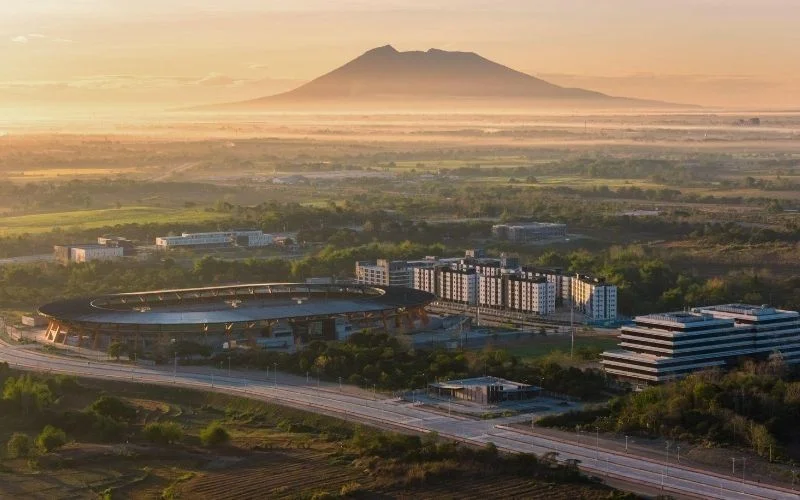
AI manufacturing hub at Clark would need up to 90 million liters of water daily
MANILA, Philippines — A US-backed artificial intelligence manufacturing hub planned at Clark would need between 65 and 90 million liters of water a day, more than three times the current water system serving New Clark City, officials said at a Senate hearing.
The estimate, given on Friday, August 14, by the Bases Conversion and Development Authority (BCDA), is the first official figure for the water demand of a project that has become one of the most contested development plans under the Marcos administration.
Joshua Bingcang, BCDA president, said the water would be drawn from rivers in Central Luzon and captured in tanks, rather than pumped from underground.
"This is not ground extraction. We will not take from there, because that is for residential use," Bingcang said in mixed English and Filipino, during the inquiry by the Senate environment committee. "What we are looking at are the waterways, the rivers, because the water there just flows."
The 1,600-hectare site at New Clark City is the first project under Pax Silica, a US-led coalition to build supply chains for AI and semiconductors outside China's reach. The Philippines joined in April and is one of only two Southeast Asian members, alongside Singapore.
Government officials have presented the hub as an opportunity to move beyond low-value electronics assembly, promising up to $70 billion (P4 trillion) in investment and up to 190,000 jobs. But farmers' groups, scientists and Indigenous rights advocates say the costs to land, water and local communities have not been properly assessed.
River as source, but what happens in a drought?
The plan, Bingcang told senators, is for detention tanks to capture surplus flow from the Bangut River, the closest source to the site, with the O'Donnell and Abacan rivers as other possible sources.
A study of the Bangut alone, carried out in the dry season, suggested it could yield more than the hub would need, Bingcang said.
A third option is desalination, Bingcang added. The BCDA has signed a preliminary deal to pipe treated seawater about 70 kilometers from Subic.
Sen. Raffy Tulfo, who chairs the Senate environment committee and called the inquiry, asked what would happen in a drought.
He noted that water utilities in provinces near Clark already draw complaints.
"So rivers are really what you're relying on. That's your main source," he said. "What if there's an El Niño and the rivers dry up? Your requirement is daily."
Bingcang said the study had deliberately been run in the dry season. He did not say what would happen if river flows fell below that level.
Questioned by Sen. Kiko Pangilinan, Bingcang said New Clark City's current system draws on deep wells with a capacity of "up to" 20 million liters a day, against a demand of under three million.
"So, you have a demand of three, you have a capacity of 20, but you are anticipating 65 to 90, which means you need to build about five times more," Pangilinan said. "In the context of a timeline of building that: How long will it take for you to reach that? Or will you not be the ones to build that?"
"In BCDA's master plan, we have a plan that by 2030, we will reach 30 [million liters a day], and by 2036, 100. That's why we need investors," Bingcang said.
During his questioning, Senate President Sherwin Gatchalian noted that the agency's budget could not cover all its needs and that nothing had been set aside for 2027, meaning the agency would essentially be acting as a "landowner."
Infrastructure rollout for the planned AI manufacturing hub could begin in the second half of 2027, Ceferino Rodolfo, undersecretary of the Department of Trade and Industry, told Gatchalian.
Essential utilities — including power, water, and road networks — will be prioritized ahead of commercial operations, Rodolfo said.
Commercial locators and businesses will not move in immediately, with operational onboarding projected for 2028 at the earliest.
**Wastewater risk **
Semiconductor plants produce wastewater containing heavy metals, solvents and toxic chemicals.
Asked how this would be kept out of local water sources, Michael Matias of the Department of Environment and Natural Resources' Environmental Management Bureau said the ideal arrangement would be a shared treatment facility on the site.
Pressed on whether that was actually in the plan, he said the details could be worked out with the agency.
Bingcang said treatment already exists in the wider master plan and can be expanded, but that the capacity the new hub would need has not been calculated.
"It should have been considered by now," Tulfo said.
'No consultation'
The mayor of Capas, the town where most of the land lies, told senators that no public consultation had taken place prior to the announcement of the planned AI manufacturing hub.
Mayor Roseller Rodriguez said the local council was invited by text message to a meeting in June without being told what it was about, and that Pax Silica was mentioned only in passing among a list of projects.
"What we are asking of BCDA now is a meaningful public consultation with the presence of all affected stakeholders," Rodriguez said.
Pangilinan pressed Bingcang to respond to that request, who then said a meeting was supposed to take place today but had to be postponed due to the Senate inquiry. Another wider meeting is planned later this month.
BCDA projects inside New Clark City also do not require permits from the Capas municipal government, Rodriguez said.
Conflicting figures
Officials gave four different counts of the number of households on the project site.
Bingcang said 14 were recorded and the number may now be about 30. National Commission on Indigenous Peoples Commissioner Nancy Catamco said 40 houses belong to Indigenous families and that a community representative had reported 75.
"Your numbers don't match," Tulfo said. "How many really? You haven't done a census and survey? This has been discussed for a long time, and until now you don't have the exact numbers."
Rodriguez said the figures can be reconciled. About 40 are permanent, occupied houses, she said, and the count rises toward 75 with scattered structures, many used by farmers only during planting season. The community is a mix of indigenous and non-indigenous residents.
Bingcang has previously said in a radio interview in July that only about 10 farmers would be affected by the project.
- Latest
- Trending