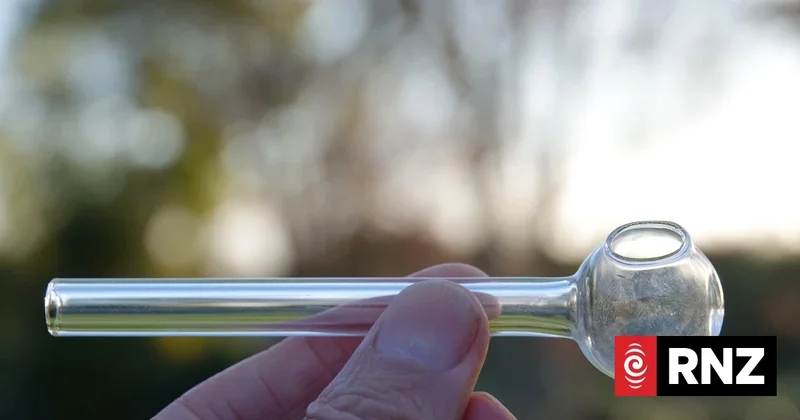
The debate around methamphetamine contamination in homes has reignited, with the authors of a new study calling for a policy u-turn over safe thresholds.
'The impact of New Zealand's 2018 methamphetamine policy on residential contamination' was published in the New Zealand Medical Journal on Friday.
The 2018 policy raised the threshold for what was deemed acceptable from 0.5μg of methamphetamine per 100cm2 to 15μg - higher than accepted levels in the United States, United Kingdom, and Australia, the report said.
In an analysis of more than 420 homes, researchers from Unitec and the University of Waikato found a "substantial" rise in meth contamination since the policy change.
The report said there could be several factors behind the trend, including a potential increase in "clandestine" meth labs that was also driving increased consumption of the drug, and the policy change leading to less vigilance about the risk.
The report noted that methamphetamine use continued to rise, according to last year's New Zealand Drug Trends Survey.
The study's lead author Dr Muhammad Irfan said people could be passively exposed to meth by living in homes where the drug had been smoked or manufactured.
He said fears about the effect of this exposure on health - particularly in children - were what prompted testing in New Zealand in 2010.
"Children are crawling ... might be touching the surface of the carpet ... putting their hands in their mouth. Their health is .. in danger because of the meth contamination."
Irfan said the cost of methamphetamine testing and a need to house people were factors in a review of the threshold in 2018, and in May that year the new levels were adopted.
He said the "huge increase" in contamination since should trigger a tightening of restrictions again, if not to pre-2018 levels then to the 1.5μg threshold recommended by Environmental Science and Research (now known as PHF Science) in 2019.
Overseas research has found passive exposure to methamphetamine could lead to eye and respiratory infections in children as well as some psychological effects, Irfan said.
Further research on the health impact was needed to establish a contamination threshold that accurately accounted for the risk, he said. In the meantime the acceptable level should be lowered, he added.
The study's release comes after neighbours in a Lower Hutt suburb raised concerns that potential buyers of a Kāinga Ora home were left in the dark about its history as a "meth lab".
'Jury still out' on health effects
Speaking to RNZ earlier this week, emeritus professor of toxicology at University of Canterbury Ian Shaw said the "jury's still out" on the health effects of living in a meth-contaminated home.
While he could not comment on this particular study or its findings, he was currently part of a research team - contracted by a New Zealand company - looking into the effects of meth exposure.
"As far as I'm aware, we don't really know whether residues of methamphetamine in houses have any effect on people that might live in those houses later. So we need ... a definitive study to determine that."
Shaw said the current statutory limits for meth contamination appeared fairly arbitrary.
"I don't think that we have set ... that threshold based on the knowledge that below that amount will have no effect on you and above that amount it might have an effect on you."
In his opinion, the effect on people who were living in a home where meth had been smoked was very low.
"Cutting your bread on a bread board that someone smoked meth next to ... you would get really low doses," he said.
"But at the other end of the spectrum you might have a house ... that's a meth lab ... then the amounts of methamphetamine contaminating that home could be very significantly greater."
Shaw said those homes could give people a "reasonable-sized" dose of the drug.
"The question is, do these doses do anything to you? And as far as I'm aware the jury's really out on this at the moment."