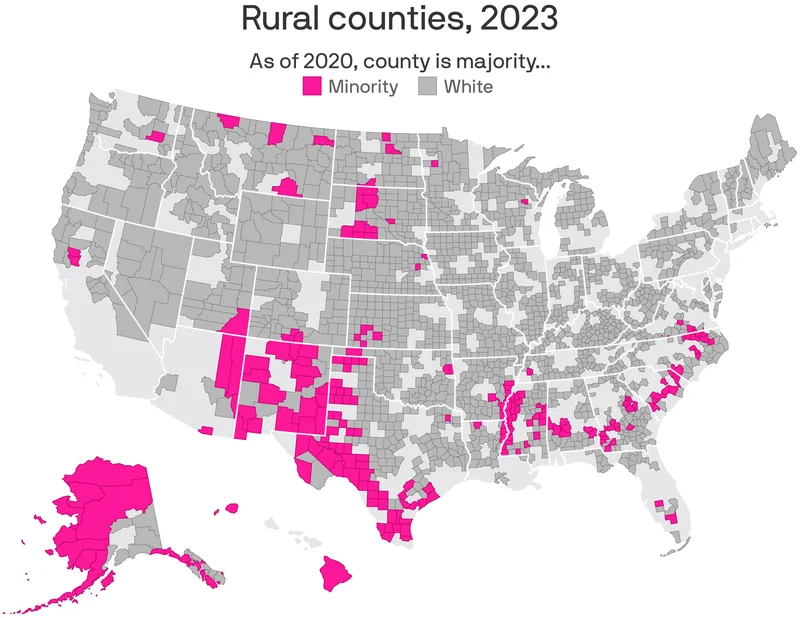
Data: U.S. Census, USDA; Chart: Erin Davis/Axios VisualsThe U.S. is projected to become majority-minority in 2046, but hundreds of rural pockets crossed that demographic benchmark years ago, an Axios analysis finds.Why it matters: The evolving face of rural America, driven both by immigration and increased mobility, has invigorated communities, increased their diversity — and presented new challenges.Rural governments dealing with rapid change, for example, often have few interpreters, bilingual election workers or translated materials — the machinery that turns civil-rights protections into access. Population shifts, particularly in rural areas, can leave schools, courts and election offices struggling to catch up.The demographic transformations are evident in Kansas and Nebraska, where immigrants work in meatpacking plants, in Hispanic communities in South Texas and mostly Black areas of the South, and in Alaska's Native population centers, where white residents are leaving or dying off.The shifts are putting unprecedented pressure on rural schools, courts, health departments and election offices, which often are cash-strapped with limited personnel. At the same time, the Trump administration has revoked a longstanding federal language-access directive and narrowed some anti-discrimination enforcement tools.By the numbers: An Axios analysis of federal data finds that 403 U.S. counties — roughly 12.8% of the national total — already are majority-minority.That includes 221 "non-metro counties" and 182 counties in urban and suburban metro areas.The non-metro or rural counties are spread across 27 states and have a combined estimated population of roughly 4.5 million.Of those rural counties, 205 — or 92.8% — had fewer than 50,000 residents, the Axios review found.Zoom in: Texas leads the nation with 57 rural majority-minority counties — all Hispanic along the Southern border and into the oil-rich Panhandle. Mississippi has 25 such counties, followed by New Mexico with 18, Georgia with 17 and Alaska with 15.The growing number of majority-minority counties go well beyond those states: In southwestern Kansas, Seward County was about 65% white in 2000; now it's 73% nonwhite. There were similar population shifts in nearby Ford and Finney counties. Not all of these rural counties' populations are tipping demographically for the same reasons.Counties in the Midwest and Southwest are seeing minority population growth, driven by immigration and higher birth rates.Meanwhile, many Southern and Appalachian counties are tipping because the white population dying off or leaving faster than people of color.The Axios analysis joined 2020 Decennial Census demographic data with the USDA's 2023 Rural-Urban Continuum Codes.A county is defined as majority-minority when fewer than 50% of residents identify as non-Hispanic white alone. Nonmetro counties are defined as those falling outside USDA metropolitan labor market boundaries.State of play: Fast-growing Hispanic agricultural hubs and Southern poultry towns are absorbing non-English-speaking populations with little to no federal mandate for bilingual ballots, poll workers or court interpreters.Federal watchdogs base much of their Section 203 language-assistance coverage under the Voting Rights Act on rigid population thresholds, leaving dispersed language-minority communities largely unserved.What they're saying: "Rural, small local governments struggle with service delivery. Period," Lisa R. Pruitt, a distinguished professor of law at UC-Davis who studies rural-urban differences, tells Axios.Pruitt said the pressure is particularly acute in communities that were already struggling to deliver basic services before being asked to provide interpreters, translated materials and multilingual communication."It's a really big challenge for things like court interpreters and any sort of public health information," Pruitt said.
America has more majority-minority rural counties than urban and suburban ones