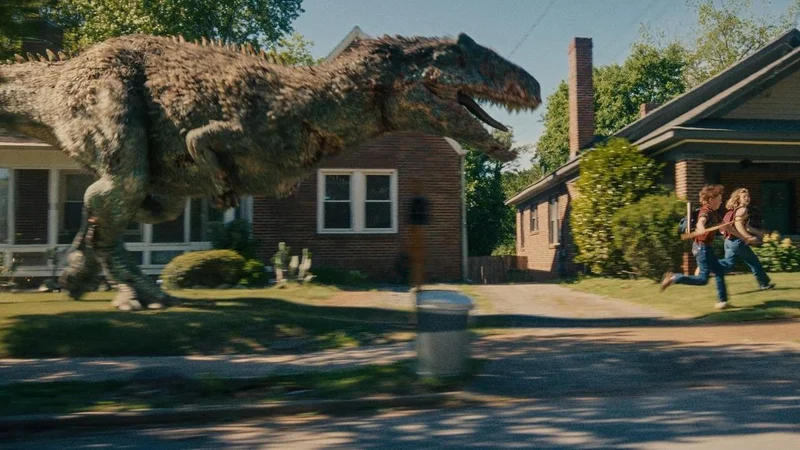
I had to physically restrain myself in my theatre seat while watching The End of Oak Street. Matt Damon’s Odysseus may have needed ropes to resist the Sirens, but I might as well have needed an entire ship’s rigging to stop the giddy dino-loving boy in me from vibrating clean out of his chair. A dinosaur summer blockbuster in 2026, released in IMAX, and written and directed by David Robert Mitchell, the filmmaker behind It Follows and Under the Silver Lake — this is a combination so absurdly satisfying that declaring cinema back feels like the only responsible response.
The opening introduces us to the Platt family in a picture-perfect 1982 Michigan suburb. Denise (Anne Hathaway) is a frustrated mother secretly writing a novel about escaping domestic life. Greg (Ewan McGregor) has lost his job and hides the humiliation behind pizza deliveries and concealed bottles of whiskey. Their daughter Audrey (Maisy Stella) is an astronomy-obsessed teenager worried about college, while younger son Brian (Christian Convery) is busy with his bow, his friends, a school bully and his enormous attachment to the family dog, Starbuck. The neighbourhood itself has the polished rituals of Reagan-era suburban fantasy, with block parties, bicycles, lawns and families drifting between houses. Very soon, the lights go strange, the weather turns tropical, and the world outside becomes prehistoric. The Platts and their entire neighbourhood have effectively been transported 250 million years into the past.
The End of Oak Street (English)
Director:David Robert Mitchell
Cast:Anne Hathaway, Ewan McGregor, Maisy Stella, Christian Convery, Jordan Alexa Davis, P. J. Byrne, Emily Kuroda, Anne Gee Byrd
Runtime:99 minutes
Storyline:A mysterious cosmic event rips Oak Street from suburbia and transports a neighborhood 250 million years into the past
The existing familial crisis gives Mitchell the scaffolding he needs, although the film ultimately has surprisingly little interest in excavating it. The world caving in around Denise and Greg reflects a family struggling to maintain the appearance of stability, while the period detail supplies a generous dose of reliable ‘80s Americana. But the true pleasures of Oak Street come from how quickly Mitchell understands that the premise itself is enough. Once a flurry of colourful prehistoric predators begin wandering through cul-de-sacs, the film has the good sense to get on with the good stuff. The Platts may have problems with their failing marriage, but for now, they also have a giant reptile outside the kitchen, so the priorities become wonderfully obvious.
Jurassic Park established the modern visual lexicon through which popular cinema and the wider world in general began imagining prehistoric life, combining scientific research with animatronic engineering and pioneering digital effects. Oak Street approaches its creatures with the same reverence for physical specificity while updating their appearance through modern palaeontological understanding, particularly the feathers and bird-like characteristics of its theropods. That fidelity gives the pulp material a pleasing historical texture, while the violence pushes it further toward gratifying levels of nastiness. People get bitten, crushed, ripped apart and swallowed with an unhinged, gleeful enthusiasm.
Michael Gioulakis’ cinematography gives Mitchell’s set-pieces a real sense of spatial menace, with the camera constantly finding ways to make the suburban environment feel unsafe. Split-diopter compositions repeatedly hold foreground and background in simultaneous focus, forcing our eyes to scan the corners of every image for movement. Mitchell also understands that creature-feature suspense depends on spatial relationships, so he frequently lets fences, hedges, windows and rooftops conceal portions of the dinosaurs, which gives the attacks a tactile sense of proximity that the modern iterations of Isla Nublar has often struggled to maintain.
The film’s early encounter with the Coelophysis/Deinonychus-like predators (the real-life dinosaur that helped inspire the classic image of the Velociraptor) is especially effective in the way Mitchell uses multiple perspectives to keep the attack brewing in the background. The Allosaurus sequence builds on that creeping anxiety, stretching the threat across the space of the scene until Mitchell suddenly pulls the rug out with an unexpected kill. The standout set-piece however, belongs to the enormous prehistoric serpent, whose silent, anxiety-inducing movement through the Platts’ house was a remarkable exercise in tension-building. Mitchell keeps finding fresh ways to stage these encounters, which gives us a steady stream of gnarly kills and an unapologetic dino fun that makes the whole enterprise so damn enjoyable.
The performances seem to be operating on a deliberately campier frequency. Hathaway commits fully to Denise’s panic and frustration, which makes her transition into suburban dinosaur-slayer in a denim co-ord strapped with a shotgun genuinely entertaining. McGregor plays Greg with a wounded earnestness that fits a man trying to preserve his idea of himself. Stella and Convery give the younger Platts enough personality to survive the film’s broad tonal shifts. Lest we forget, there is also Starbuck, one of the goodest boys ever committed to the screen, whose loyalty eventually earns him a glorious, eleventh-hour clutch.
The explanation for the time displacement remains deliberately thin, while the escape mechanism belongs to the category of ideas best accepted with popcorn in hand. Mitchell trusts the break-neck pace to cover the gaps, and that momentum is one of his strengths. More than anything though, this is Mitchell’s unabashed love letter to the Amblin era, with Spielberg worship baked into practically every frame. Except Mitchell takes that affection to places the famously goody-two-shoes auteur probably never imagined, with two hairy sauropods doing the Jurassic deed against a suburban house in what may be the most committed display of dinophilia in a major studio movie.
Bloody, goofy, nostalgic and gloriously ridiculous, The End of Oak Street knows that the cinema can still be a place where hundreds of strangers collectively lose their minds over a dinosaur eating someone. It’s a fitting way to close out the summer.
The End of Oak Street is currently running in theatres
Published - August 14, 2026 04:00 pm IST